WDTPRS POLL: Holy Thursday Foot Washing Rite – what happened?

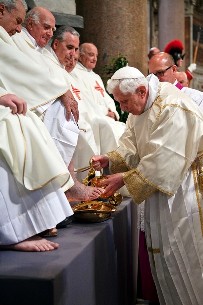
mandatum, foot waashing, Pope BenedictLet’s return for a moment to your experience of the Triduum and Holy Thurday’s Mass of the Last Supper.

The rite of washing of feet, or Mandatum, is an option in the Roman Rite.  I know of a few places where it is not done.  In fact, we discussed whether or not to do it where I am in New York City.  (We did it.)

Also, the Church’s liturgical law is crystal clear: only males can be chosen for this, and they should be men: viri selecti.  Vir means “man” and cannot, cannot – period – mean a female.

NB: I am not trying to be speciesist.  The Roman Rite still limits this to human beings.  Furthermore, I think the race is still limited to two sexes.  Therefore I edited one of the answer options from “and only males and females were chosen” to “and males and females were chosen”.  Please know that I am trying to overcome my speciesist tendencies.

So, what happened where you went to Holy Thursday’s Mass, assuming, of course, that you went.  Otherwise, if you did not go, perhaps you know what happened by word of mouth or by reading the bulletin, etc.

Chose your answer and add a comment in the combox, below.

Holy Thursday Mass I attended ...

View Results

Loading ...
Posted in "How To..." - Practical Notes, Liturgy Science Theatre 3000, POLLS | Tagged , , , ,
107 Comments

QUAERITUR: Use of force to defend a church from vandalism

From a reader:

Is is okay to fight in churches ? Can one shoot or punch vandals ? Can one defend the priest, or himself, or the Sacrament ?

Many who comment on destruction stories want to put up watches. Would this really work out properly ?

Thank you for your zeal.  The motto I have for my own coat-of-arms is Zelus Domus Tuae.

If there is serious concern about probable vandalism or break-ins, I would – first – hire a security service.  For example, one of my favorite parishes, Assumption Grotto in Detroit, has a service that watches the whole property, even at night.

In other words, if there are realistic concerns, perhaps professionals are the best starting point.

After that, I suppose that the usual moral considerations about the use of force are in play.  People have a right to defend themselves and their property and an obligation to defend others whose care is in their charge as well as the defenseless.  A proportionate use of force can be used in defense of self, others, and property.  That would also extend to that which is sacred.

Whatever is done, should not be done without consultation of the parish priest and also the police.  They should be advised if people are going to be around so they themselves are not taken for vandals.

Another idea: If people are going to be around the place, perhaps start Perpetual Adoration.  This would not only serve the cause of having people around and making they place a less desirable target, but it would also please the Lord and be of great spiritual benefit for the whole parish.

Perhaps some of the readers have had some experience with their own parish churches and security problems.

Posted in "How To..." - Practical Notes, ASK FATHER Question Box, Our Catholic Identity | Tagged , , , ,
29 Comments

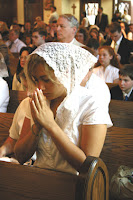
QUAERITUR: Chapel veils revisited – What color?

QUAERITUR: Chapel veils revisited - What color?From a priest:

A quick question: a woman approached me wondering if there was anything inappropriate in wearing a white veil as an older, married woman.  She was told by another parishioner that white is only proper for young women who are not married.  Is there any rule or tradition that can be pointed to as a guide?

Does it really make a difference?

Okay… that was the wrong question.  What was I thinking?  All questions having to do with what women wear in church are important questions.

Leaving aside the fact that even in the day when head coverings were obligatory for women they could fulfill their obligation by wearing a hat, my understanding… and believe me when I tell you that I have made a long and deep study of this, not… is that married women tended to wear black veils.  Certainly widows would.  Unmarried women and girls – without any question virgins every one – wore white veils, white being a sign of virginity, which is proven in each and every wedding.

Of course there are any number of proofs to the contrary of both these uses of black and white.

So… as a man, I say: What difference does it make?  Wear what it pleaseth thee to wear.

I think that this custom of women wearing head coverings in church should be revived.   As it revives, if the virginal desire to wear white to signal either their nuptial availability or, in the case of consecrated virgins, their nonavailability, great!  If the espoused want to show either that they are non-nubile by using black, great!  If they want as widows to signal their continuing attitude of prayer for their late spouses, great!

What would a gray veil mean?  I wonder.  Perhaps that the woman is hoping to be a widow?  That she is divorced?

I would avoid veils that imitate liturgical colors other than white and black.  The red veil however, was used in ancient Rome for brides.  I think in China brides had red, because it called down good fortune and prosperity.  Also, avoid the use of sports or product logos, though I suppose the weave of the lace could include religious symbols, such as the … I don’t know… pelican in her piety?

And so we’re off to the races again.

Posted in "How To..." - Practical Notes, ASK FATHER Question Box, Lighter fare | Tagged , ,
63 Comments

QUAERITUR: 1st Communion denied child with cerebral palsy

Remember, if it is Easter, it is time for news stories that make the Church look bad.

I was alerted to this by a reader and it brings up a good question:

Please note this short hit piece dished out at Easter by a Texas TV
station. This little piece contains so much innuendo on proper
disposition to receive, a priest’s authority, canon law, and even
anointing of the sick that it seemed worth passing on for your
elucidation:

Child Denied First Communion
Family Of Floresville 8-Year-Old Fighting For Holy Sacrament

(Excerpt) FLORESVILLE, Texas — It was a religious milestone Irma
Castro spent months preparing her grandson Kevin for, but when it came time for his first communion, he was denied. [The way this is written makes it sound as if this happened in church, during Mass.]

“It hurts and I think it’s a form of discrimination,” Castro said.

Castro was told by Pastor, Father Phil Henning, with the Sacred Heart Catholic Church of Floresville, that because Kevin had cerebral palsy and has the mental capacity of a 6-month-old, he didn’t qualify to receive his first communion. [And the priest is right.  And this is why we need continuing catechism for adults, especially when it comes to the sacramental preparation of their children.]

“He said because he was not able to understand the meaning of receiving the body of Christ,” Castro said. [And the priest is right.]

Canon law requires that a child receiving holy communion have
“sufficient knowledge” of Christ, but it doesn’t define what level of knowledge is considered sufficient. [Canon Law doesn’t say exactly, true.  But it doesn’t say nothing.]

The Code of Canon Law does not specify everything.  But, in basic, terms the person has to be able to know the difference between bread which has not been consecrated, and “bread” which has been.  Put another way, if a child can’t distinguish between ordinary food and, once told it is consecrated, a Host, then the child can’t be admitted to Communion.

Can. 97.2 there is a presumption of age of the use the reason at about 7, unless circumstances demonstrate otherwise.

Can. 913.1, says that people must be able to grasp something of what the mystery of Christ means.  They must be able to receive the Body of the Lord with faith and devotion.

Can. 913.2 the Eucharist may be administered to children in danger of death if they can distinguish it from ordinary food.

Can. 914 says that the parish priest must see to it that those who are not prepared and not sufficiently capable, should not come to Holy Communion.

In this case it sounds as it the parish priest did the right thing in the final analysis.  Of course there is nothing in the news piece about the manner in which the priest passed on this information to the parents.

It must be a terrible thing for parents to know that their child may never be able to receive the Eucharist.  But admission to the sacraments is not governed by sentimentality.  We don’t admit children who are incapable of receiving the Eucharist with faith and devotion simply for the sake of avoiding making parents feel bad.

I am frankly not sure that many of the adults going forward for Communion on Sunday could tell you what the Eucharist is, even at the level a 7 year old’s knowledge before First Communion.

Imagine my horror one day when I was asked to explain children about a week out from their First Communion what some of the things in church are.  First, they had never been taught to genuflect.  That got me to the tabernacle.  I explained why we genuflect before the tabernacle: this is where the Hosts are kept, where Jesus can be found when you come into Church, etc.  Blank stares.   Hosts… [crickets] …. Eucharist… [crickets] wafers… [crickets]…. the small round white Host people receive at Communion…  [crickets] ….

Then one little soon-to-be-First-Communicant said, and I quote, “You mean that piece of bread thing?”

Parents: Don’t assume that your children are learning anything in their sacramental preparation.

YOU are the first teachers of your children.  If you don’t instruct them properly to the best of your ability, then you will be help accountable by God for their lack of sufficient preparation.  Do your best.  The parish’s sacramental prep programs are not your surrogates.  That means that you have to know your stuff.

Posted in "How To..." - Practical Notes, Biased Media Coverage, Our Catholic Identity, Throwing a Nutty | Tagged , , , ,
63 Comments

Easter weirdness

From a reader:

My wife and I attended the Easter vigil last night and while it was
well done for a NO Mass, I still rankled at few bits. Today, Sunday
morning, I was not able to attend at our usual parish, but instead
went to Saint M______. It is a fairly small, rural, New Jersey parish in the dioceses of Trenton.

I was greeted by a 6’+ tall nun, dressed like a Roman priest, complete with stole. When I entered the church, the din was so loud that it reminded me of a sporting event. No one was paying the slightest attention to the altar, statues, or the like.

Finally, a lay person greeted everyone, told us to hug our neighbors and introduce ourselves, and then led the congregation in a round of applause for being in church. The processional hymn was a very lively number that was accompanied by piano, trumpet, and tambourine. The musicians were actually quite good and under other circumstance, would have been enjoyable; just odd to hear them in church.

I had trouble following the Mass, as it seemed pretty well “adjusted” by the priest. Not sure where some of the readings and responses came from. The homily focused on God’s love and how everyone would be saved, regardless of belief. Even the consecration was also to a large extent ad libbed and no one knelt at any point. In fact, the folding chairs were placed such that sort of pushing my neighbors out of the way, it was not possible to do so.

The Mass ended with Father calling for and receiving round after round of applause for various people and groups.

Since I’ve only been a Catholic for a year this Easter, my exposure to things like this has been limited. It certainly gave me a new
appreciation for my parish, warts and all
. It may not be perfect or even close to traditional, but it is far more “orthodox” in practice than this.

Like Joni Mitchell said, you have greater appreciation for what you have lost, even if it wasn’t perfect, after you don’t have it anymore.

Posted in Liturgy Science Theatre 3000 | Tagged ,
43 Comments

WDTPRS: Easter Sunday (1962MR): the remedy of eternity

We have come to the high point of the Church’s liturgical year.  Each year Holy Church sacramentally re-presents the history of our salvation from creation to Second Coming together with the earthly life of the Lord from conception and birth to death, resurrection and ascension.

Our baptism makes us capable of participating at Mass with active receptivity for everything being done for us by Christ, the true principal actor in the in Holy Mass.

Lent prepared us.  The Sacred Triduum was observed: the priesthood was celebrated, the Eucharistic Christ was reposed and the altar stripped, the Passion was sung and the Cross kissed. Our liturgical death was complete.

Then in the evening, in some places even at midnight, the solemn Vigil began.  Flowers, instrumental music, white and gold vestments return after a long drought of ornamentation.  The Exsultet rang out next to the Christ-like Paschal candle, burning bright in the shadows.  Baptismal water was blessed.  We sang Alleluia once again.  Catechumens are received or baptized, some also confirmed.  They received Christ for the first time in the Eucharist.

After the Gloria, resurrected the night before, we move to today’s Collect, an adaptation of a prayer in the “Gelasian Sacramentary” now more commonly and accurately called the Liber Sacramentorum Romane Ecclesiae or Aeclesiae and the 8th c. L.S. Engolismensis. The Novus Ordo version actually returns to the more ancient text.

COLLECT – LATIN TEXT (1962MR):
Deus, qui hodierna die per Unigenitum tuum
aeternitatis nobis aditum, devicta morte, reserasti:
vota nostra, quae praeveniendo aspiras,
etiam adiuvando prosequere.

The repetition of the –er– sound is very pleasant to sing: hodierna… per… aeternitatis… reserasti.

Consult your dependable Lewis & Short Dictionary.  Aditus, -us is “an approach” or “going to” in the sense of movement, but it is also leave or permission to approach as well as the place through which one approaches.  Reserasti is a shortened form for reseravisti.  That -a- tells us that this is not resero, -sevi (“to sow or plant again”) but is rather from resero, -avi, -atum meaning “to unlock, open, disclose, reveal”.  My version of “unbar the gate” is a bit more poetic than “open the way” but this is a rather solemn moment.   A votum is, in classical Latin, “a solemn promise made to some deity, a vow.”  Aspiro is “to breathe or blow upon; to breathe or blow upon, to infuse, instill”.  Praevenio is “to come before, precede” and thus it is “anticipate”.
Prosequor is deponent and means “to follow” or “to accompany”.  It can also be “to follow up”.  The form we have in our prayer, prosequor, looks like an infinitive, but it is really an imperative.

LITERAL TRANSLATION:
O God, who today, death having been conquered,
unbarred for us the gateway of eternity through Your Only-begotten,
follow up upon our prayers which You instill in us by anticipating them.

The word praevenio (prae – “before” + venio “to come”) reminds us of a distinction made when speaking about grace. God gives us habitual grace, also called sanctifying grace, which is in us in a stable and abiding manner. Actual graces are given according to our needs here and now, in this or that circumstance. Among the actual graces is gratia praeveniens, or “prevenient grace”, called sometimes “preventing grace” (cf. Council of Trent, Session VI, ch. 5). When we fall into habitual sin and our will has little strength to extricate ourselves, God gives an actual grace that “comes before” other graces we can then receive. God helps us even to repent, before we take the action of confessing our sins.

This prayer reminds us that God knows us better than we know ourselves.  He perfectly anticipates our needs from all eternity. He crowns His own merits within us in such a way that He makes what is truly His become also truly ours.  So it is too with the Resurrection.

There is a very short reading from 1st Letter of St. Paul to the Corinthians.  It underscores a unifying theme for the whole Mass formulary: Christ is the paschal Lamb, slain and risen.  Pascha and its various forms concerns all things “Easter”: the first Passover and passage of the Jews from slavery to freedom, the Jewish rites of the sacrificing the lambs at Passover or, in the Christian sense, the Passion and Resurrection of the Lamb of God, and the subsequent renewal of these mysteries both in Holy Mass and each year in the Triduum and Easter.

In the Gradual we sing “This is the day the Lord has made!  Let us rejoice and be glad!” The Alleluia, which has also risen from its Lenten tomb, echos the theme of the pascha.  We hear the Sequence Victimae paschali laudes about Christ the “Victor King” and His duel with Death.  It is contains the famous dialogue between St. Mary Magdalene and the Apostles.  In the Medieval period this sequence led to the performance of mystery plays. The first Alleluia of the season and the Gospel proclaimed in the usual way.  The people renewed their vows at Vigil Mass.  For the Mass of Easter Sunday we say the Creed. The Offertory reminds us of the material repercussions of the Passion and Resurrection, but also the eschatological consequence, namely, that the Just Judge will come at the end of the world.  “Terra tremuit… the earth shock and then was still, when God arose in judgment. Alleluia!”

When the Eucharistic part of the Mass begins, wreathed in incense the priest quietly says the

SECRET (1962MR):
Suscipe, quaesumus, Domine, preces populi tui
cum oblationibus hostiarum:
ut paschalibus initiata mysteriis,
ad aeternitatis nobis medelam, te operante, proficient
.

This is identical to the corresponding prayer in the ancient L.S Romane Ecclesiae It survived the cutters and gluers of Fr. Bugnini’s Consilium to live on as the Super Oblata for the Vigil of Easter in the Novus Ordo editions.

LITERAL TRANSLATION:
Receive, O Lord, we beg you, the prayers of Your people
with offerings of sacrifices:
so that the things initiated in the paschal mysteries,
may, You causing it, avail for us unto the remedy of eternity.

Holy Mass continues as normal to the consecration, and thence to the most perfect form of active participation, the distribution and reception of Holy Communion.

POSTCOMMUNIO (1962MR):
Spiritum nobis, Domine, tuae caritatis infunde:
ut, quos sacramentis paschalibus satiasti,
tua facias pietate concordes.

You can locate this prayer in your own trusty edition of the ancient Veronese Sacramentary called once the “Leonine Sacramentary” which E.A. Lowe dated to the first part of the 7th century. It is in the collection of orations for the month of September, though it has uno caelesti pane rather than sacramentis paschalibus.  It is also in the 9th c. Liber Sacramentorum Augustodunensis as well as the 8th c. Gellonensis.  It survived the liturgical experts assigned by Fr. Bugnini and his chief Card. Lercaro, to live on as the Post Communion of the Vigil of Easter.

LITERAL TRANSLATION:
Infuse in us, O Lord, the Spirit of Your charity,
so that in Your mercy You make one in mind and heart
those whom you have satiated with the mysterious paschal sacraments.

Please accept my prayerful best wishes to you and yours for a fruitful and holy Easter season.

Posted in WDTPRS | Tagged
5 Comments

Happy Easter everyone!

I wish a happy and grace-filled Easter to you and yours.

Let us know what you have going one for Easter!

Posted in SESSIUNCULA | Tagged
70 Comments

NYC, Manhattan: EASTER SUNDAY at Holy Innocents

If you are in or around NYC, consider coming to Holy Innocents on 37th (btwn Broadway and 7th) for Triduum ceremonies in the Extraordinary Form.

Sunday
Fr. Zuhlsdorf – Celebrant
Missa cantata 10 AM

Chant Propers
Plainsong Mass I: Lux et origo

Sunday Vespers 3 PM

Fr. Zuhlsdorf – Celebrant
Chant Psalms and Antiphons
Magnificat: Falsobordone Mode 3 by Charles Weaver


Thursday
Solemn Mass 7:30 PM [I understand it was listed as 7 pm in one place]

Chant propers and antiphons for the Mandatum
Mass for Four Voices by Thomas Tallis
Motet at Communion: Domine, non sum Dignus by Tomás Luis de Victoria

Friday
Solemn Afternoon Liturgy 3 PM

Chant propers
Passion according to St John: Turba choruses by Victoria
Music at the Adoration: Improperia by Victoria [I prefer Gregorian chant, but these are good.]
Motet at communion: Vere Languores Nostros by Victoria

Saturday
Solemn Easter Vigil 9 PM

Fr. Zuhlsdorf – Celebrant
Chant propers
Mass for Four Voices by William Byrd
Motet at the offertory: Dum transisset sabbatum by John Taverner
Motet at communion: In resurrectione tua by Byrd

Posted in On the road, SUMMORUM PONTIFICUM, What Fr. Z is up to | Tagged , , ,
20 Comments

Preparing for the Easter Vigil

Some quick glimpses.

20110423-085148.jpg

20110423-085158.jpg

20110423-085208.jpg

20110423-085217.jpg

Posted in SESSIUNCULA |
11 Comments

Benedict XVI’s sermon for the Easter Vigil

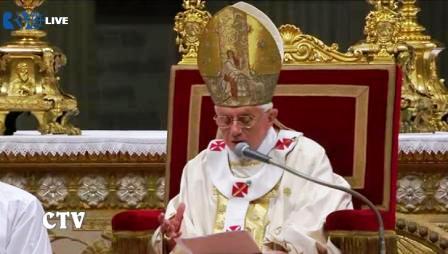
Easter VigilPope Benedict’s sermon for the Vigil of Easter with extra paragraph breaks and my emphases and comments:

Dear Brothers and Sisters,

The liturgical celebration of the Easter Vigil makes use of two eloquent signs. First there is the fire that becomes light. As the procession makes its way through the church, shrouded in the darkness of the night, the light of the Paschal Candle becomes a wave of lights, and it speaks to us of Christ as the true morning star that never sets – the Risen Lord in whom light has conquered darkness. The second sign is water. On the one hand, it recalls the waters of the Red Sea, decline and death, the mystery of the Cross. But now it is presented to us as spring water, a life-giving element amid the dryness. Thus it becomes the image of the sacrament of baptism, through which we become sharers in the death and resurrection of Jesus Christ.

Yet these great signs of creation, light and water, are not the only constituent elements of the liturgy of the Easter Vigil. Another essential feature is the ample encounter with the words of sacred Scripture that it provides. [Fire… light… Word.] Before the liturgical reform there were twelve Old Testament readings and two from the New Testament. The New Testament readings have been retained. The number of Old Testament readings has been fixed at seven, but depending upon the local situation, they may be reduced to three. The Church wishes to offer us a panoramic view of whole trajectory of salvation history, starting with creation, passing through the election and the liberation of Israel to the testimony of the prophets by which this entire history is directed ever more clearly towards Jesus Christ. In the liturgical tradition all these readings were called prophecies. Even when they are not directly foretelling future events, they have a prophetic character, they show us the inner foundation and orientation of history. They cause creation and history to become transparent to what is essential. In this way they take us by the hand and lead us towards Christ, they show us the true Light.

Benedict XVI's sermon for the Easter VigilAt the Easter Vigil, the journey along the paths of sacred Scripture begins with the account of creation. This is the liturgy’s way of telling us that the creation story is itself a prophecy. It is not information about the external processes by which the cosmos and man himself came into being. The Fathers of the Church were well aware of this. They did not interpret the story as an account of the process of the origins of things, but rather as a pointer towards the essential, towards the true beginning and end of our being. Now, one might ask: is it really important to speak also of creation during the Easter Vigil? Could we not begin with the events in which God calls man, forms a people for himself and creates his history with men upon the earth? The answer has to be: no. To omit the creation would be to misunderstand the very history of God with men, to diminish it, to lose sight of its true order of greatness. [A foundational feature of the Judeo-Christian system of belief is the God created the cosmos from nothing.  This differentiates the Judeo-Christian understanding of creation from all other religions.  We cannot be Christian without creatio ex nihilo.] The sweep of history established by God reaches back to the origins, back to creation. Our profession of faith begins with the words: “We believe in God, the Father Almighty, Creator of heaven and earth”. If we omit the beginning of the Credo, the whole history of salvation becomes too limited and too small. [This is why we must have it in the Creed as well, and why at the end of the older form of Mass we use the beginning of the Gospel of John.] The Church [Get this…] is not some kind of association that concerns itself with man’s religious needs but is limited to that objective. No, she brings man into contact with God and thus with the source of all things. Therefore we relate to God as Creator, and so we have a responsibility for creation. Our responsibility extends as far as creation because it comes from the Creator. [The Holy Father establishes theme early on.  I am sensing that down the line we will hear something of a theology of creation, perhaps a theology of ecology, which the Pope has spoken of before at different times.] Only because God created everything can he give us life and direct our lives. Life in the Church’s faith involves more than a set of feelings and sentiments and perhaps moral obligations. It embraces man in his entirety, from his origins to his eternal destiny. Only because creation belongs to God can we place ourselves completely in his hands. And only because he is the Creator can he give us life for ever. Joy over creation, thanksgiving for creation and responsibility for it all belong together.

Easter VigilThe central message of the creation account can be defined more precisely still. In the opening words of his Gospel, Saint John sums up the essential meaning of that account in this single statement: [As I anticipated… ] “In the beginning was the Word”. In effect, the creation account that we listened to earlier is characterized by the regularly recurring phrase: “And God said …” The world is a product of the Word, of the Logos, as Saint John expresses it, using a key term from the Greek language. “Logos” means “reason”, “sense”, “word”. It is not reason pure and simple, but creative Reason, that speaks and communicates itself. It is Reason that both is and creates sense. The creation account tells us, then, that the world is a product of creative Reason. Hence it tells us that, far from there being an absence of reason and freedom at the origin of all things, the source of everything is creative Reason, love, and freedom.

Here we are faced with the ultimate alternative that is at stake in the dispute between faith and unbelief: are irrationality, lack of freedom and pure chance the origin of everything, or are reason, freedom and love at the origin of being? Does the primacy belong to unreason or to reason? This is what everything hinges upon in the final analysis.

As believers we answer, with the creation account and with John, that in the beginning is reason. In the beginning is freedom. Hence it is good to be a human person.

[Is there rational life elsewhere in the cosmos?] It is not the case that in the expanding universe, at a late stage, in some tiny corner of the cosmos, there evolved randomly some species of living being capable of reasoning and of trying to find rationality within creation, or to bring rationality into it. If man were merely a random product of evolution in some place on the margins of the universe, then his life would make no sense or might even be a chance of nature. [Another problem is that the order we see is not in any way proportioned to the claim of previous disorder and a chance event that initiated creation, some random occurance.  Even without direction from divine revelation, claims that this cosmos was a random occurrence is irrational.]

Benedict XVI's sermon for the Easter VigilBut no, Reason is there at the beginning: creative, divine Reason. And because it is Reason, it also created freedom; and because freedom can be abused, there also exist forces harmful to creation. Hence a thick black line, so to speak, has been drawn across the structure of the universe and across the nature of man. But despite this contradiction, creation itself remains good, life remains good, because at the beginning is good Reason, God’s creative love. Hence the world can be saved. Hence we can and must place ourselves on the side of reason, freedom and love – on the side of God who loves us so much that he suffered for us, that from his death there might emerge a new, definitive and healed life.

The Old Testament account of creation that we listened to clearly indicates this order of realities. But it leads us a further step forward. It has structured the process of creation within the framework of a week leading up to the Sabbath, in which it finds its completion. For Israel, the Sabbath was the day on which all could participate in God’s rest, in which man and animal, master and slave, great and small were united in God’s freedom. Thus the Sabbath was an expression of the Covenant between God and man and creation. In this way, communion between God and man does not appear as something extra, something added later to a world already fully created. The Covenant, communion between God and man, is inbuilt at the deepest level of creation.

Yes, the Covenant is the inner ground of creation, just as creation is the external presupposition of the Covenant. God made the world so that there could be a space where he might communicate his love, and from which the response of love might come back to him. From God’s perspective, the heart of the man who responds to him is greater and more important than the whole immense material cosmos, for all that the latter allows us to glimpse something of God’s grandeur.

Benedict XVI's sermon for the Easter VigilEaster and the paschal experience of Christians, however, now require us to take a further step. The Sabbath is the seventh day of the week. After six days in which man in some sense participates in God’s work of creation, the Sabbath is the day of rest. But something quite unprecedented happened in the nascent Church: the place of the Sabbath, the seventh day, was taken by the first day. As the day of the liturgical assembly, it is the day for encounter with God through Jesus Christ who as the Risen Lord encountered his followers on the first day, Sunday, after they had found the tomb empty.

The structure of the week is overturned. No longer does it point towards the seventh day, as the time to participate in God’s rest. [We are into the eighth day… outside of time, as it were.  This is why we have liturgical octaves.] It sets out from the first day as the day of encounter with the Risen Lord. This encounter happens afresh at every celebration of the Eucharist, when the Lord enters anew into the midst of his disciples and gives himself to them, allows himself, so to speak, to be touched by them, sits down at table with them. This change is utterly extraordinary, considering that the Sabbath, the seventh day seen as the day of encounter with God, is so profoundly rooted in the Old Testament.

Benedict XVI's sermon for the Easter VigilIf we also bear in mind how much the movement from work towards the rest-day corresponds to a natural rhythm, the dramatic nature of this change is even more striking. This revolutionary development that occurred at the very the beginning of the Church’s history can be explained only by the fact that something utterly new happened that day. The first day of the week was the third day after Jesus’ death. It was the day when he showed himself to his disciples as the Risen Lord. In truth, this encounter had something unsettling about it. The world had changed. This man who had died was now living with a life that was no longer threatened by any death. A new form of life had been inaugurated, a new dimension of creation. The first day, according to the Genesis account, is the day on which creation begins. Now it was the day of creation in a new way, it had become the day of the new creation. We celebrate the first day. And in so doing we celebrate God the Creator and his creation.

Yes, we believe in God, the Creator of heaven and earth. And we celebrate the God who was made man, who suffered, died, was buried and rose again. We celebrate the definitive victory of the Creator and of his creation. We celebrate this day as the origin and the goal of our existence. We celebrate it because now, thanks to the risen Lord, it is definitively established that reason is stronger than unreason, truth stronger than lies, love stronger than death. We celebrate the first day because we know that the black line drawn across creation does not last for ever. We celebrate it because we know that those words from the end of the creation account have now been definitively fulfilled: “God saw everything that he had made, and behold, it was very good” (Gen 1:31). Amen.
Benedict XVI's sermon for the Easter Vigil

Posted in The Drill | Tagged ,
11 Comments