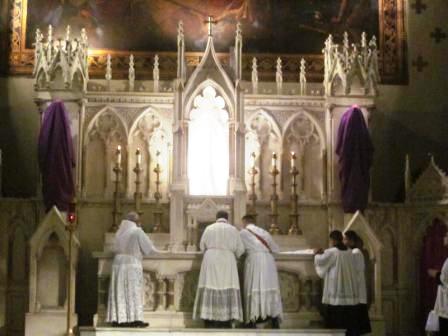
WDTPRS: Vigil of Easter: stir up in your Church a spirit of adoption

Our Lenten journey brings us to the greatest feast day of the whole liturgical year.

We saw the priesthood and Eucharist instituted at Holy Thursday.  A glimpse of Easter glory was given us with the singing of the Gloria.  The priest responded to Christ’s priestly command to serve by washing the feet of males only (viri). Christ in the Blessed Sacrament was reposed and the altar was stripped.

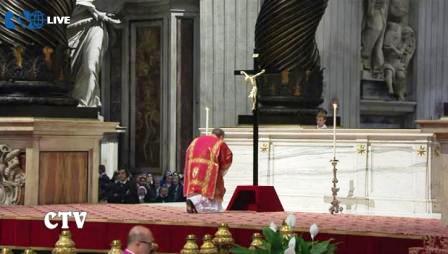
On Friday the Passion was sung and the Cross kissed.  We could receive Communion but we “fasted” from Mass.  On “liturgical” Saturday, that is until sundown, we had neither Mass nor Holy Communion, and thus we arrived at the nadir of the year in our preparation for Easter.  Suddenly with the Vigil, flowers, instrumental music, and white and gold vestments return.  The Church springs back to life like Christ from His tomb.

Remember that at this point, the liturgy begins in darkness.

The priest kindles the fire and prepares the candle.  Light spreads through the church from hand to hand.

The deacon sings three times Lumen Christi … The Light of Christ, three times as the sacred ministers process to the sanctuary.  The Christ Candle is set in place, incensed, and Exsultet is sung.

The liturgy of the word begins, and after each reading there is a Collect.

The 2002 Missale Romanum presents 11 different prayers.  We shall examine the final Collect, which follows the singing of the Gloria and the lighting of the candles on the altar during the ringing of the bells.

FINAL COLLECT (2002MR):
Deus, qui hanc sacratissimam noctem
gloria dominicae resurrectionis illustras,
excita in Ecclesia tua adoptionis spiritum,
ut, corpore et mente renovati,
puram tibi exhibeamus servitutem.

This is adapted from the prayer in the 1962MR situated in the same moment of the Mass.  The 1962 prayer was the same as that found in the ancient Gelasian Sacramentary.

LITERAL TRANSLATION:
O God, who illuminate this most holy night
by the glory of the Lord’s resurrection,
rouse up the spirit of adoption in Your Church,
so that, having been renewed in mind and body,
we may render You our unstained service.

NEW CORRECTED TRANSLATION:
O God, who make this most sacred night radiant
with the glory of the Lord’s Resurrection,
stir up in your Church a spirit of adoption,
so that, renewed in body and mind,
we may render you undivided service
.

Posted in EASTER, WDTPRS | Tagged ,
4 Comments

Gregorian chant v. folk music. A parish in Toronto. Fr. Z rants.

Pope Benedict has proposed what I have called his “Marshall Plan” to renew Catholic identity.  This must involve a reading of the Second Vatican Council in continuity with all the other Councils, not as a point of rupture.  That goes for our liturgical worship, which is a sine qua non for Catholic Christian living.

Gregorian Chant was specified by the Council as the Church’s sacred liturgical music, first and foremost.

Who are we if we ignore that?

Some bits from a longish piece in Canada’s National Post with my emphases and comments:

In the search for the Voice of God, some believe Gregorian chants are preferable to folk music

Charles Lewis  Apr 22, 2011

When Philip Fournier sings a line of Gregorian chant, it hangs like a puff of smoke in the air before it slowly dissipates above the empty pews below.

The sound, listening to it live from a distance of just several inches away in the choir loft at St. Vincent de Paul Parish in Toronto, is ancient, elemental. The sound originates in his abdomen — a line of text that flows out like a wave, sung in tones that are dark and rich. The words are in Latin. It is not a song so much as prayer that is sung. [Exactly.]

Mr. Fournier, with his ragged sweater and perpetual five o’clock shadow, is part of a small cadre of traditionalists for whom singing Gregorian chant is an attempt to restore what they see as the real music of the Catholic Church [They are in good company.  The Second Vatican Council also thought that.] — sounds that go back to the time when King David sang psalms in the temple.

If they had their way, they would storm the parish churches and hurl all the guitars and drums into the street because they believe substituting modern music for ancient music has eroded worship. [Do I hear an “Amen!”?  I remember the old quip that the true renewal of the liturgy will begin with the breaking of the last guitar over the head of the last ex-nun minister of Holy Communion.  Facetious, I know.  Some guitars are very valuable and have their proper place.]

“Rather than work with our tradition, they took the easy way out,” said Mr. Fournier, who was raised in Maine and has been the director of music at St. Vincent de Paul for three years. “I have been repulsed by what I have experienced in the Church. Going to mass should be more profound and of a greater depth than what you experience day to day.” [Do I hear another “Amen!”?]

He grew up in the 1980s, when folk masses and other forms of “music of the moment” were the norm. “At the time I knew it was weak and didn’t match the little I knew about the faith.”

Now, Mr. Fournier works with both lay singers and seminarians who attend the nearby Oratory of St. Philip Neri — a 400-year-old congregation of priests and brothers who have always incorporated sacred music into the liturgy. The Oratory oversees both St. Vincent de Paul and Holy Family.

David Domet, another Toronto choirmaster who has worked with several parishes, said Catholics have been so disconnected from sacred music that they no longer understand the richness of their own tradition. [“Amen!”?]

“Gregorian chant as we have it today is the closest thing we know to what Jesus would have sung and heard himself in the Temple in Jerusalem,” he said. [That could very well be true.  In any event, Jesus would not have heard “Gather Us In”… except perhaps during the time He spent in the harrowing of Hell.]

The appeal of Gregorian chant is undeniable. During a service, it adheres itself to the mass — moving with it hand in hand in perfect harmony.  [When Chant CD’s are released they not rarely make it onto the popular music charts.]

[…]

He began the choir five years ago out of a desire to create more authentic Catholic music, but also to flee “the drivel” he was hearing in some of his neighbourhood churches.

The priests at the parish were not initially thrilled about having Gregorian chant brought into their church. [It’s almost always the clergy and religious who are the dinosaurs.]

“One priest said, ‘This is all archaic. We don’t want to be Catholic icicles frozen in another time,’ ” Mr. Mundra recalled. [He would rather be, what… a drip?]

“You have beautiful architecture, beautiful music, beautiful windows — the evidential power of beauty,” he said. “All human beings respond to beauty. So you also need beautiful music.” [The key word there is “beautiful”.  But he left out another key word “sacred”.]

Now the choir is flourishing. The number of people in the pews for the Saturday evening service is up, and the choir has solidified into a unit.

Even Mr. Mundra’s mother, Marie, has joined the choir.

She, too, had longed for music that matched the holiness of worship. She had been a Carmelite nun years ago and was eager to regain some of the reverence of worship.

“We went to mass one day as a family and we heard all this terrible secular music. And then going home we heard sacred music on the radio,” she said, laughing at the recollection. “There are people out there who want to hear this, but they are not being given a chance. This will be the music we will hear in heaven.”

National Post
clewis@national post.com

I cut a few large chunks out.  Read the whole article there.

This, friends, is the key to the NEW EVANGELIZATION.

We must renew our liturgical worship.  Liturgy is doctrine is daily life.

WDTPRS KUDOS to this parish in Toronto!

Posted in "How To..." - Practical Notes, Brick by Brick, Fr. Z KUDOS, Just Too Cool, New Evangelization, Our Catholic Identity, The Last Acceptable Prejudice, Wherein Fr. Z Rants | Tagged , , , , , ,
59 Comments

RECENT POSTS OF INTEREST

RECENT POSTS OF INTERESTSome posts, as they scroll along.

Posted in SESSIUNCULA |
Comments Off on RECENT POSTS OF INTEREST

Preparing for Good Friday

As we get ready at Holy Innocents.

20110422-030441.jpg

20110422-030451.jpg
For noise.. the crotulus…

20110422-055258.jpg

20110422-055324.jpg
The clacker…

20110422-055423.jpg

Posted in SESSIUNCULA |
15 Comments

A WDTPRS favorite spotted

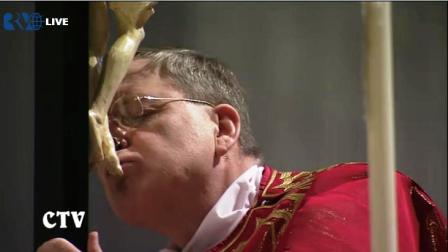
From the Vatican Multimedia feed of the Good Friday service in St. Peter’s Basilica.

Just a glimpse of one of WDTPRS’s favorite churchmen, in our daily prayers.

Card. Burke

Cardinal Burke was one of the Deacons at the Throne for the service.

Card. Burke

Posted in Just Too Cool | Tagged
10 Comments

WDTPRS REVISITED: The “new” Good Friday prayer for Jews inserted into the 1962MR

Later today, I will participate in the Good Friday service in the Extraordinary Form.  Thank you, Holy Father for Summorum Pontificum.

During the Good Friday service, there are many intercessory prayers.  One of them is for the Jews.  Over the decades, the Good Friday prayer for the Jews has stirred controversy in diverse quarters. Benedict XVI changed the text of the 1962 Missale Romanum permitted for use according to Summorum Pontificum.  He inserted a new prayer for Jews of his own composition.

Let us revisit the issue and the prayer.  Some time ago, I wrote about this issue here.

Observations.

  1. Most people really don’t care one way or another about this prayer.
  2. It is used once a year.
  3. Missals were changed by Popes all along the way.
  4. Our Church is not a fly in amber.
  5. People should actually read the prayer and think about it before freaking out.

Let’s have a look at the prayer as it appears in the 1962 Missale Romanum and now in its revised form in the 1962 Missale. My translations:

MR62 Latin

MR62 English

Revised ‘62 Latin

Revised ‘62 English

Oremus et pro Iudaeis: ut Deus et Dominus noster auferat velamen de cordibus eorum; ut et ipsi agnoscant Iesum Christum Dominum nostrum. …

Let us also pray for the Jews: that our Lord and God take away the veil from their hearts; that they too may acknowledge Jesus Christ to be our Lord.

Oremus et pro Iudaeis: ut Deus et Dominus noster illuminet corda eorum, ut agnoscant Iesum Christum salvatorem omnium hominum.

Let us also pray for the Jews: that our God and Lord may illuminate their hearts, that they acknowledge that Jesus Christ is the Savior of all men.

Omnipotens sempiternae Deus, qui Iudaeos etiam a tua misericordia non repellis: exaudi preces nostras, quas pro illius populi obcaecatione deferimus; ut agnita veritatis tuae luce, quae Christus est, a suis tenebris eruantur. Per eundem Dominum.

Almighty eternal God, who also does not repel the Jews from Your mercy: graciously hear the prayers which we are conveying on behalf of the blindness of that people; so that once the light of Your Truth has been recognized, which is Christ, they may be rescued from their darkness.

Omnipotens sempiterne Deus, qui vis ut omnes homines salvi fiant et ad agnitionem veritatis veniant, concede propitius, ut plenitudine gentium in Ecclesiam Tuam intrante omnis Israel salvus fiat. Per Christum Dominum nostrum. Amen.

Almighty and eternal God, who want that all men be saved and come to the recognition of the truth, propitiously grant that even as the fullness of the peoples enters Your Church, all Israel may be saved. Through Christ Our Lord. Amen.

WDTPRS REVISITED: The "new" Good Friday prayer for Jews inserted into the 1962MRIn first prayer of the couplet, the older version prayed that the darkness, in the image of a veil, be taken from the hearts of the Jews, presumably to let in the light of Christ, light being a metaphor for the Truth, who also is Christ. In first prayer of the newer version, we pray that God may illuminate, that is shed light, which is a metaphor for the Truth (who is Christ) in the hearts of the Jews.

Okay… it is a little less poetic in the new version. I like the poetry of the previous version and mourn its loss. I found nothing, zero, offensive to Jews in that older version. After, we Christians pray in terms our our own darkness. Still… the first prayers of both the older version and the newer version say the same thing.

The second prayer of the couplet, in the older version begins with a statement that God does not reject the Jews from His mercy. An obvious point. However, the Latin could be read to say in English: “O God, who does not reject even the Jews from Your mercy”. In English this could be made to sound rather like the Jews must be pretty bad indeed and that it would be reasonable for a less merciful God to not be merciful. However, Latin, not English, is the language of Mass and this phrase need not have that negative connotation. It is better to render it “also the Jews” and not just “even the Jews”. In the next part of the prayer we take it on ourselves to pray on behalf of their “darkness”, that is, that they lack the Truth, the light of Christ. That’s fine: we Christians pray for ourselves in those very same terms. We refer to our own dark sins all the time, etc. Then we pray that they will be rescued from darkness, which is a metaphor for error and the possibility of the loss of salvation. No problems there. I think we are pretty much praying for ourselves in those terms to. However, the force of the statement comes as much through the beautiful turn of phrase, the poetry that has an impact on the ear.

The second part of the newer version of the prayer, starts from the larger picture, rather than the smaller group. The older prayer focuses entirely on the Jews. The newer version starts from the fact that all men, whomever they may be, were made to be saved and happy with God in heaven. They are saved through “recognition of the Truth”. Christ is that Truth.

The interesting point here is what is being said in “grant that even as the fullness of the peoples enters Your Church, all Israel may be saved”.

This is a reference to Romans 11:25-26:

For I would not have you ignorant, brethren, of this mystery (lest you should be wise in your own conceits) that blindness (caecitas) in part has happened in Israel, until the fullness of the Gentiles (plentitudo gentium) should come in (intraret). And so all Israel should be saved (omnis Israhel salvus fieret), as it is written: There shall come out of Sion, he that shall deliver and shall turn away ungodliness from Jacob.

Earlier in Romans St. Paul says that the Church is the fulfillment of the Israel. However, here Paul is saying that God is not therefore finished with the Jews. In chapter 11, Paul is exploring how the Gentiles must be very humble in regard to their salvation. However, Paul says that Israel has, in fact, a blindness problem (caecitatas)… and that this blindness of Israel, that is the part of the Israel that did not covert and come into the Church… until the fullness of the Gentiles should come in. So, Paul focuses on the responsibility of the Gentiles, but he is also saying that God is not finished with the unconverted Jews.

So, in the second part of the second prayer in the new, revised couplet: there is a direct scriptural reference to the “blindness… caecitas” of the Jews. This is very common with our Catholic prayers: often they only mention a fragment of a phrase of Scripture, and we must pick up the context.

If the Jews who hear this newer prayer think they have scored a victory over the Church because the Pope was persuaded to change the text, they are very much deluded. The reference to the blindness of the Jews is still there: you just have to take the veil off your Christian Bible and look up the reference. Frankly, I think that if the Jews who were really grousing at the Holy See look at this prayer, they are not going to like what the find. They won’t be happy until the Pope stands at the center balcony of St. Peter’s and says that Jews are right and that Christ irrelevant to salvation.

If any Catholic traditionalists are angry that the Pope changed the prayer, they too should pick up their Bibles and take a look around, thinking first, about what the prayer really says.

The new prayer has retained the substance of the old prayers. As a matter of fact, Pope Benedict has provided a deeper point of reflection. Let us not forget that the earlier versions, going back to the 1570 editio princeps, are not doctrinally wrong. We are free to change our manner of expression. What Pope Benedict has done is shift the style, yes, but also add a layer for our prayer life, rather than take one away.


WDTPRS REVISITED: The "new" Good Friday prayer for Jews inserted into the 1962MR

Posted in WDTPRS | Tagged , , ,
31 Comments

WDTPRS Good Friday: cruor… streaming gore

Cruor has a precise meaning: “Blood (which flows from a wound), a stream of blood (more restricted in meaning than sanguis, which designates both that circulating in bodies and that shed by wounding).

ORATIO
:
Reminiscere miserationum tuarum, Domine,
et famulos tuos aeterna protectione sanctifica,
pro quibus Christus, Filius tuus,
per suum cruorem instituit paschale mysterium.

The subtle meaning of cruor suggests the image of the blood and water flowing from Christ’s side. I would like to say “gore”.

SLAVISHLY LITERAL VERSION:
Remember Your mercies, O Lord,
and with your eternal protection sanctify Your servants,
for whom Christ, Your Son,
established the paschal mystery by means of His streaming Blood.

NEW CORRECTED ICEL:
Remember your mercies, O Lord,
and with your eternal protection sanctify your servants,
for whom Christ your Son,
by the shedding of his Blood,
established the Paschal Mystery
.

And now for the very last time ever:

LAME-DUCK ICEL:
Lord, by shedding his blood for us,
your Son, Jesus Christ,
established the paschal mystery.
In your goodness, make us holy
and watch over us always
.

Posted in LENT | Tagged ,
2 Comments

Major League Baseball – another Good Friday blown save

There are quite a few Major League Baseball games scheduled for tonight, but there is just one scheduled during the day at the time Good Friday services are on: 2:20 PM ET in Chicago: Dodgers at Cubs at Wrigley.

I honor the day game tradition at Wrigley, but this is Good Friday.

For today… BOO CUBS.

I can live with evening and night games.

A day game on Good Friday afternoon is bad taste.

Posted in SESSIUNCULA | Tagged , , , , , ,
7 Comments

23 April: Talk Like Shakespeare Day…. POSTPONED?

A had a note from a reader:

Father Z:  thank you for supporting Talk Like S. Day in the past.  Because it falls on Holy Saturday, will you defer it this year to a later date?

Quoth I in response shot back email-like:

Should we rush this saucy season’s feast,
which annual comes? For this sun’s circuit
‘gainst vigil sweet of Easter after fast,
will make it but a labor of love lost!
Look we forward then to Shakespeare’s day
postponed. Store your relish up, methinks.
Deferred joy gains savor in delay.

Posted in Lighter fare | Tagged
11 Comments

Preparing for Holy Thursday Mass

The chasuble I get to use tonight at Holy Innocents in Manhattan.

20110421-071758.jpg

A detail. I am told the Sister who made this didn’t have the chance to finish it.

20110421-071911.jpg

UPDATE:

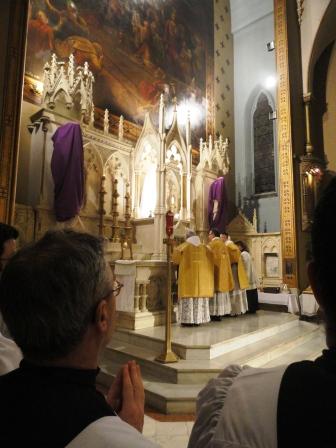
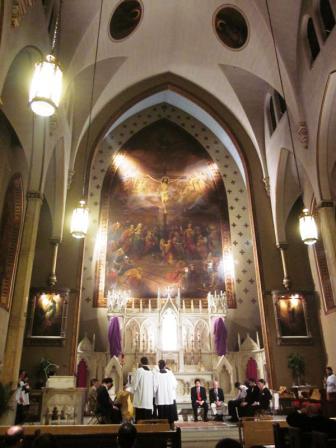
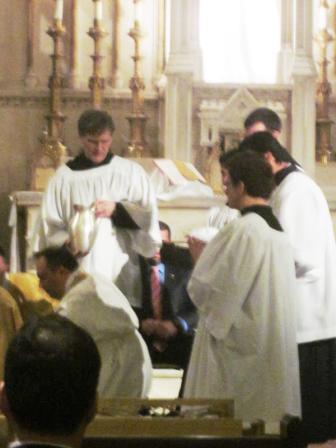
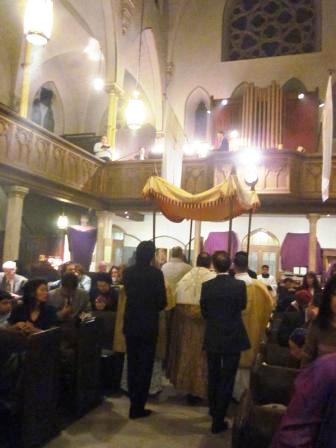
A few photos of the Mass.

Preparing for Holy Thursday Mass

Preparing for Holy Thursday Mass

Preparing for Holy Thursday Mass

Preparing for Holy Thursday Mass

Preparing for Holy Thursday Mass

Posted in SESSIUNCULA |
25 Comments