Hell’s Bible spits more goo in Pope Benedict’s direction

Hell’s Bible is at it again.

In a 4000 word article HB‘s Cumaen Sybil moos against Pope Benedict.

A sample.

But the future pope, it is now clear, was also part of a culture of nonresponsibility, denial, legalistic foot-dragging and outright obstruction. More than any top Vatican official other than John Paul, it was Cardinal Ratzinger who might have taken decisive action in the 1990s to prevent the scandal from metastasizing in country after country, growing to such proportions that it now threatens to consume his own papacy.

It is the usual thing.

No matter how much Card. Ratzinger did, it wasn’t enough.

The same goes today.

No matter how much or what Pope Benedict does, it can never be good enough for the editors of HB.

What is so slimy about this article is that it ends with simple inuendo, because that is all they really have.

Where Benedict lies on this spectrum, even after nearly three decades of handling abuse cases, is still an open question.

Wellllll, yes… it is an open question.  But it requires an open mind to drill into it.  

There is no question that in the issue of the clerical abuse of children, some Catholic clergy fell down hideously.  Is this news?

But HB has its sights set on Pope Benedict.  They will do anything to claw at him.

UPDATE:

Read this too…

The key purposeful error in the NYTimes new attack on Pope Benedict

Posted in Biased Media Coverage |
20 Comments

PODCAzT 107: Most Precious Blood and your sins; Interview with Fr. Finigan

PODCAzT 107: Most Precious Blood and your sins; Interview with Fr. FiniganAt the beginning of July, a month dedicated in a special way to devotion to the Most Precious Blood of the Lord, I give you in the PODCAzT a short reflection on the Blood of the Lord, what happens at Holy Mass and what happens in the Sacrament of Penance.

Also, I have an interview with my friend Fr. Tim Finigan about liturgical silence.  I was inspired to call him after reading his excellent blog entry on the subject.

https://wdtprs.com/wp-content/legacy/audio-archive/podcazt/10_07_01.mp3

 
Posted in Mail from priests, PODCAzT | Tagged , ,
3 Comments

My feet are like wings!

Via rogueclassicism:

My feet are like wings!

Don’t you want a pair?

I can’t figure out how to make these liturgical.

Can you?

Posted in Linking Back |
20 Comments

NYC: 5-11 July

I will be in NYC, Manhattan, from 5-11 July.

Posted in What Fr. Z is up to |
Comments Off on NYC: 5-11 July

New Motu Proprio on “new liturgical movement”?

My friend the nearly-ubiquitous fair-minded John L. Allen, Jr., still sadly writing for the unworthy National Catholic Reporter, has an piece today on Pope Benedict at his promotion of a new liturgical movement.

I have long contended that this Pope during this pontificate has as a major goal the restoration of our Catholic identity.  Liturgy must be a key component of such an endeavor.

My emphases and comments:

What Benedict means by ‘new liturgical movement’

John L Allen Jr

Sometime soon, [in…. say…. Vatican "soon"?…] the Vatican is expected to release a motu proprio, meaning a legal document under the pope’s authority, which will transfer responsibility for an aspect of marriage law from one Vatican office to another. Though it will probably fly below the public radar, the document provides a glimpse into Pope Benedict XVI’s approach to liturgy, meaning how the church celebrates the Mass and its other rituals.

Specifically, Benedict is expected to encourage the Congregation for Divine Worship and the Discipline of the Sacraments, the Vatican’s office for liturgical policy, to focus on promoting what he describes as a “new liturgical movement." The obvious question, of course, is what exactly he means by that. [Indeed, yes.]

In a narrowly tailored legal document, the pope can’t unpack the idea, but Vatican observers say that [get this…] Benedict’s broad liturgical approach can be described in terms of “continuity,” i.e., recovering elements of the liturgical tradition which he believes were too hastily set aside or downplayed in the immediate period after the Second Vatican Council (1962-65). [So far so good.  Nothing new here.]  His own style when he celebrates Mass reflects this thrust, including distributing communion on the tongue, rather than in the hand, and placing a crucifix on the altar to remind people that the focus is on God rather than the celebrant.

New Motu Proprio on "new liturgical movement"?The “new liturgical movement,” then, is one which attempts to restore what Benedict XVI and like-minded observers believe was lost in the post-Vatican II period, perhaps principally, in the pope’s mind, a strong sense of transcendence.

The phrase “new liturgical movement” was first used by the pope back in 1997, when as Cardinal Joseph Ratzinger he published a set of memoirs about his life up to 1977 under the title Milestones. [The idea of a new liturgical movement came with strength from his book, named after a book by Romano Guardini, Spirit of the Liturgy.]

Here is the relevant section, which I’ll quote at length:

“There is no doubt that this new missal [after Vatican II] in many respects brought with it a real improvement and enrichment; but setting it as a new construction over against what had grown historically, forbidding the results of this historical growth, thereby makes the liturgy appear to be no longer a living development but the product of erudite work and juridical authority; this has caused us enormous harm. For then the impression had to emerge that liturgy is something ‘made’, not something given in advance but something lying within our own power of decision. From this it also follows that we are not to recognize the scholars and the central authority alone as decision makers, but that in the end each and every ‘community’ must provide itself with its own liturgy. When liturgy is self-made, however, then it can no longer give us what its proper gift should be: the encounter with the mystery that is not our own product but rather our origin and the source of our life. A renewal of liturgical awareness, a liturgical reconciliation that again recognizes the unity of the history of the liturgy and that understands Vatican II, not as a breach, but as a stage of development: these things are urgently needed for the life of the Church.”

“I am convinced that the crisis in the Church that we are experiencing today is to a large extent due to the disintegration of the liturgy, which at times has even come to be conceived of etsi Deus non daretur, in that it is a matter of indifference whether or not God exists and whether or not he speaks to us and hears us. But when the community of faith, the worldwide unity of the Church and her history, and the mystery of the living Christ are no longer visible in the liturgy, where else, then, is the Church to become visible in her spiritual essence? Then the community is celebrating only itself, an activity that is utterly fruitless. And because the ecclesial community cannot have its origin from itself but emerges as a unity only from the Lord, through faith, such circumstances will inexorably result in a disintegration into sectarian parties of all kinds – partisan opposition within a Church tearing herself apart."

"This is why we need a new Liturgical Movement, which will call to life the real heritage of the Second Vatican Council.”

That extract provides the context in which the phrase from the forthcoming motu proprio should be understood (assuming it appears as expected), which otherwise may seem a bit out of the blue.

"Out of the blue"…?

Some of us have been talking about this –  not generally NCR readers, however, for a while now.

It will be interesting to see what Mr. Allen is talking about.  Motu Proprio… hmmmm….

Remember 07-07-07!

Posted in Brick by Brick | Tagged ,
41 Comments

The Feeder Feed: oddities

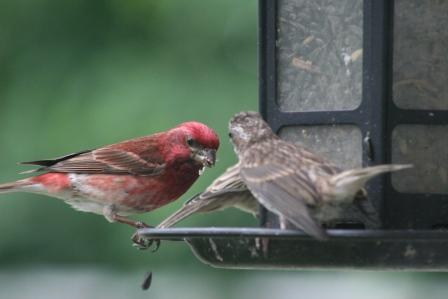
There is a lot of activity at the feeders right now, but only sparse fare, I’m afraid.The Feeder Feed: oddities

But some interesting sights have come around.

This wren is declaring its mastery of this little house.

The Feeder Feed: oddities

Thrashers have particularly beady eyes.

The Feeder Feed: oddities

This is a puzzler.  I am not sure if this is simply an Eastern Phoebe or if it perhaps a Kingbird.

He zipped around in the air after flies near the pond.

I am leaning toward Kingbird.  If I am right, it is a first for me.

The Feeder Feed: oddities

A young Oriole getting into the grape jelly.

The Feeder Feed: oddities

Just for some color…Twitter

The Feeder Feed: oddities

A begging baby House Finch.

The Feeder Feed: oddities

This baby something or other was strolling around in the garden refusing to fly.

It practically let me pick it up.

It wasn’t injured, however.  It was just lazy.

Eventually it flew up into a nearby pine tree, a low branch, and was lazy there.

The Feeder Feed: oddities

And one of the oddest things I have ever seen.

This woodpecker simply took a nap on the supporting rod of the Oriole feeder.

The Feeder Feed: oddities

Posted in SESSIUNCULA, The Feeder Feed |
11 Comments

The retiring Card. Kasper

Who will begrudge His Eminence Walter. Card. Kasper a long long rest.

The Cardinal retires now from his position at the Pontifical Council for the Promotion of Christian Unity.

He is to be replaced by H.E. Kurt Koch, Bishop of Basel.  Bishop Koch is made Archbishop. Perhaps later he will be a Cardinal.

Archbishop Koch is known to be in the theological orbit of Papa Ratzinger.

Hopefully Card. Kasper will have a good rest and not trouble himself with too much… writing.

Posted in SESSIUNCULA | Tagged ,
9 Comments

Liturgical silence

You should take a moment to read the latest post by His Hermeneuticalness, Fr. Finigan, about liturgical silence.

Here is a bit.

One of the attractions for many people, of the celebration of Mass according to the usus antiquior is that there is more silence. I can heartily sympathise with this preference from my relatively rare opportunities to assist at another priest’s Mass in addition to celebrating my own.

Interestingly, though, the ceremonies of the usus antiquior provide little in the way of pauses for silence. The "silence" that people love so much is mostly when the priest is praying secreto, that is to say, he vocalises the words in such a way that he can hear them but others don’t. Thus the "silence" is a more or less determined length of time which comes to an end when the priest reaches the next part that is to be said out loud or sung.

In the older form of Mass, there are three moments where the priest pauses in silence. At the memento of the living in the Canon, he remains for a short time in silence, remembering those for whom he wishes to pray (stat paulisper in quiete). In this case, the rubric explicitly says that he does not need to express the names but may remember them in his mind. The instruction for the memento of the dead says that he remembers them in the same way (though now that the sacred host has been consecrated, he is instructed to look at the host.) In fact, the priest may have many names or classes of people he wishes to remember and may simply recall in general those for whom he has made an intention to pray during his preparation for Mass. When people ask for my prayers, I usually promise to remember them at my Mass in this way.

The third pause for silence in the usus antiquior is after the priest has consumed the sacred host (not after he has received Holy Communion from the chalice.) He is instructed to be quiet for a short time in meditation on the most holy Sacrament (aliquantulum quiescit in meditatione sanctissimi Sacramenti).

The Missal of Pope Paul VI provided for more pauses for silence; though you might not realise this since the overall impression of the Mass is that there is virtually no silence since the Eucharistic Prayer is said out loud, something that Gueranger deplored: Cardinal Ratzinger suggested that an option should be provided for saying it quietly. Very often the Offertory is also said out loud as well, so that the only time when there is a prayer of any length said secreto is before the priest’s Communion. In fact, many priests, I think, feel slightly embarrassed at this and rush the prayer or say it out loud. The pauses for silence are detailed in the General Instruction of the Roman Missal (GIRM – I will refer to the edition promulgated with the 3rd edition of the Missale Romanum in 2002)

[…]

I would love to redo the whole piece here, but I would rather all of you go to visit Fr. Finigan’s excellent blog and spike his stats while reading the rest.

Posted in SESSIUNCULA | Tagged
23 Comments

WDTPRS POLL: About the iPad app for the Roman Missal… again

I have written before about the iPad app for the Roman Missal (which costs $4.99 through iTunes), iMissal.

Not much reason to write about it again, except for a few details.  For example, I wondered what would happen with a new translation.  Updating such wasn’t the strong point for the iBreviary app.  I grant that the Roman Missal is less complicated, but I wasn’t filled with confidence.

Fellow Minnesota John Thavis of Catholic News Service has an article about this iPad app.

With my emphases and comments:

New iPad application won’t replace liturgical books, creator says

By John Thavis
Catholic News Service

WDTPRS POLL: About the iPad app for the Roman Missal... againVATICAN CITY (CNS) — Are Catholics soon going to see their parish priest celebrating Mass with an iPad instead of traditional liturgical books? [In short… No.]

That’s the impression left by recent reports about Italian Father Paolo Padrini’s planned launch of an iPad application that features the Roman Missal on its 10-inch screen. [Not from here or most other of the blog accounts I read suggested.] But Father Padrini and church officials say no one should throw the printed books out yet.

“Liturgical books on the altar will never be replaced by the iPad. This is an additional instrument, not an attempt to get rid of paper books,” Father Padrini said in late June. [Getting a little heat?]

“If I went on vacation, I’d take along my iPad and celebrate Mass that way. Obviously in my parish, where I have the books, I’m not going to deliberately use an iPad,” he said.

The application should be ready by the end of July and will feature the Roman Missal in various languages, including English, French, Italian, Latin and Spanish. It loads the missal and breviary, or book of prayers, for a particular day, with the option of pre-loading up to 10 days worth of texts.  [That sounds useful.  Could the iBreviary have that?]

Father Padrini said that for the English version, he plans to use the missal text as currently approved for use in the United States. But he apparently has not yet nailed down the necessary permissions.

[But wait, there’s more!]

Msgr. Andrew Wadsworth, executive director of the International Committee on English in the Liturgy, said June 25 that Father Padrini currently had not received authorization to publish English liturgical texts as digital “applications.”

“We are trying to find a way forward in this situation and are currently in consultation with the U.S. Conference of Catholic Bishops regarding the matter. I imagine that it will take some time to reach a solution which is equally satisfactory to all the parties concerned,” Msgr. Wadsworth said in a statement to Catholic News Service.

Father Padrini did not run his idea past the Vatican’s liturgical experts, presuming that there should not be a problem.

“As far as I can see, there is no liturgical rule saying a printed instrument must be used. The rules do say the liturgy should be dignified and fitting and should not be disturbed,” he said.

In Father Padrini’s opinion, the small iPad would not detract from the liturgical decorum, and would be less noticeable than other objects placed on the altar these days.  [Okay.. there are two facets to that.  First, it is not to be immediately conceded that the iPad would not detrat from liturgical decorum.  Second, many inappropriate things are placed on altars.  Should that justify an iPad?]

But Vatican officials were not so certain that an iPad belongs on the altar.

Marist Father Anthony Ward, an undersecretary at the Congregation for Divine Worship and the Sacraments, said liturgical rules generally refer to “the book,” and there’s been an effort in recent years “to promote the book, and the embellishment of the book.” The idea of having a substitute for the book at public Masses seems to go against that consensus, he said.

Father Ward said the congregation wasn’t specifically considering the suitability of the iPad application, and that there didn’t appear to be explicit rules against such devices. But he added that in this case, one should not assume that if it is not forbidden, it is allowed.

The final judgment on the iPad-as-missal may come with experience. Father Padrini said he thinks the shock effect will disappear as more people carry such devices around with them.

“The liturgy should be beautiful. But personally, I’d rather celebrate Mass with an iPad, which is small and doesn’t disturb the faithful, than with an old, worn-out missal with yellow pages and small type,” he said.

Let’s got back to a point I raised and have a poll.

You remember that last poll.

About the use of the iPad or similar device in the place of a book for Mass….

Total Votes: 2116 Started: 18 June 2010

In your opinion, in a regular parish setting, not a camping trip, would an iPad "detract from liturgical decorum"?

{democracy:69}

Posted in POLLS, SESSIUNCULA | Tagged
23 Comments

Clinton Era Memo Betrays Kagan’s Extremist Pro-Abortion Thinking

From Operation Rescue with my edits:

Clinton Era Memo Betrays Kagan’s Extremist Pro-Abortion ThinkingClinton Era Memo Betrays Kagan’s Extremist Pro-Abortion Thinking

Written by Operation Rescue
Posted June 30, 2010

Commentary by Cheryl Sullenger, Senior Policy Advisor, Operation Rescue

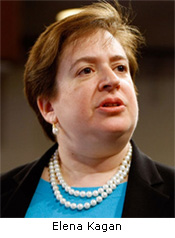
Washington, DC – Earlier this week, the Clinton Library released a number of memos related to Supreme Court nominee Elena Kagan. The most discussed memo, dated January, 1997, concerns her take on the necessity of partial birth abortions and her input by adding language to a statement issued by the American College of Obstetricians and Gynecologists (ACOG) that favored the now-illegal late-term abortion method.

While Kagan determined that the pro-abortion ACOG was perhaps the most reliable source of medical opinion on Partial-Birth abortions, she cites statements of opposing viewpoints issued by the Society of Physicians for Reproductive Health (PRCH) and “a group of mostly pro-life physicians called PHACT.”

Kagan does not include a written statement from PHACT and only quotes from that organization in part. In contrast to her dismissive attitude toward PHACT, Kagan not only includes a full, two-page statement issued by PRCH on their letterhead, but highlights portions of that statement that agreed with the position in support of partial birth abortion that she advocated.

The Society of Physicians for Reproductive Choice is without a doubt the most extreme organization of abortionists in the nation. It is a group of abortionists who proudly boast of having committed illegal abortions prior to Roe v. Wade and advocate for no restrictions on abortion at all – ever.

[…]

In other words, the PRCH wants abortionist to have the right to conduct human experimentation on their unwitting abortion patients in order to develop new ways to dismember, poison, or otherwise kill innocent pre-born babies, many which are viable and healthy. One of their members, Curtis Boyd has already admitted he has done so much in his development of new ways to kill babies in the second trimester of pregnancy.

It simply doesn’t get any more extreme than that. Yet, this is a group that Kagan has taken cues from in the past. The same basic philosophy promoted in the 1997 PRCH memo made its way into the policy statement of ACOG, thanks to recommendations made by Kagan in her own handwriting.

The 1997 ACOG statement, with the PRCH inspired Kagan additions, helped defeat the Federal ban on partial birth abortions that year and prolonged the use of this grisly brain-sucking technique an additional six years until the Partial Birth Abortion Ban Act of 2003 was finally passed and signed into law.

“This memo shows us that Kagan had no problem dictating policy to physicians, just like she is going to dictate policy from the bench,” said Operation Rescue President Troy Newman. “Any Senator who supports Kagan supports abortion policy in its most extreme form, including abortions through the ninth month of pregnancy and human experimentation on women. This is unthinkable and unconscionable.”

“The American people overwhelmingly oppose late-term abortions and radical abortion policy that is reflected in the Kagan memo. Senators who would have the bad judgment to vote for her confirmation invite serious voter backlash during their next election,” said Newman. “Remember the public outrage expressed when Senators Ben Nelson and Bart Stupak betrayed their pro-life constituency during the debate on tax funding of abortions in health care. Kagan supporters should expect nothing less.”

Read the full Kagan/ACOG memo

Contact your Senator to voice opposition to the Kagan confirmation to the U.S. Supreme Court

Posted in Emanations from Penumbras | Tagged ,
16 Comments