WDTPRS – 3rd Sunday of Easter (Novus Ordo): a candle is honey sweet summons

This Sunday, in the Novus Ordo calendar, is called the 3rd Sunday of Easter. Let’s have a look at the Collect.

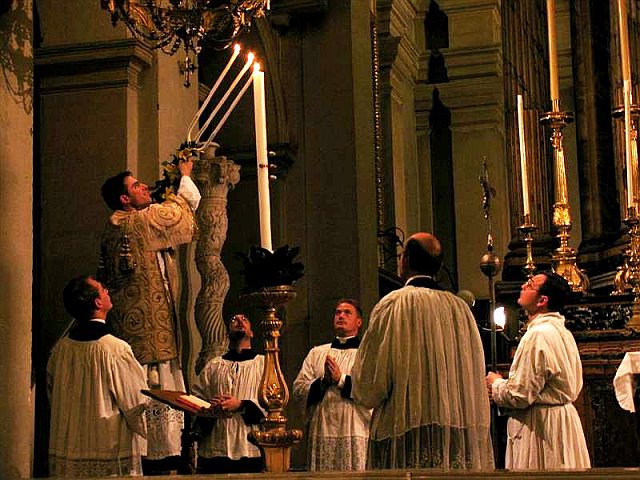
This Sunday’s Collect, it seems to me, reflects a conscious attempt on the part of Holy Church to remind us of the Easter Vigil.  As a matter of fact, let’s see if I can give you a new way to look at that Paschal candle which burns in the sanctuary during Mass in this Easter season.

The prayer has antecedents in both the Veronese and Gelasian sacramentaries, though it is not in pre-Conciliar editions of the Missale Romanum.

Semper exsultet populus tuus, Deus, renovata animae iuventute, ut, qui nunc laetatur in adoptionis se gloriam restitutum, resurrectionis diem spe certae gratulationis exspectet.

Vocabulary similar to our Collect is found in the works of St Ambrose (+397), such as his Exposition of Psalm 118 and his De mysteriis, a post-Easter explanation of the sacred, liturgical mysteries to the newly baptized.  For example, “… adulescens vel certe renovatus aquilae iuventute per baptismatis sacramenta…” (ex. Ps. cxviii, 18, 26).

Adoptio is, of course, “adoption” in the sense of “to take as one’s child.”  We find the phrase “adoptionem filiorum Dei … adoption of the sons of God” in the Latin Vulgate (cf Romans 8:23, Gal 4:5, Eph 1:5).

The words exsultet and adoptio bring our mind’s ear and eye to the Vigil of Easter, the deacon’s great moment to shine as he sings the Praeconium Paschale or Exsultet before the Paschal candle as the people hold their candles.  The Vigil is when many new Christians are by baptism made the Father’s sons and daughters through a spiritual adoption.

The Exsultet was composed perhaps as early as the fifth century. Parts may go back to St Ambrose.  In this great proclamation there are many images of light and darkness.  One image concerns the fiery light of candles: beeswax nourishes the divided and yet undiminished flame.  Pope Benedict in his sermon for the Easter Vigil of 2010 remarked that

“the cooperation of the living community of believers in the Church in some way resembles the activity of bees. It builds up the community of light. So the candle serves as a summons to us to become involved in the community of the Church, whose raison d’être is to let the light of Christ shine upon the world.”

VERY COOL POINT: Another meaning of adoptio in classical Latin is the “admission of a bee into a new hive.”

Look at what we lose when we lose our Latin.

What a marvelous way to think of sincere and observant Catholic Christians!

May all our works and words reflect the cooperation of God’s grace and love of neighbor!

May we be bright like kindled candles, honey sweet!

Some of you may be thinking, “But Father! But Father! This is over the top.  You’ve gone too far this time in making those connections.  All this… ancient stuff is not relevant to us. As a matter of fact, that was a time of PATRIARCHY, which is bad!   “FATHERS” of the Church.  Get it?  You posts are triggering me!  And I even called you “Father”!  See what you’ve done? Your are an angry and hate-filled micro-aggressor and YOU HATE VATICAN II!”

Our prayers flow down to us from an ocean of ancient culture, pagan and Christian.  Dare I say it flows down to us like honey from the comb?

Our vocabulary retains overtones of the Roman military, of agriculture, philosophy and religion. In previous centuries, people not yet gifted with glowing screens and text messaging more easily heard connections between fleeting phrases. They needed as a hook only a few words of a psalm, or even a single unusual word to evoke a massive interior meaning.  For them, certain words and phrases were like the TARDIS: bigger on the inside.  In the Gospels, Our Lord constantly alludes to psalms and the prophets. His (often hostile) listeners caught these allusions immediately.  People of seemingly simpler oral/aural cultures are better at this than we O so technologically sophisticated denizens of the West.  Our memories and attention spans are shrinking with each apparent advance.

But I digress. What was I talking about, again?

SLAVISHLY LITERAL ATTEMPT:

O God, let your people rejoice always, the youth of spirit having been renewed, so that they (the people) who rejoice now that they have been restored in the glory of spiritual adoption, may in the hope of true thanksgiving await the day of the resurrection.

OBSOLETE ICEL (1973):

God our Father, may we look forward with hope to our resurrection, for you have made us your sons and daughters, and restored the joy of our youth.

CURRENT ICEL (2011):

May your people exult for ever, O God, in renewed youthfulness of spirit, so that, rejoicing now in the restored glory of our adoption, we may look forward in confident hope to the rejoicing of the day of resurrection.

Posted in SESSIUNCULA | Tagged , , ,
3 Comments

@austinruse on “Slippery Jim” @JamesMartinSJ and his non-explanation explanation

Over at the excellent Crisis I see that Austin Ruse (President of the Center for Family and Human Rights – C-Fam) has caught up.

He penned a piece about Jesuit homosexualist activist James Martin’s wobbly affirmation of “official” Catholic teaching about homosexuality and homosexual acts.   Ruse made pretty much the same point I made several days ago.  HERE

However, Ruse always writes well.  I liked this bit in particular along with the great title.

James Martin S.J. vs James Martin S.J.

Donald Trump might refer to James Martin S.J. as “Slippery Jim.” He is certainly slippery. His latest act of slipperiness is a column he published this week at America wherein he claims to support the teaching of the Church on homosexuality.

[…]

He goes on to quote my good friend Fr. Gerald Murray, who is always worth paying attention to.

Father Gerald Murray points out that for Martin “…a disordered inclination or tendency is ‘one of the deepest parts of a person.’ He refers to ‘the part that gives and receives love.’ It is our heart and soul that constitute our innermost being, the center of love. An inclination toward unnatural sexual activity is not the heart and soul of a person. True love is expressed in virtuous deeds. Evil inclinations or tendencies to sin must be seen by the Christian for what they are and resisted.”

What he prefers is that the homosexual inclination is merely “differently ordered.” You are right handed, and I am left and that is just different. As Father Murray writes, such a change to differently ordered “…would mean that God created two different orders of sexual behavior that are both good and right according to his will: Some people are homosexual by God’s express design and some are heterosexual by God’s express design.” Murray says if the inclination is merely different, then the act—sodomy—is too, and therefore would be “simply natural” and not disordered.

But we know that that is not the case.  More on that HERE.

Also, Austin adds:

For some, this column settles the question. On Twitter, Elizabeth Scalia of Aleteia called the column “elegant.” My friend Maggie Gallagher says we need to take a yes for a yes. But, I do not believe this is a yes.

No.  This is not a “yes” and it wasn’t “elegant”.  It was a ruse, as Ruse and I point okay.

Martin’s piece is so filled with hedges and evasions that it cannot be taken for anything other than a signal to his followers to dig in their heels, defy the Church and continue on their merry way towards the cliff edge.

Posted in Linking Back, Sin That Cries To Heaven, The Drill | Tagged , , ,
8 Comments

IMPORTANT from @HeartbeatIntl – abortion pill reversal method rescues babies without bad effects, physicians network

This is VERY important.

The pro-life organization Heartbeat International has announced that they are now able to help women rapidly access a method to reverse – without bad effects – an in-process chemical abortion.

Imagine a woman who has taken the first of the drugs which will induce an abortion, a kind of “morning after” pill, RU-486.  Then, before she takes the second drug, she has a change of heart.  What to do?

A doctor, George Delgado and another physician Dr. Matthew Harrison, developed an FDA-approved method to reverse the process without ill effects either to the mother or to the baby.

But, because that reversal drug has to be prescribed by a doctor, they also developed a network of doctors all over these USA who can help these women in time.   The doctors can be contacted through a 24/7 hotline.

Now, Heartbeat International will take over the 24/7 hotline and the provider group, which will make the network far more visible and helpful.

To date, the network has some 400 doctors involved and over 450 mothers have successfully reversed the abortion process and rescued their children.

The complete press statement from Heartbeat International is HERE.

About Heartbeat International
Heartbeat International is the first network of pro-life pregnancy help organizations founded in the U.S. (1971), and the largest network in the world. With 2,500 affiliated pregnancy help locations—including pregnancy help medical clinics (with ultrasound), resource centers, maternity homes, and adoption agencies—Heartbeat serves on all six inhabited continents to provide alternatives to abortion.

Posted in Emanations from Penumbras, Just Too Cool | Tagged , , ,
7 Comments

Gallup Poll points to future demographic disaster. Wherein Fr. Z rants.

We are wobbling on the edge of a point where two demographic cliff faces converge.

First, there is in most dioceses a clamant, ongoing loss in the number of active priests.  This will get worse in the next few years.

Also, there is in most dioceses a clamant, ongoing loss in the number of practicing Catholics.  This will get worse in the next few years.

Look at the numbers for young people who profess any faith, much less the Catholic faith of their heritage.

I’m posting about a Gallup Poll, below, but I want to rant for a bit first.

Clamant problems, by definition, cry out for strong responses.

What we have been doing isn’t working.

I’ve used this image before.  If you discover that you have mis-buttoned your shirt, do you shrug and go out anyway or do you unbutton your shirt, match the right buttons and buttonholes and get it right?

If you go out with a properly buttoned shirt, people might not notice you at all.  If you go out with a mis-buttoned shirt, people will notice you and think that you are an idiot.

The one view is worse than the other.

Getting the shirt buttoned correctly is the minimum we have to do before we get out into the world.

I contend that celebration of our sacred liturgical worship at least correctly and without abuses is the mininum we have to do before getting out into the world.

No initiative of evangelization, new or other, will succeed unless and until we get our liturgical shirts together. Then we start to dress up for the job at hand, whatever uniform or garb is needed.

Using Paul’s analogy of armor for the pilgrim warrior of the Church Militant, we have to not merely put on the armor, we have to put it on correctly lest it be dangerous to ourselves.

Frankly, I think the way that our liturgical worship has been over the last few decades has made us all look like idiots to each wave of young people who have come along since the degradation began.   That and lack of catechesis resulted with other factors in an ongoing, self-sustaining spiral downward towards a point of no return.

And our pastors insist on doing the same damn things over and over, ignoring the single most important factor in our Catholic lives: worship.   There is a hierarchy to our loves and the activities that flow from them.  Atop the hierarchy is what we owe God, whom we must love above all creatures, by the virtue of religion: worship.  If we get our worship wrong, as individuals and as groups small and large, then everything else will be screwed up.

The result: erosion of Catholic identity.

And if we don’t know who we are, why should anyone pay attention to us except to crush out what we could be were we to get our act together again?

We must NOW….

  • purify celebrations of the Novus Ordo of their aberrations and bring them back into harmony with tradition and do what the Council asked regarding music, etc.
  • expand the use of the traditional form of Mass in many more places
  • bring formation of priests into continuity with our past while looking forward, which will include actually obeying Canon Law about Latin and Aquinas and attending to what is laid down in the Congregation for Educations document about Patristic studies, etc.
  • get down on our knees and do penance, openly, publicly, with bishops and priests even lying flat on their faces on the steps of their cathedrals begging God to forgive our collective stupidity and offenses against Christ’s Sacred Heart and Mary’s Immaculate Heart
  • GO TO CONFESSION!
  • etc.

This, from Gallup Polls:

Catholics’ Church Attendance Resumes Downward Slide

STORY HIGHLIGHTS
Fewer than four in 10 Catholics attend church in any given week
Catholic attendance is down six percentage points over the past decade
Protestant attendance steady, but fewer Americans now identify as Protestants

WASHINGTON, D.C. — Weekly church attendance has declined among U.S. Catholics in the past decade, while it has remained steady among Protestants.

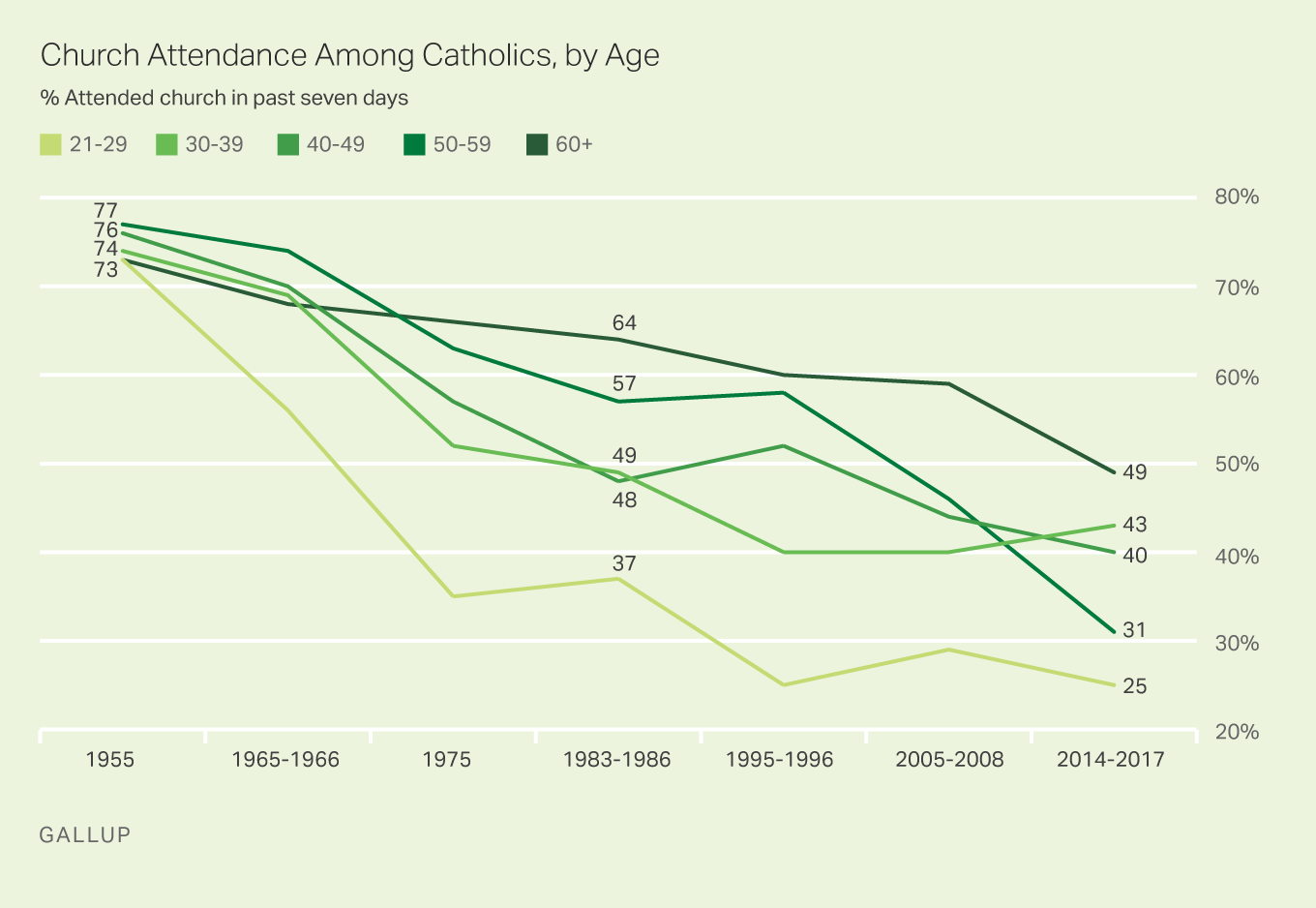
From 2014 to 2017, an average of 39% of Catholics reported attending church in the past seven days. This is down from an average of 45% from 2005 to 2008 and represents a steep decline from 75% in 1955.

By contrast, the 45% of Protestants who reported attending church weekly from 2014 to 2017 is essentially unchanged from a decade ago and is largely consistent with the long-term trend.

As Gallup first reported in 2009, the steepest decline in church attendance among U.S. Catholics occurred between the 1950s and 1970s, when the percentage saying they had attended church in the past seven days fell by more than 20 percentage points. It then fell an average of four points per decade through the mid-1990s before stabilizing in the mid-2000s. Since then, the downward trend has resumed, with the percentage attending in the past week falling another six points in the past decade.

This analysis is based on multiple Gallup surveys conducted near the middle of each decade from the 1950s through the present. The data for each period provide sufficient sample sizes to examine church attendance among Protestants and Catholics, the two largest religious groups in the country, as well as the patterns by age within those groups. The sample sizes are not sufficient to allow for analysis of specific Protestant denominations or non-Christian religions.

[…]

All of this comes amid a broader trend of more Americans opting out of formal religion or being raised without it altogether. In 2016, Gallup found one in five Americans professing no religious identity, up from as little as 2% just over 60 years ago.

UPDATE:

Meanwhile, the Fishwrap (aka National Schismatic Reporter) there’s a plan for what to do with all the empty churches that their own agenda is creating.

 I have never really understood why the creeds insist that Jesus’ bodily resurrected (“who rose on the third day”), [try 1 Cor 15:14] but I do understand how our buildings, if reimagined and adapted, could contribute to the people coming back to the buildings to experience God.

Minimally, adaptive reuse would welcome the kinds of people who don’t normally “darken the door.”

Examples abound.

At my [non-Catholic] church, Judson Memorial Church, in New York’s Greenwich Village, we have a morning dance for people who want to dance sober, called the “Morning Glories.” Other churches welcome opioid users to a worship service of a Sunday night. They call it “stigma-free” worship.

Still others create in their empty sanctuaries workstations that people can use at no or little cost. They remove the pews to make space for people to do yoga or sleep or work or all three.

[…]

This seems entirely in keeping with the rest of Fishwrap‘s non-Catholic identity.  Good job, Fishwrap!  Let that mask down once in a while!

Posted in "How To..." - Practical Notes, Hard-Identity Catholicism, Liturgy Science Theatre 3000, Our Catholic Identity, POLLS, The Coming Storm, The Drill, The future and our choices, Wherein Fr. Z Rants | Tagged ,
26 Comments

R.J. Snell reviews @DouthatNYT book about Pope Francis and his pontificate

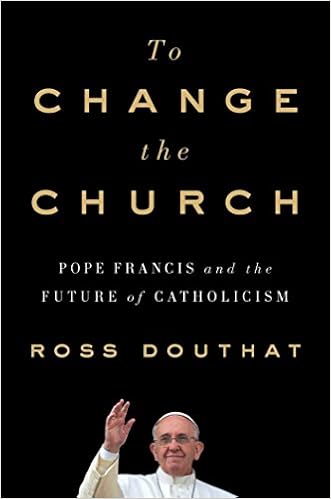
At Public Discourse, R.J. Snell (director of the Center on the University and Intellectual Life for the Witherspoon Institute in Princeton, NJ) looks at Ross Douthat’s recent book for the 5th anniversary of the pontificate of Pope Francis.

It is a sharp and reasoned contrast to the ACME quality spittle-flecked nutty of the Coyote over at Fishwrap. (Still amusing.)

To Change the Church: Pope Francis and the Future of Catholicism

US HERE – UK HERE

If you haven’t read this yet, you are missing out on a fascinating, ongoing discussion.

Snell add his commentary, of course.  Here are a couple samples:

[…]

Of course, if the church was in error on communion for the divorced and remarried, it meant that the previous popes were in error, that previous councils were in error, that the English martyrs were in error, that not only the Church’s moral teachings but also her ecclesiology and sacramentology were wrong, and that there were no principled reasons to reject communion for cohabitating couples or sincere homosexual couples. That is, this was not a matter of pastoral accommodation but a revolution calling into doubt the very meaning and existence of the Roman Catholic Church. It also meant that untold millions of Catholics had struggled to resist sin, and to confess when they failed, for no reason. It had all been in vain, a ridiculous hang-up without cause. (One bishop even suggested that Jesus himself had been wrong and unmerciful to reject the Mosaic law permitting divorce.) ….

[…]

So, what will be the Francis legacy? An exhausted but ultimately victorious orthodoxy? A swelling resurgence of traditionalists, especially among the young? (There is some evidence of this, certainly more than the supposed return of the lapsed and alienated Catholic.) Or will it be schism? A new theology, what Flannery O’Connor derided as “the Church of Christ without Christ”? Will it be the ascendancy of the African Church and the marginalization of the European, where it survives only because of full coffers? Will the old truce hold, or will it fail now that everyone realizes they kept the truce only because they felt their side would inevitably succeed?

Douthat doesn’t tell us. The book maintains its studied ambiguity, showing the fault lines and commitments of the various factions. …

[…]

Good and serious Catholics sometimes welcome converts not with, “well, at last, you’ve found the true faith” but “come on in, the water’s terrible,” or “really, this old thing?” They confess their love more like a wife at her fiftieth anniversary than in the poetry of first love. The Church is all too human, all too dysfunctional, and has always been so. Yet, this ark, battered and leaky, survives and thrives. There’s a quiet sense that the Vatican thinks in centuries, that a thirty-year crisis will hardly matter in time.

Or, perhaps this time is different. It feels different to many, as if something unprecedented and irreversible is happening. But we don’t know, and Douthat is honest enough to leave us hanging, waiting for the next installment of the Church’s story to be told. His story is unsatisfying in its ambiguity, but all the more interesting and truthful for it.


Posted in Francis, REVIEWS, The Drill | Tagged ,
3 Comments

Jesuits to host homosexual “Pride Prom” at @MarquetteU

It seems that whenever some morally questionable thing comes up these days, there is an “SJ” somewhere in the frame.

Jesuit-run Marquette University is hosting a homosexual prom.  There is a story about how the Jesuits are digging in their heals in favor of this homosexualist event at the site of the infamous New Ways Ministry.

That story also mentions a petition protesting the prom.

It seems to me that this sort of thing undermines the dignity of students with SSA.

Let’s ask some questions.

  • Does this sound like a good thing to host at an even nominally catholic school?
  • What is the tuition cost that parents are paying to send their children to this place?
  • Could it be that that tuition money could be better spent at a Catholic school which doesn’t actively and openly promote scandalous events?

Perhaps students and others at Marquette should at least have a look at the online petition.

>>HERE<<

Another story about this HERE.

Posted in Sin That Cries To Heaven | Tagged
23 Comments

Beautiful video about the Traditional Latin Mass. Wherein Fr. Z rants.

I was given a link to a video about Holy Mass in the traditional Roman Rite made at the oratory of the Institute of Christ the King in San Jose, CA.

YouTube thumbnailYouTube icon

It is interesting to view this video immediately after posting about Pope Francis’ remark about “punctilious (sic … “ostentatious”) concern for the Church’s liturgy” in GEE 57.

When I look at the architecture of the church in this video, the vestments, the attentive care to the ritual, I don’t see ostentation or punctiliousness. I see love.

When you love, you pour your care out on the one whom you love. You are relentless and punctilious in your concern for your beloved. You lavish your best upon those whom you love. You break yourself in self-sacrifice and bleed out when needed.

When you love God, you love His Church. When you love God and His Church, you love the sacred liturgical worship God gives us through His Church so that we foster the essential virtue of religion.

When you love you give your best. Enough is not enough. Enough is just the beginning.

If the liturgy of heaven before the throne of God will be forever increasingly alluring and glorious, then so too our earthly foreshadowing of the heavenly liturgy should be increasingly triumphant. We can start small, with the best we can provide now, humble as it might be. If clay is all we have, we’ll use clay beautifully until we have gold. Then we’ll use gold, until we can add diamonds.

People who do not understand why grand and triumphal liturgy is entirely appropriate, do not understand what it is to love.

This is not to say that small and simple liturgy is entirely inappropriate.

The core problem that critics of triumphal and lavish liturgical worship have is a stony heart and inflexibility.

It is possible to have both simple and grand, each in the right place and moment. The one doesn’t exclude the other.

That said, there is a hierarchy to these modes of worship and it is obvious which has priority.

In his Summa Theologiae II-IIae, q. 30, a. 4, St. Thomas Aquinas explores whether mercy is the greatest virtue.  Answer, it is and it isn’t.  That is to say, he makes distinctions.

Objection 1. [Remember that when Thomas gives an “objection”, he is giving a false claim which he will later refute.] It would seem that mercy is the greatest of the virtues. For the worship of God seems a most virtuous act. But mercy is preferred before the worship of God, according to Hosea 6:6 and Matthew 12:7: “I have desired mercy and not sacrifice.” Therefore mercy is the greatest virtue.

[…]

I answer that, A virtue may take precedence of others in two ways: first, in itself; secondly, in comparison with its subject. On itself, mercy takes precedence of other virtues, for it belongs to mercy to be bountiful to others, and, what is more, to succor others in their wants, [NB] which pertains chiefly to one who stands above. Hence mercy is accounted as being proper to God: and therein His omnipotence is declared to be chiefly manifested [Collect, Tenth Sunday after Pentecost].

On the other hand, with regard to its subject, mercy is not the greatest virtue, unless that subject be greater than all others, surpassed by none and excelling all: [chiefly, God!] since for him that has anyone above him it is better to be united to that which is above than to supply the defect of that which is beneath. Hence, as regards man, who has God above him, charity which unites him to God, is greater than mercy, whereby he supplies the defects of his neighbor. But of all the virtues which relate to our neighbor, mercy is the greatest, even as its act surpasses all others, since it belongs to one who is higher and better to supply the defect of another, in so far as the latter is deficient.  [See? Mercy is and isn’t the greatest.  It depends on your point of view, God or neighbor.  Yet, they are connected, for charity directs us to mercy.]

[Watch this!] Reply to Objection 1. We worship God by external sacrifices and gifts, not for His own profit, but for that of ourselves and our neighbor. For He needs not our sacrifices, but wishes them to be offered to Him, in order to arouse our devotion and to profit our neighbor. Hence mercy, whereby we supply others’ defects is a sacrifice more acceptable to Him, as conducing more directly to our neighbor’s well-being, according to Hebrews 13:16: “Do not forget to do good and to impart, for by such sacrifices God’s favor is obtained.”

[…]

In this question Thomas is tackling the question of mercy being greater than charity.  Hence, even the issue of worship is brought back to mercy.

Worship is not done merely for its own sake.  It is not done merely for God’s sake, who has no need of it, for He is already perfect.  Worship is for our sake, but not for our sake merely, as if we were closed in our ourselves.   Worship is for uniting more closely with God in devotion so that we can in turn be more closely united toward our neighbor who is in need.  

It is interesting that the Roman and Catholic concept of piety, pietas, duty, devotion, concerns that which we owe, which we are bound to give, that which is our duty.  When we use pietas in reference to us, we refer to the devotion we owe to God.  Pietas can also describe our relationship with others, such as Aeneas for his father and fatherland.  However, when pietas is used in reference to God, as in liturgical prayer, it refers to His mercy towards us.  We owe God everything in duty and He owes us nothing.  Hence, words such as piety and devotion have a bi-directional force, which is in harmony when, out of devotion to God we come also to show mercy and charity to neighbor.  By religion (related to justice) we give what is owed to God: worship.  By mercy (related to justice) we give what is due to our neighbor: providing what they lack and truly need.

Our sacred liturgical worship of God brings great harmony in our lives as individuals and as communities small and large when it produces corporal and spiritual works of mercy.

However, it is charity that has the logical priority over mercy, because true mercy flows from charity. We love is God and worship Him in devotion and love, with the result that we love God’s images, ourselves and others, properly.

Otherwise, it is self-referential.

Those who are locked in only on liturgical worship and its details, without consideration for works of mercy, probably don’t get why we have liturgical worship in the first place. They are probably defective in love.

Those who are locked on to minimalism in worship and are scornful towards its details and it’s possibilities of grandeur and beauty, and instead want constantly to sell that jar of precious ointment, the nard, for alms for the poor, probably don’t get the deeper why of why we help the poor. They are probably defective in love.

The woman with the jar of nard didn’t spend all that money just to keep it for herself and admire its elegant lines and lovely fragrance.  She had a greater use for it and its contents and that purpose involved her own hair and the Lord’s feet in a magnificent work of “mercy” towards Mercy Himself. In her humble action, she obtained Mercy’s mercy.  Judas, on the other hand, disdained the beauty of her purpose for the jar and its contents, seeing only its immediate utility, and wanted to sell it for a good that was a lesser good, not seeing that greater ultimately leads to multiplication of the lesser.  He also wanted to steal some of the profit from the sale, which is certainly self-referential.  Don’t be that guy.

By the way, I used the Summa reference here because I just recently reviewed it on account of it’s being referenced in a footnote in Pope Francis’ recent Gaudete et exsultate 106.  What’s puzzling is that, once again, whoever did his homework for the Pope in that paragraph seems to have misused Aquinas, as also occurs in Amoris laetitia.  The use in GEE 116 simply picks out part of St. Thomas’ response.  In respect to our neighbor, mercy is more important than external acts of worship.  However, just as charity is greater than mercy, so too worship is greater than external acts of mercy because worship moves us to external acts of mercy.  Somehow that last part was ignored.

Let’s wrap up this rant.

The Eucharist – itself and its celebration – is the source and summit, the origin and goal, of our Catholic life.  There is no disconnect between proper and even magnificent liturgical worship and works of mercy.  Authentic leitourgia, “work of the people”, is simultaneously work for the people.

Posted in Liturgy Science Theatre 3000, Wherein Fr. Z Rants | Tagged , , , , , ,
17 Comments

Look! Up in the sky! It’s a bird… it’s a plane… it’s…. STEVE!

Run, don’t walk, to SpaceWeather for a super cool video of STEVE!

STEVE RETURNS (UPDATED WITH VIDEO): Last night in Alberta, Canada, photographer Alan Dyer looked up and saw a mauve ribbon of light bisecting the night sky. Auroras? Not exactly. “It was STEVE,” says Dyer, who took these pictures of the glowing arc:

STEVE (Strong Thermal Emission Velocity Enhancement) often appears alongside auroras, but it is not the same thing. Researchers are only beginning to understand the phenomenon–aided by a chance encounter between STEVE and a European satellite. In situ measurements suggest that STEVE is the afterglow of a hot ribbon of gas that flows through Earth’s magnetosphere during some geomagnetic storms.

Dyer caught STEVE just as it was fading. Other photographers saw a more spectacular display.

“My dog barked at STEVE for the entire hour it was visible,” reports Matthew Wheeler of Robson Valley, British Columbia. “We spotted the ribbon just after midnight, and even without dark-adapted eyes it was easy to see the textures moving at astonishing speed.” Click to view Wheeler’s video of STEVE in motion:

Posted in Look! Up in the sky! | Tagged
1 Comment

The Sovereign Merciless Order of Malta – Another step toward creepy.

UPDATE 12 April 2018:

This whole thing reminds me of something.

Do any of you remember waaaaay back in the 1980’s when John Paul II removed the head of the Jesuits and replaced him with his own pick Father, later Cardinal, Paolo Dezza?

Dezza went on to silence Jesuit left-wing (is there any other kind?) criticism of the Pope.

Of course the Jesuits and rest of the catholic Left reacted badly to that and denounced the silencing of criticism.

I wonder… has the catholic Left denounced this silencing of criticism?

___ Originally Published on: Apr 11

In the Palazzo of the Doge in Venice there is a rather creepy slot in the wall where people could drop anonymous denunciations of their fellow Venetians.  What could possibly go wrong with that?  Right?

Did you read the Catholic Herald story?   It seems that the Sovereign Military Merciless Order of Malta (SMOM) has commanded its members not to say or write anything “offensive” about Pope Francis.

Also, and this is a little creepy, members are instructed to grass on, rat out, any member who does say or write something “offensive” about the Pope.

It isn’t entirely clear what might constitute “offensive”.   But then again, during the Cultural Revolution in China it wasn’t entirely clear what was “offensive” about Mao.

I don’t remember them doing this about John Paul II or Benedict XVI.  Then again, they were under different ownership at the time, weren’t they.

Is saying something like, “The Pope made a mistake about how he handled the situation of the Chilean bishop” offensive?

Is saying something like, “I think the Pope should wear the traditional papal vestments for the Urbi et Orbi blessing” offensive?

Is saying something like, “What the Pope said about women being ‘strawberries on the cake’ was offensive to women!”, offensive?

Do you suppose this is retroactive?   Are Knights of SMOM suppose to tattle on anyone who wrote something “offensive” about Benedict XVI?

Where does this stop?

Who else will move in this direction?

(That’s a trick question.  It’s already being done on a wide scale.)

Posted in SESSIUNCULA | Tagged ,
3 Comments

Reading #GaudeteEtExsultate – Pope Francis blasts “punctilious concern for the Church’s liturgy”

I’ve been working my way through the very long Apostolic Exhortation Gaudete et exsultate.  It’s a whopping 20K words.

A point that people have been asking me about, and which libs will surely throw in the teeth of anyone who wants a traditional sacred liturgical worship of God, is the Pope’s remark about liturgy in GEE 57.

My emphases.

57. Still, some Christians insist on taking another path, that of justification by their own efforts, the worship of the human will and their own abilities. The result is a self-centred and elitist complacency, bereft of true love. This finds expression in a variety of apparently unconnected ways of thinking and acting: an obsession with the law, an absorption with social and political advantages, a punctilious [sic] concern for the Church’s liturgy, doctrine and prestige, a vanity about the ability to manage practical matters, and an excessive concern with programmes of self-help and personal fulfilment. Some Christians spend their time and energy on these things, rather than letting themselves be led by the Spirit in the way of love, rather than being passionate about communicating the beauty and the joy of the Gospel and seeking out the lost among the immense crowds that thirst for Christ.

My first reaction when I read things like this from the Holy Father are: Who are these people?  Again and again the Pope describes people who are hard to identify.   I have an idea of whom he has in mind here.  More on that later.

A “punctilious” concern for the Church’s liturgy?  What to make of that?

Let’s use the text and context itself to interpret this passage.

I’m going to go with “punctilious”, even though after looking at the same paragraph in other languages it is pretty clear that “punctilious” is not quite the correct English word choice.

YES, friends, we need LATIN.   In lieu of Latin, what does the text of GEE 57 really say at this point in other languages?

French: l’ostentation dans le soin de la liturgie
Italian: l’ostentazione nella cura della liturgia
Spanish: la ostentación en el cuidado de la liturgia
Portuguese: a ostentação no cuidado da liturgia
German: dem Zurschaustellen [sic… Zurschaustellung?] der Sorge für die Liturgie

I’m sensing a theme.   Why choose “punctilious”?

“ostentation in the care/custody of the liturgy”

Ostentation is characterized by vulgar or pretentious display; designed to impress or attract notice to oneself. One might say, “flamboyant”.

Clearly, the other languages want to convey something “over the top”, something “ostentatious”.  “Punctilious” and “ostentatious” are not interchangeable.   The former is concerned with great attention to details.  The later is concerned with open pretension.

They have a common characteristic, however: excess.

Let’s pull all these things apart and make sense of them because libs are surely going to use “punctilious” as a club with which to beast those of us who want tradition, so let’s stick with that.

When you read Francis, you have to slow down and think.   The texts coming out over his signature are not always clear, or easily deciphered.

To understand “punctilious” look at some of the vocabulary and phrases in that paragraph:  “… obsession… absorption… excessive…”

The principle is this: Too much of a good thing is too much.

That “punctilious” here is surely meant to mean something like “obsessive … excessive”, rather than “careful… reverent… attentive…” etc.

It would be absurd to suggest that the Pope thinks that liturgy should not be careful, attentive, reverent.  That the Pope thinks liturgy should be the opposite of “punctilious”, which is sloppy or careless.

Keeping in mind the context and vocabulary, we affirm that observance of law is good.  Being socially and politically active is good.  Careful attention to detail in worship is good.  Knowing, teaching, and following the Church’s doctrine is good.  Defending the Church’s reputation and prestige is good.  Being practical is good.  Etc.

However, being excessive in any good thing is not good.  Too much of a good thing is too much.  Quantum potes tantum aude.  Right?  This applies to just about everything in life, except for faith, hope and charity, which – anyway – are all gifts from God.

Next, and this is important, this remark about liturgy is under the subhead “New pelagians”. 

We have to remember that just a little while ago the CDF issued document, Placuit Deo, which sort of explained in advance something of how the Pope uses these terms.  It was careful to state that the terms as used by the Pope are not strictly interchangeable with their technical use in Patristic and systematic theological spheres.

That said, what do we make of “… their own efforts…” when it comes to liturgy?

This is a salutary point from the Pope if we understand it properly.  Libs probably won’t, but we won’t fall into the trap with them.

Catholics know that the true Actor in our worship is Christ and that every word and gestures is truly Christ the High Priest’s.  Liturgy is a gift to be respected and not abused.   Hence, our liturgical practice, our ars celebrandi, should be careful and exact.  In addition, we are not doing it on our own or merely in reference to ourselves.   Liturgy is for us in that it is given to us.  Liturgy is about us in as much as it is God’s gift to us.  Liturgy, however, is not for us or about us.  God doesn’t need our liturgical worship, we do.  So, God gives it to us so that we can be good images of God in all we say and do in regard to God and neighbor.

As I have explained in preaching and conferences and here on this blog, it is possible to lose sight of the purpose of our liturgical worship, which certainly includes striving for an encounter with transforming mystery as a preparation for our inevitable death and judgment.

It is possible to focus on the details of liturgical worship, the trees, to the point that one loses view of the reason why we are there, the forest.

For example, some may be entirely fixed on whether or not the server started out with the left foot or the right, or how the book was moved from the Epistle to the Gospel side, or whether a turn was made at a sharp enough angle, etc.  I have actually been graded by the Mr. Punctilious who rushed to the sacristy to inform me that I got a C+ because I didn’t wiggle my pinky at the same place in his heavily-worn St. Joseph Daily Missal where old Father Bill did back when he was growing up.

Mr. Punctilious does a lot of harm to our project.  Don’t be that guy.  Don’t give the Pope another excuse to hurtful things about people who want tradition.

Ironically, in my experience, it’s not usually traditionalists who are fiercely positivistic about liturgy, but rather liberals.

For the most part the “trads” I’ve been around for the last few decades have a healthy respect for details, but without being scrupulous…. “punctilious” in the negative sense.  There are a few exceptions, such as the Mr. Punctilious I mentioned above.  On the other hand, many older libs, now into serious liturgical abuse or craziness (which they then insist on imposing on everyone), were once upon a time known as rigid and conservative.   Then the nutty 60’s hit.  They changed and became as rigidly liberal as there were rigidly conservative.

My old pastor, Msgr. Schuler, would describe some of the raging libs of the archdiocese were back in the day.  Some of them would nearly hyperventilate from scrupulously trying to make signs of the Cross exactly between the syllables of words as they appeared on the pages of the Missal.  Later in life, when the loony days hit, they threw off their restraints and became as doctrinaire in their progressivist antics as they were in their pre-Conciliar conservatism.   I heard the same sorts of stories when I was in Rome: priests who were famously traditional when they were young became crazy libs later in life.  A common trait: they impose their brand of crazy on others.

When we scratch libs, we generally find nazis underneath.   Similarly, when we really look into who out there are the authentic self-absorbed Promethean Neo-pelagians, we inevitably find that they are liberals, defined also as “those with whom you are free to agree”.

“But Father! But Father”, some of you libs – shaking with fury and pounding your little feetsies on the arms of your fainting couches – are howling, “you yourself said that the word is supposed to be ‘ostentatious’ not ‘punctilious’.  You are being both ostentatious and punctilious in your explanation!  HA HA! See what I did there?  You are trying to fool all your readers into running down a rabbit hole.   The Spirit of Vatican II says that we had to get rid of all the ostentatious statues and vestments and music and precise language and … and… just, you know, use clay pots and authentic macramé and a contemporary style of speech just like Jesus wants.  But you want us to turn the clock back to the bad old days because YOU HATE VATICAN II!”

Yawn.

Quickly, and to close, let’s rework that phrase from GEE 57 as “an ostentation in the care/custody of the Church’s liturgy” (l’ostentazione nella cura della liturgia).

Again, the title of this sub-section of the Pope’s really long Apostolic Exhortation is “New pelagians”.  The overall theme is self-sufficiency without reliance on God.

Lack of reliance on God turns what is otherwise good into something ruinous.   Law is good, when our reading and making of law is rooted in the justice and truth which is God and in the reason and natural law which reflects God.  Godless, merely human law – grounded in ourselves – in our will – is open to horrible abuse.   So too with everything else the Pope lists, including liturgy.

Liturgy filled with liturgical abuses and illicit creativity is self-referential… neo-pelagian.  It is the soul of ostentation.   It is like the restrictive closed-circle that Ratzinger described in Spirit of the Liturgy.

When our liturgy is carried out for our self-satisfaction, closed in ourselves, then what we lavish on it is a manifestation of selfish ostentation.   It might be beautiful, tasteful, and precise, but in itself, in its essence it is closed off to the ultimate victory of God which it outwardly mimics.

The driving force of triumphalism is “victory”.  When we celebrate God’s victory, we can hardly be “ostentatious” enough.  When we celebrate our own accomplishments, then even raising our faces from the dust is already too much.

When our liturgy is carried out for God and for the purposes God chooses for it, namely a transforming encounter with Him in mystery and love, then all that would otherwise be ostentatious and triumphalistic is hardly even a beginning of what we should desire to give.

Liturgical worship which is informed by our faith, hope and love of God, victorious over death and glorious in heaven, is not ostentation in the negative sense, triumphalistic in the bad sense.

Of course all virtuous behavior is governed by the “golden mean”.  It is okay and even meritorious to tighten the belt and fast and make sacrifices for the sake of the purchase of a new vestment for the parish priest to use at Mass.  It is not alright to neglect feeding your children for the sake of buying a new vestment.   It is meritorious to lavish money and care upon the building of a new church.  It is not okay to build a new church and, all the while, ignore corporal and spiritual works of mercy.

Balance… the mean in prudence… virtue.

The problem is that reasonable people see what libs don’t see.  We can do more than one thing at the same time.  We can build beautiful churches and care for the poor.  (Beauty is good for the poor, too, by the way.)  We can have lovely and – if you insist – “punctilious” liturgical worship and have a regard for the needs of our neighbor.  (Prayer on our knees in church is also good for the poor, by the way).   We can multitask.  Libs, however, seem to see the world as if through a “zero sum” lens.   According to their twisted line of thought, those who want traditional worship with all its lavish care and beauty are indifferent toward the poor.

B as in B.  S as in S.

But that’s what we are going to hear, especially in conjunction with GEE 57.

When libs fling GEE 57 at you, as if you were some sort of “pelagian”, just chuckle.

Posted in Liberals, Liturgy Science Theatre 3000, The Drill, Vatican II, What are they REALLY saying? | Tagged , , , ,
23 Comments