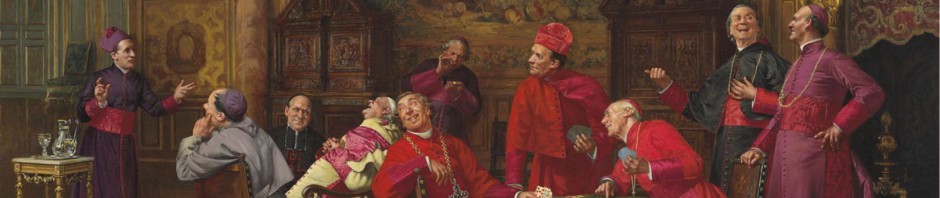
Plus ça change…

From the Martyrologium Romanum for today, 10 January, for the predecessor of Pope Sylvester:

1. Romae in coemeterio Callisti via Appia, santi Miltiadis, papae, qui, ex Africa oriundus, pacem Ecclesiae a Constantino imperatore redditam expertus est, sed a sectatoribus Donati acriter vexatus ad comparandam concordiam prudenter incubuit.

He died in 314.

How ’bout you giving us your perfect, yet smooth, renderings?


Posted in Saints: Stories & Symbols | Tagged ,
7 Comments

Z-Cam fun: Ray!

I have dubbed all male Cardinals “Ray”.

It was nice to see Ray on Father Z TV this morning, live from the Steam Pipe Trunk Distribution Venue.

Which reminds me… I have to redo the playlist.

UPDATE:

Then the Missus showed up.

Posted in LIVE STREAMING, The Feeder Feed | Tagged ,
16 Comments

Fr. Anscar Chupungco, OSB – R.I.P.

Fr. Anscar Chupungco, OSB, a well-known and influential liturgist, has died. He was 73.

I will remember him in my prayers, sincerely. In my opinion he created a lot of damaging confusion to our understanding of liturgical worship and inculturation.

An era is passing. The Biological Solution is working … on all of us.

Memento mori.

Posted in Liberals, Liturgy Science Theatre 3000 | Tagged
23 Comments

Sodality of St. Augustine – to pray for the conversion of loved ones

My friends of the Latin Mass Society in England have a new and worthy initiative.

The Sodality of St Augustine of Hippo

From the website:

The purpose of the Sodality is to unite the prayers of members for the conversion of those dear to them. There can be few Catholics today who do not have family members or close friends who have either lapsed from the practice of the Faith, or never had it; it is a particular source of grief when parents see children and grandchildren living without the support of the Sacraments. We take heart from the example of St Augustine, converted at last by the prayers and tears of his mother St Monica, and wish to demonstrate our fellowship with others in the same position, by praying not only for our own dear ones, but for those of others who will do the same for ours.

The Sodality takes advantage of three principles of Catholic prayer:

1. The Public Prayer of the Church is more pleasing to God than private prayer.

Not only are the Sodality’s prayers supported by regular Masses, but the Sodality’s own prayer is a Collect of the Roman Missal, linking our individual prayers further to the Church’s prayer and the Masses being said for the same intention.

2. The united prayer of a group of Catholics is more pleasing to God than the prayers of individuals alone.

The prayers of Sodality members are united for a single intention: the conversion or return of our friends and family to the Faith.

3. Prayers motivated by charity are more pleasing to God than prayers motivated by necessity.

By praying for each others’ friends, members of the Sodality show fraternal solidarity and charity, even towards those unknown to them.

St Thomas Aquinas wrote (quoting someone else):

“Necessity makes us pray for ourselves, fraternal charity urges us to pray for others. But sweeter before God is prayer which is not sent from necessity, but commended by fraternal charity.”
(“…pro se orare necessitas cogit, pro altero autem, caritas fraternitatis hortatur. Dulcior autem ante Deum est oratio, non quam necessitas transmittit, sed quam caritas fraternitatis commendat.”)
Summa Theologica II, Q88 a.7 c.

So please join the Sodality!
There is no fee, you just send us an email: info@lms.org.uk

You can arrange your own Masses for the intentions of the Sodality, but the LMS is offering the service, which will be convenient for some people, of passing on Mass Offerings to priests for such Masses. We are also going to have at least one Mass a year said publicly, with more solemnity, for this intention, which we will advertise, towards which you can make a donation.

The Sodality prayer:

Deus, qui caritátis dona per grátiam Sancti Spíritus tuórum fidélium córdibus infudísti : da fámulis et famulábus tuis, pro quibus tuam deprecámur cleméntiam, salútem mentis et córporis ; ut te tota virtúte díligent, et quæ tibi plácita sunt, tota dilectióne perfíciant. Per Dóminum nostrum Iesum Christum Fílium tuum, qui tecum vivit et regnat in unitáte eiúsdem Spíritus Sancti, Deus, per ómnia sæculórum. Amen.
O God, who, by the grace of the Holy Ghost, hast poured the gifts of charity in the hearts of thy faithful, grant to thy servants and handmaids, for whom we entreat thy mercy, health of mind and body; that they may love thee with all their strength and, by perfect love, may do what is pleasing to thee. Through our Lord Jesus Christ thy Son, who liveth and reigneth in the unity of the same Holy Ghost, God, world without end. Amen.

Fr. Z wholeheartedly endorses this good initiative.

Perhaps some priests could offer their services to take a Mass or two from the Sodality for intentions, if they wish to coordinate such an endeavor.

Posted in "How To..." - Practical Notes, Brick by Brick, Fr. Z KUDOS, New Evangelization, Our Catholic Identity, The future and our choices | Tagged , , , , , , ,
24 Comments

JUST TOO COOL: Of Niobids and Rovers

This is simply too cool.

Every once in a while, we find something from antiquity that we knew about but thought lost.

Check this out, from Gazzetta del Sud.  Dorothy King’s PhDiva has a lot of photos.  With a biretta tip to rougeclassicism. La Reppublica HERE.

Archaeologists discover Augustan-era sculptures near Rome

08/01/2013
Sculptures found in villa in Ciampino tell myth of Niobe

Archaeologists discover Augustan-era sculptures near Rome

Rome, January 8 – Archaeologists say they’ve uncovered an “exceptional” group of sculptures dating to the 1st century BC in a villa in Rome’s suburb of Ciampino. The sculptures, found in an ancient villa owned by Roman general Marcus Valerius Messalla Corvinus, a patron of the poet Ovid, tell the myth of Niobe, the proud daughter of Tantalus who lost all her 14 children after boasting to the mother of Apollo and Artemis, Leto, about her fertility. Niobe, regarded as a classic example of the retribution caused by the sin of pride or hubris, was turned to stone. Excavations at the villa have also revealed a thermal bath area with fragments of artistic mosaics and a swimming pool as long as 20 meters with walls painted blue. Inside the bath area were found seven sculptures dating to the Augustan age, as well as a complete series of fragments that experts say can be reassembled. The group tells the story of Niobe, which figured in Ovid’s epic poem of transformation, the Metamorphoses, published in AD 8. La Repubblica newspaper said Tuesday a team of archaeologists made the valuable discovery last summer. “Statues of Niobe have been found in the past, but in the case of Ciampino, we have a good part of the group,” of statues, said Elena Calandra, superintendent of archaeological heritage. According to their reconstruction of the bath area, experts say the statues were carved on all four sides of the swimming pool, which may have been buried by an earthquake in the 2nd century AD. (file photo of Niobe statue)

This is as cool as another story on the other end of the spectrum, as it were.  The Mars rover Curiosity has – for the first time – used its brush!  Yes!  It has!  HERE.

PASADENA, Calif. — NASA’s Mars rover Curiosity has completed first-time use of a brush it carries to sweep dust off rocks.

Nearing the end of a series of first-time uses of the rover’s tools, the mission has cleared dust away from a targeted patch on a flat Martian rock using the Dust Removal Tool.

The tool is a motorized, wire-bristle brush designed to prepare selected rock surfaces for enhanced inspection by the rover’s science instruments. It is built into the turret at the end of the rover’s arm. In particular, the Alpha Particle X-ray Spectrometer and the Mars Hand Lens Imager, which share the turret with the brush and the rover’s hammering drill, can gain information after dust removal that would not be accessible from a dust-blanketed rock.

Choosing an appropriate target was crucial for the first-time use of the Dust Removal Tool. The chosen target, called “Ekwir_1,” is on a rock in the “Yellowknife Bay” area of Mars’ Gale Crater. The rover team is also evaluating rocks in that area as potential targets for first use of the rover’s hammering drill in coming weeks.

Images of the brushed area on Ekwir are online HERE.

Ciampino.

Mars:

Posted in Just Too Cool, Look! Up in the sky! | Tagged , , , ,
2 Comments

“The Latin Mass is like beer. You have to drink it in a few times to like it.” Why Taylor Marshall attends the TLM.

May I suggest that you trot like Chaucer over to Taylor Marshall’s place and read his reflection on why he now attends Holy Mass in the Usus Antiquior?

Some highlights to whet the… you know…

I’ve not always been partial to the Latin Mass. For a few years after my conversion to the Catholic Faith, I was cautiously curious about the the “old Mass.” I perceived it as exotic, antiquarian, and even as a dangerous.

[…]

Most of it had to do with my alarm at the liturgical abuse that we witnessed. For example, the first time that my 4 year old daughter saw female “altar boys” serving at the altar, she tugged on my sleeve and said, “Daddy, look. I wanna be a girl priest, too.” Not encouraging.

[…]

The EM to whom we were routed that day was wearing jeans and she had on an over sized blue shirt with a giant image of Grover’s face. I just did a Google search and found a picture of the exact shirt: …

[…]

As I returned to my pew, I thought inwardly: “This is it! I just can’t take it anymore. Things have to change Lord. I’m now desperate. I don’t want my children to grow up with this perception of the one true Faith.” I had seen worse things than this before, but for some reason the Grover moment broke me.

I was now ready to make full hearted foray into the Latin Mass community served by the FSSP (Priestly Fraternity of Saint Peter – in union with the Holy Father, of course). Yet, I had a few pre-conceived notions against the Latin Mass and its adherents.

[…]

The Latin Mass is like beer. You have to drink it in a few times to like it. My challenge would be for you to attend the Latin Mass for four Sundays in a row before making a decision. Give it that long. Here’s why.

You will slowly make a shift in the way that you assist at Holy Mass. Your concept of Active Participation will transform in your heart. There is a lot of quiet “space” in the Latin Mass. The first time or so, you’ll be sitting there doing nothing and thinking, “What’s going on? Why aren’t we doing anything?”

When you’ve reached that point, you’re getting close. It’s like drinking beer for the first time. “This tastes terrible? What’s the hype? I don’t understand.” But then you come to realize that beer is more than just the taste.

[…]

Read the rest there.

Posted in "How To..." - Practical Notes, Benedict XVI, Liturgy Science Theatre 3000, New Evangelization, Our Catholic Identity, SUMMORUM PONTIFICUM, The Drill | Tagged , , ,
57 Comments

Faithful Chinese Bishops dies – forgave his enemies

From Fides:

The death of Mgr. Chen Shizhong: during forced labor he had received the gift of forgiving his enemies

Yibin (Agenzia Fides) – On December 16, 2012, His Exc. Mgr. John Chen Shizhong, Bishop of the Diocese of Yibin (Suifu), in the province of Sichuan (Mainland China) died. The Archbishop was 95 years old. He was born in 1917 to a Catholic family. When he was ten years old he began his vocational journey in the minor seminary of Yibin, then continued with the philosophical and theological formation at the seminary of the Annunciation. In 1947 he was ordained a priest and worked as a parish priest. In the 50s and during the Cultural Revolution he was first imprisoned and then sentenced to hard labor as a farmer. In this regard, a few months ago, he confided to a faithful that during that ordeal he had received the gift of forgiving his enemies.
In 1985 he was consecrated bishop and in 1988 and was appointed Rector of the Regional Seminary of Sichuan, a position he left the following year for health reasons. He returned to the diocese of Yibin where he remained for over twenty years. On 30 November 2011, seriously ill, he consecrated Rev. Peter Luo Xuegang as Coadjutor for the office in Yibin.
Mgr. John Chen Shizhong, the last elderly Bishop of Sichuan, is remembered for the work of formation of priests and religious women. Thanks to him, in the 80s and 90s, vocations to priesthood and consecrated life resumed throughout the province. Over 30 priests received sacred orders from his hands, thus ensuring the survival and development of the Church in a region, which was characterized by a hard Maoism and in which the hardships and persecutions of the Cultural Revolution strongly influenced the society and the life of the Church.
The funeral of Bishop Chen, celebrated on December 18 in the Cathedral of Yibin, were presided over by His Exc. Mgr. Luo Xuegang. His Excellency Mgr. Paul He Zeqing, Bishop of Wanxian also concelebrated. The Mass was attended by priests, religious women, and many of the faithful of the Diocese. Mgr. Chen’s body was then buried in the Catholic cemetery, close to the diocesan seminary. The diocese of Yibin has 9 priests, 7 religious women and 40,000 Catholics.

I understand that the bishop of the bishop of the Chinese Patriotic Catholic Association was present at the funeral.

I read stories like this and reflect upon both my own faults in charity, and I have had a relatively easy time of things compared to that old bishop, as well as the direction we are heading in West, these U.S.A. in particular.

When the times comes, will I be so forgiving?  I think it probably helps to get my head in to a mental place where I can think about this scenarios now.  Bp. Chen Shizhong said that he had received the gift, the grace, of being able to forgiven enemies.  Grace perfects our nature.  We have to do our part too.  We have to work on all the virtues, because they are habits.  We have to ask for graces.  We have to pray for and beg for miracles.  We have to be engaged and then strive to be at peace with the results God permits or grants.

Will we in time see the formation of an American Patriotic Catholic Association?

Some people don’t think that the horrors that happened in other places can possibly happen where they live.

I think they are wrong and I think we should all remember, daily, not only the Four Last Things, but also how precarious are our comforts and our worldly freedoms.

I should watch For Greater Glory again soon.

Posted in "How To..." - Practical Notes, Cri de Coeur, Modern Martyrs, Pò sì jiù, Religious Liberty, The future and our choices | Tagged , , , ,
6 Comments

QUAERITUR: Participating in wedding of sister to a married man

From a reader:

My sister is getting married next month. She has asked me to ‘give her away’ as our father is deceased. She has not practiced the Catholic faith for a long time. Although she was civilly married once before, and divorced, she was never married in the church, so no impediment there.
Her fiance (a fine man who I really like) WAS married before, in the church, and is legally divorce (no grounds for annulment). Ergo, they are getting married in an Episcopal church.
1- Is there a canon that would affect ME if I ‘give her away’ in an Episcopal ceremony?
2- Canon or no canon, would participating in the ceremony in this manner be sinful?

Canonically, there seems to be no prohibition against attending or participating in an invalid wedding. There are no penalties applied or suggested in Law for going to an invalid wedding, serving as best man, maid of honor, groomsman, bridesmaid, flower girl, etc. at an invalid wedding. The only penalty would be for the bride or the groom. By entering into an objectively invalid marriage, a Catholic thus deprives himself of the ability to receive the sacraments: Holy Orders, Confirmation, Penance, Anointing, and most importantly Holy Eucharist (danger of death can be a factor, but let that pass). Only when his marriage is regularized, or when he ceases to live in the invalid conjugal situation are the doors of sacramental grace open to him (after a good confession, of course).

Morally, however…

This is something that an individual involved must work out with his pastor and/or confessor. Those “on the ground” with the situation would know details, circumstances which would color and give texture to the situation.

Then one must ask: Which response would be more likely to bring the recalcitrant Catholic back to practicing the Faith?

If you say “No!” to participation, would it shock your sister into realizing the damage she is about to do to her relationship with the Church? Would it make her think twice about proceeding with the invalid wedding? Her intended spouse may be a fine man, but he is (if there truly are no grounds for a declaration of nullity) a married man, and therefore not free to marry.

Would saying “no” harden your sister’s heart and drive her even further away from the Church? Would it be possible to say “no” to giving her away to an already married man, but still attend the service out of sincere affection for your sister?  Would your answer set an example for your own children, if you have children?  They watch and learn about how important the Church is by watching you.

From the bare facts given, inadequate facts, my gut tells me – say “no”.  Do not participate.

But this is a moral question, not a canonical one.  You need input from your pastor, confessor, or trusted spiritual adviser, who could more fully work out with you some of the issues in this, your, particular care.

Comment moderation is on.
Posted in "How To..." - Practical Notes, Liturgy Science Theatre 3000, Our Catholic Identity | Tagged , ,
11 Comments

Brick by Brick… Altar by Altar

My friend Fr. Richard Heilman, pastor of St. Mary’s in Pine Bluff, WI, in the Diocese of Madison – where there reigneth Bp. Morlino – has made the move to the East.

After a process of catechesis, St. Mary’s has gone ad orientem versus. All Holy Masses will now be celebrated with priest and congregation facing liturgical East.

Here is a happy photo of the table altar being taken out of the church, which I hope to see in many variations in the future.

“But Father! But Father!”, some of you might be saying, “Where are they taking it?  That priest must hate Vatican II as much as you!  Now people won’t be able to participate!”

They are taking the altar over to the rectory, where Father will create a nice private chapel.

The New Evangelization continues at St. Mary’s in Pine Bluff.

To put table in front of that splendid altar was just plain silly.

Now they need an altar rail.

Bp. Morlino has spoken clearly about the importance of ad orientem worship.  HERE.

I’m sure that the day will come when we will turn toward the Lord together, in even a more full way when we all face east, when we all turn toward the Lord in the same direction. And when we do that, that’s not the priest turning his back on the people, it’s the priest directing the people to look toward the east, to obey the prophetic word, to believe how concrete, real, physical and visible Jesus Christ was and is. How concrete, real, physical and visible is the last coming, from the east.

The east matters. It matters a lot. That’s why the creator gave us the sunrise from the east to remind us that from there, comes the light, who is Christ.

As we behold the flesh and blood of Christ, in the sacramental sign of the Eucharist, we are turned toward the east, as Jesus comes to use here in mystery, to remind ourselves that our whole life is an eager, prayerful waiting for him to come in majesty, waiting for him to come from the east, turning toward the Lord.

The Diocese of Madison has 35 seminarians.

Posted in "But Father! But Father!", "How To..." - Practical Notes, Benedict XVI, Brick by Brick, Liturgy Science Theatre 3000, Mail from priests, New Evangelization, Our Catholic Identity, Year of Faith | Tagged , , , , ,
36 Comments

A mordant look at the wrong notion of “active participation”

From the amusing Eye of the Tiber:

Culver City, CA––Parishioners of St. Raymond Catholic Church in Culver City, California were forced to jump into action during Mass early Monday morning when it appeared that only one priest would be available for the consecration. According to sources at the scene, parishioners went into a frenzy when it appeared that visiting priest Fr. Bryce Carbone was close to saying the words of consecration all by himself. [!] “Our regular pastor, Fr. Ed, usually invites us all to gather and encircle the Lord’s table during consecration,” said longtime parishioner Donna Fullwood, before reassuring reporters that Carbone was doing well despite his brush with Mass without liturgical participation. “All I can say is it was a close call. I know a few parishioners are a little shaken up thinking of what could’ve happened if they hadn’t been able to participate. All’s well that ends well, though.” 56-year-old Fullwood went on to recount the story of how 20 or so quick-thinking parishioners rushed into action as Carbone prepared to consecrate the bread and wine without a single layman there to assist him. “We all looked at each other like ‘Oh no,’ then rushed to the altar as quick as we could and surrounded it. Then we all lifted one hand each in the concelabratory way. It was amazing how fast everyone moved to assist Fr. Bryce. I’m sure he’s really thankful. Maybe they’ll make a movie about it one day, like Zero Dark Thirty or something.”

Remember: A thousand lay people, ten thousand, a million, can say the words of consecration over bread and wine again and again and again with all the fervor they can humanly muster and, at the end of the day, there will still be only bread and wine on the altar. A single priest, even a little distracted, can whisper the words of consecration over the same bread and wine and they become the Body, Blood, Soul and Divinity of Christ.

The priesthood shared in by all the baptized and the priesthood of the ordained are qualitatively different. Lay people, by their participation in Christ’s priesthood as the baptized, are enabled to offer in their manner spiritual sacrifices and join their sacrifices to that which the priest does at the altar in his way.

Priesthood is for sacrifice. Sacrifice requires priesthood. No priest, no sacrifice.

Pray for an increase in vocations to the priesthood.

Posted in Liberals, Lighter fare, Liturgy Science Theatre 3000, Our Catholic Identity, Priests and Priesthood | Tagged , , ,
32 Comments
























