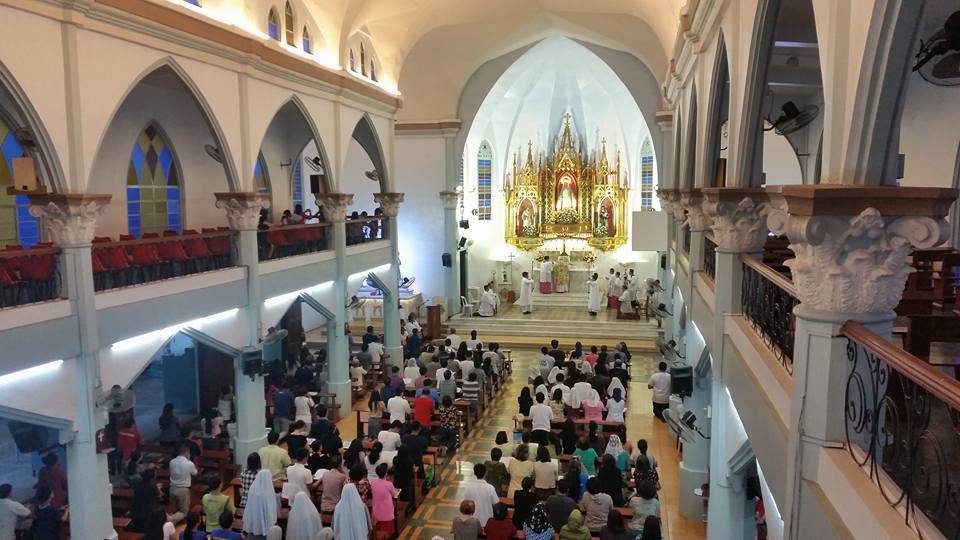
PHILIPPINES: Card. Zen celebrates TLM during Eucharistic Congress

PHILIPPINES: Card. Zen celebrates TLM during Eucharistic CongressDuring a Eucharistic Congress held in the Philippines, His Eminence Joseph Card. Zen Ze-Kiun, Bishop Emeritus of Hong Kong, celebrated Holy Mass in the Extraordinary Form.

From CBCPNEWS:

Cardinal Zen: Traditional Latin Mass ‘nourishes faith, inspires adoration’

CEBU City (Jan. 28, 2016) – Delegates to the 51st International Eucharistic Congress (IEC) flocked to the beautiful chapel of Asilo de la Milagrosa on Jan. 26 to assist at the Traditional Latin Mass (TLM) offered by Hong Kong Bishop Emeritus Joseph Cardinal Zen Ze-Kiun, who called for the preservation of the old rite.

Because it inspires a “sense of adoration” and keeps the Eucharist’s “sense of mystery,” the TLM is a tradition worth keeping, said Cardinal Zen, who offered the Votive Mass of the Blessed Sacrament in what has been called the Extraordinary Form of the Roman Rite since the liberalization of the old rite in 2007.

Latin is no longer the lingua franca, acknowledged Zen. “But the whole ceremony inspires majesty, solemnity.”

“In this way of saying the Mass, you don’t even hear the priest pronouncing the words. But you know what this means, because so many times, we hear, we pray … So we understand what is going on,” he added.

[…]

Through an announcement at the IEC Pavilion, congress delegates were invited to the Mass organized by Societas Ecclesia Dei Sancti Ioseph (Ecclesia Dei Society of St. Joseph)-Una Voce Philippines.

Old rite strengthens

An outspoken critic of the Beijing’s tight grip on Chinese Catholics, Cardinal Zen, recalled how the “Tridentine” Mass had nourished the faith of his compatriots amid upheaval in China. Zen, 85, was among those who fled Communist rule in the mainland for Hong Kong, where he joined the Salesians.

“The Mass offered in this fashion nourished our faith, nourished our vocation. And so many people in my native town Shanghai were fortified … by receiving the faith from this Mass, and during the time of persecution, they were so strong,” he said.


[…]

Read the rest there.


Posted in Liturgy Science Theatre 3000 | Tagged
4 Comments

Communion given to Lutherans in St. Peter’s Basilica – The Wrap Up

There was a kerfuffle about some Lutherans who visited Pope Francis and then – horribile scriptu – were somehow invited to receive Holy Communion during a Mass. Frankly, I didn’t follow this too closely, though the very thought irritated me in the extreme.

Now, some clarity comes from Ed Pentin.   It seems that this wasn’t part of some gruesome plot of ecumenical indifferentism.  In the end, it seems that the priest was just dumb.  Read on.

Finnish Catholic Spokesman: Communion for Lutherans at the Vatican Was a Mistake [D’ya think?]

The distribution of Holy Communion to a group of Finnish Lutherans in St. Peter’s basilica last week was a mistake and not a sign that the Church is changing its practice on access to the Sacraments, a spokesman for the Finnish Catholic Church has asserted. [Would there also be a statement of some kind from the Holy See?]

In a statement issued Jan. 20, Marko Tervaportti, director of the Catholic Information Centre in Helsinki, stressed that only members of the Catholic Church “in a state of grace” may receive the Eucharist, with some “special exceptions”. [The Code of Canon Law states that there is a narrow set of circumstances in which a non-Catholic may be admitted to Holy Communion.  In this case only the diocesan bishop can give permission for this to happen, not the pastor of a parish, not an individual priest, not a deacon, not a lay minister, not a nursing home administrator.  The question is: Who invited them to Communion?  Of course the Roman Pontiff could make this decision, but someone else… not.]

Tervaportti was referring to reports last week that a Lutheran group from Finland, led by their bishop, Samuel Salmi of Oulu, had received Holy Communion in St  Peter’s basilica, despite indicating to the priests present that they were ineligible to do so. According to Finnish news agency Kotimaa, the priests celebrating the Mass were aware that they were Lutherans.  [Good grief. It is in moments such as these that I am inclined to set up special “Reeducation Camps”.]

In his statement, Tervaportti rejected talk of a “new ecumenical attitude” at the Vatican, reiterating that the Church’s doctrine and practice in this regard “has not changed in recent years and decades”, and if it does change, it will do so through “alteration of Church law and additions to teachings.” [“additions to teachings”… ummm… how about “non-Catholics embrace Catholics teachings and become Catholics”?]

He also said a so-called “new mindset” of Pope Francis “is not a sign that the Catholic Church is going to change its practice with regard to the distribution of the Holy Eucharist,” but rather it is a “sign” for Catholics to be more careful in examining their conscience.

“For Catholics the Eucharist is the ‘source and summit’ of our Christian life,” Tervaportti explained. “It is, as it were, our credo. We carefully prepare to receive it, and confess our serious sins and fast (even shortly) before receiving it.

“We adjust our lives so that we might receive the Lord’s Supper worthily,” he continued, “knowing that ‘Therefore whoever eats the bread or drinks the cup of the Lord in an unworthy manner, shall be guilty of the body and the blood of the Lord’ (1. Cor. 11:27).”

He said “not every person distributing the Holy Eucharist knows every point of teaching and practice of the Church” and so “mistakes” can happen. [It seems to me that before a priest is given faculties to say Mass, he should know about that whole “Catholics in the state of grace” thing, or at least “Lutheran ministers… no, I can’t give them Communion” thing.  Too much to ask?]

But he said “creating communion” between the churches “on one’s own authority” makes the “true efforts of the churches to draw closer more challenging.” It would therefore “be good to respect the approach of each church in this matter,” he concluded.

So, I guess the take away here is that those priests were simply dumb, not loony.

Gosh, that’s reassuring.

I’d would, however, like to know that priest’s name, or their names.

Posted in Liberals | Tagged , ,
35 Comments

PODCAzT 141: Two Prayers of St. Thomas Aquinas

In the post-Conciliar, Novus Ordo calendar today is the Feast of St. Thomas Aquinas (+1274).  Let’s hear two prayers from the Angelic Doctor, his Prayer Before Mass and Communion and his Prayer After Mass and Communion in both Latin and English.PODCAzT 141: Two Prayers of St. Thomas Aquinas

Some of the music came from the Dominican Sisters of Mary, Mother of the Eucharist.  

As a bonus, here is my 1st class relic of the saint.

PODCAzT 141: Two Prayers of St. Thomas Aquinas
https://wdtprs.com/wp-content/legacy/audio-archive/podcazt/16_01_28.mp3

Posted in Our Catholic Identity, PODCAzT, PRAYERCAzT: What Does The (Latin) Prayer Really Sound L, Saints: Stories & Symbols | Tagged , , ,
1 Comment

Fr. Finelli’s podcasts about the Extraordinary Form

Fr. Finelli's podcasts about the Extraordinary FormI direct the readership’s attention to the page of our friend and frequent commentator here Fr. Jay Finelli, iPadre.

Fr. Finelli has a series podcasts about his experience of learning and saying Holy Mass in the Extraordinary Form.

Gosh… he’s up to Episode #340.  I feel like an underachiever.

His first podcast on the Extraordinary Form is HERE.

Go spike his stats!

Posted in HONORED GUESTS, Liturgy Science Theatre 3000, Mail from priests, SUMMORUM PONTIFICUM | Tagged ,
1 Comment

ASK FATHER: Father says funerals without a pall on the coffin

ASK FATHER: Father says funerals without a pall on the coffinFrom a reader…

QUAERITUR:

I attended at funeral mass at a parish recently and I found it strange that the funeral pall was not draped over the casket for the mass. The priest wore purple vestments and used the paschal candle, but for some strange reason, the funeral pall was not used. The priest who said the Mass has a reputation to be very traditional in his ways. From being at funeral Masses at this parish in the past, this priest does not use the funeral pall in both the Traditional Requiem Mass and in the Novus Ordo. Is the funeral pall necessary, is this a liturgical abuse?

For the Novus Ordo, The Order of Christian Funerals states:

38. If it is the custom in the local community, a pall may be placed over the coffin when it is received at the church. A reminder of the baptismal garment of the deceased, the pall is a sign of the Christian dignity of the person. The use of the pall also signifies that all are equal in the eyes of God (see James 2:1-9). . . . Only Christian symbols may rest on or be placed near the coffin during the funeral liturgy. Any other symbols, for example, national flags, or flags or insignia of associations, have no place in the funeral liturgy.

132. Any national flags or the flags or insignia of associations to which the deceased belonged are to be removed from the coffin at the entrance to the church. They may be replaced after the coffin has been taken from the church.

So, in the Novus Ordo, a pall may be used and it is not, strictly speaking, obligatory.  Gosh! It’s an option!  An option? In the Novus Ordo?  I’m shocked!

That said, I believe there could be particular law in a diocese for the use of the pall.  That should be easy to verify where you are.  I imagine that particular law in a diocese would pertain to the Novus Ordo and wouldn’t mention the Extraordinary Form at all.  The Extraordinary Form is hardly noticed by diocesan liturgy offices, is it.

ASK FATHER: Father says funerals without a pall on the coffinFrom what I can tell by consulting liturgical manuals for the older, traditional Requiem Mass, as often happens auctores scinduntur… authors are divided.  I’m not shocked by that at all.

From what I make out in Reid/O’Connor/Fortescue for the Extraordinary Form the pall may be used but it is not, strictly speaking, obligatory.   “A black pall is usually laid over the coffin…” (p. 461)  I think that, if one is available, it should be used.  On the other hand, ASK FATHER: Father says funerals without a pall on the coffinTrimeloni says (my translation), “Things to prepare. In the middle of the Church: the CATAFALQUE which consists of a riser painted black or covered with a black drape….  When the body isn’t present, upon the catafalque there is placed a litter, that is, a raised level in the form of a mortuary casket covered with a drape.”  Trimeoni also says that it is permitted to place on it coats-of-arms, other insignia, flags, etc.  It seems that the older, traditional form of Mass was more flexible than the option-laden Novus Ordo.

So, much depends on local custom.

Is it an abuse not to use a pall in either Form of the Roman Rite?   Strictly speaking, I don’t think it is.

However, I believe that in most places these days – certainly in these USA at least – a pall, black in the traditional Requiem and white in the Novus Ordo, is indeed customary.  They should be used, lest their absence cause wonder… as it has in this case.

I suspect this will prompt fervent suggestions, additions and corrections from the gallery.

Posted in "How To..." - Practical Notes, ASK FATHER Question Box, Four Last Things, Liturgy Science Theatre 3000 | Tagged
12 Comments

Do small communities (e.g., TLM) have a future?

A while back, a conversation was initiated by a post by my friend Msgr. Charles Pope about the number of people attending the Extraordinary Form.  My post about it HERE.

At the UK’s best Catholic weekly, the Catholic Herald, there is a offering by a young priest, Fr. Matthew Pittam, who has been serving a small rural parish.  What he says has something to offer to the discussion of the numbers (growing numbers) of people attending mostly or only the Traditional Latin Mass at legitimate churches and chapels.

What future is there for small communities within the Catholic Church? [I think most will agree that TLM communities are small communities.]

Rural parishes like mine are struggling because of a drop in vocations and a lack of imagination

For almost the last five years I have ministered in a small rural parish in the Midlands. Twelve villages, outlying farms and countryside comprise the parish and many people travel long distances to attend Mass.  [That applies to TLM communities too.] If you were a bishop planning for Catholic provision today you probably wouldn’t open a church here, but thanks to the historic conversion of Rudolph Fielding, 8th Earl of Denbigh, the parish was endowed and established.  [“endowed”… I assume this means that lots of money was provided to see to the parish’s future.]

Today the parish is lively and vibrant, although a normal Sunday would see attendances at Mass which are just below 100. [This probably describes many TLMs.] We have a choir, full serving team, an active (and youthful) Union of Catholic Mothers and regular young peoples activities. [Sound familiar?] There is a daily Mass, weekly adoration and the full cycle of the liturgical year is celebrated in all its fullness. Our musical tradition is flourishing and unusually for a Catholic parish, everyone sings. There are good links with the local village communities and other churches, as well a longstanding relationship with the village C of E school and care homes. The school is probably unique in that there is a regular Mass for Catholic children and a Catholic teacher is employed to provide catechesis. In many ways the parish punches well above its weight.

When the secular Parish Council recently published its Parish Plan, St Joseph’s was regarded as a valuable and important community asset. This is in a community where so many assets, such as the shop, have long since disappeared.

The challenge
Whilst our parish may be active and full of life, when it comes to numbers of parishioners we could easily be seen as non-viable. The Catholic news is full of stories of church closures, amalgamations of parishes and reorganisation. I know of parishes nearby which are much larger than we are, where Masses have been lost and where they now share a priest with a neighbouring community. What future is there then for small communities within the Catholic Church?

Bishops have an unenviable job when faced with declining numbers of clergy. It would be sad however if they were they were to see the future solely in terms of financial viability and the ability of the faithful to travel to Mass at other centres. A church such as mine is a community at the heart of the community. We have a strong visible and emotional presence in the villages that we serve and this would be lost if local Catholics were expected to travel to a larger church in a neighbouring town.

The Supermarket Model
Over the last thirty years supermarket chains have established larger and larger stores on out of town sites away from local communities. [A priest friend, deceased at too young an age, once had the nearby parishes of St. Martin and St. Walburga.  He thought that if they were forced to merge he would call it St. Walmart.] Each time a new branch was opened it seemed to be bigger and better than the last. However, the tide has now begun to turn and many large out of town sites remain undeveloped. The big six chains have recognised again the value of local convenience stores and this has represented a massive growth in the sector over the last few years. This is also coupled with a desire amongst consumers to buy produce with local provenance.

[NB] It appears that in seeking to amalgamate parishes and create bigger centres, the church is adopting a model of ministry just at the point when the commercial and retail world is abandoning it.

Should we therefore think again about the value of smaller churches and the missional possibilities that local communities present in the work of The New Evangelisation?

[…]

Read the rest of the piece over there.  And, please do read it, especially if you are going to comment here.

I saw a connection.  I bring it to your attention.


Posted in SESSIUNCULA | Tagged ,
13 Comments

“Mercy, not magic”. Year of Mercy Doors are NOT a substitute for confession

From CNS:

Mercy, not magic – Archdiocese of Bombay clarifies Holy Doors and the Jubilee

.- The Archdiocese of Bombay issued a clarification last week after WhatsApp users in Maharashtra were circulating a ‘misleading’ message which promoted a superstitious understanding of the Year of Mercy.

The archdiocese’s Jan. 19 statement noted that the text “gives the impression that merely walking through the Doors of Mercy will result in the forgiveness of sins.”

“These doors are not magical doors and we need to understand that to experience and obtain the indulgence, the faithful are called, as pilgrims, to avail themselves of the Sacrament of Reconciliation, to participate in the celebration of the Holy Eucharist with a reflection on mercy, make a profession of faith, and pray for the Holy Father and for his intentions for the good of the Church and of the entire world.”  [GO TO CONFESSION!]

The archdiocese’s noted added, “It must be understood that walking through the Door of Mercy indicates the desire for the forgiveness of sins, and walking through it symbolises a leaving behind of the past and entering into a new life through Christ, who is the door.”

“Please note that walking through the Holy Doors is not a substitute for the Sacrament of Reconciliation.”

[…]Cardinal Oswald Gracias of Bombay opened the Doors of Mercy at Mumbai’s Basilica of Our Lady of the Mount on Dec. 20, 2015. He   reminded the faithful: “This is the Lord’s Gate: let us enter through it and obtain mercy and forgiveness.” The doors were then opened, using the Bible as the key, with the following invocation, “Open the Gates of Justice; we shall enter and give thanks.”

The cardinal in his homily at the Mass explained the characteristics and significance of the Holy Year and urged the faithful to “fix your eyes on Jesus”   and to be “agents of God’s mercy.”

“No one should say that it is difficult to reach God and difficult to obtain mercy, for the Church is indeed the vehicle of mercy,” Cardinal Gracias said. “We are the Church and it becomes our Christian duty to spread the message of God’s mercy and reconciliation.”

“With the corporal and spiritual acts of mercy, we have direction; with the example of our religious leaders, we have motivation; and with God’s mercy through Jesus himself, we have a straight path.”

Everyone…

GO TO CONFESSION!

Posted in GO TO CONFESSION, Liturgy Science Theatre 3000, The Drill, Year of Mercy | Tagged , , ,
10 Comments

CNS: Catholic Colleges and Title IX Exemptions

This comes from the Cardinal Newman Society:

Catholic Colleges Should Claim Title IX Exemptions, Says Newman Society President

As Title IX interpretations have expanded to include discrimination policies grounded in gender theory, Catholic colleges should have no qualms about claiming constitutionally-protected exemptions, said The Cardinal Newman Society President Patrick Reilly in an interview with National Catholic Register.

“Of course these colleges have no interest in sex discrimination. They have had no problems complying with Title IX,” said Reilly. “But now things are changing, and the Obama administration is pushing the extreme gender ideology that Pope Francis has strongly warned against. The law could be used to force practices that violate our beliefs and even natural law, unless religious educators claim the exemption that Congress gave them to uphold the First Amendment.”
The necessity for Catholic colleges to claim exemptions has increased recently, as the Department of Education’s Office of Civil Rights recently expanded Title IX interpretation to include “discrimination based on gender identity or failure to conform to stereotypical notions of masculinity or femininity,” [“stereotypical notions”] the Register reported. This interpretation conflicts with a Catholic institution’s responsibility to uphold Church teaching on human sexuality, according to Reilly.
As Reilly noted, Pope Francis has spoken out on the issue of gender theory several times, calling it “an expression of frustration and resignation that aims to erase sexual differentiation because it no longer knows how to come to terms with it.” If acceptance of gender theory becomes widespread in society, “we risk going backward,” said the Holy Father. In another speech, the Pope called gender theory “an error of the human mind that leads to so much confusion,” according to LifeSiteNews.
“The big question is why some Catholic colleges are voluntarily declining to claim the exemption, when discrimination against our beliefs is a very serious prospect,” Reilly noted.
The Education Department’s Office for Civil Rights dictates that “[a]ll public and private elementary and secondary schools, school districts, colleges, and universities receiving any federal financial assistance … must comply with Title IX.” However, it also stipulates that “[a]n educational institution that is controlled by a religious organization is exempt from Title IX to the extent that the law’s requirements conflict with the organization’s religious tenets.”
Expanded Title IX interpretations have caused concerns for Catholic identity and academic freedom at Catholic colleges. At Marquette University in Milwaukee, the Register reported, “[P]rofessors have complained that the aggressive implementation of Title IX’s expansive interpretations, combined with vague definitions of what constitutes a ‘hostile environment,’ are suppressing their academic freedom to teach Catholic theology in the classroom and promote Marquette’s Catholic identity on campus.”
At other Catholic colleges, the Newman Society has reported on multiple instances of gender theory being promoted and aggressively pushed on campuses, including DePaul University, Fordham University, Georgetown University and Saint Louis University.
In an interview with The Cardinal Newman Society, Abbot Placid Solari, O.S.B., chancellor of Belmont Abbey College noted that such an expansion would “legitimize gender identity issues … abdicat[ing] the responsibility of the college community as a whole to act in accord with its fundamental identity as a community which publicly identifies itself as in communion with the Catholic Church.”
Three Catholic institutions have been granted Title IX exemptions thus far: Franciscan University of Steubenville in Ohio, Belmont Abbey College in Belmont, N.C., and St. Gregory’s University in Shawnee, Okla. Another two universities are in the process of requesting exemptions: the University of Dallas in Irving, Texas, and John Paul the Great Catholic University in Escondido, Calif. All of these institutions are recommended in The Newman Guide to Choosing a Catholic College.

Posted in Liberals, Our Catholic Identity, Pò sì jiù, Religious Liberty, Sin That Cries To Heaven | Tagged , , ,
4 Comments

RISEN – New movie about the Resurrection from the view of a non-believer

A new movie will soon be released. Here are a couple trailers.

I, for one, look forward to seeing it.

Play video

Play video

Posted in Events | Tagged
9 Comments

ASK FATHER: Talking about homosexuality without sounding cruel

Pompeo_Batoni_prodigal_son_smFrom a reader…

QUAERITUR:

I’m a consevitive ctholic teen and my friends are not and when they ask about my faith I try my best to answer correctly but then we get to Gay’s and why don’t we except them, I don’t know how to answer them with them thinking that being a catholic is crule and judgmentle how would you respond?

First… spelling, dear, spelling.

There may have been times and places in the past when being a faithful Catholic was easy, when society at large supported the moral teachings of the Church. Sadly, those times have been few and far between.

For the most part, throughout history, being Catholic has meant to stand in opposition to what large swaths of society believe.

We have many examples from the lives of the saints on which to pattern our response to society.   Our response may require us to withdraw from society, like St. Antony of Egypt or St. Mary of the Desert.  Elsewise, we must confront society boldly, even though we know that there will be serious, even lethal, repercussions, like St. Thomas More, St. Charles Lwanga, and the countless martyrs of Spain, Mexico, Russia, and so forth.  St. Charles, by the way, was killed because of his opposition to a homosexual pedophile king.  HERE Sometimes, our interaction with society can take a middle ground.  We can work to reform it without trying outright to overturn it, like St. John Damascene, St. Catherine of Siena, St. Katherine Drexel.

Yes, I expect you to pull out books about the saints or do some internet searches.

Another thing which you should read is the Holy See’s Letter to the Bishops of the Catholic Church “On The Pastoral Care of Homosexual Persons”.

Now to your specific question.  It can be difficult to explain the Church’s stance to those who are convinced that homosexual activity is natural, normal, or harmless. They think the Church is harsh when it says that those who have sexual attractions to member of the same sex must learn to control their urges and be chaste.  These days, people aren’t used to being told that something is bad.  They live in their urges and appetites, which they now habitually satiate without delay.  Since their arguments (responses, really – arguments rarely make an appearance) come largely from an emotional or hormonal perspective, presenting them with a rational argument will rarely be successful.

Perhaps one tack might be to say, “If I am convinced that what you are doing is harming you, and I were to do nothing to help you to stop, would I be acting out of love? Love sometimes requires us to say something we know won’t be well received.”

Posted in "How To..." - Practical Notes, ASK FATHER Question Box, Sin That Cries To Heaven | Tagged
25 Comments























