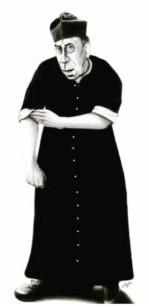
Excommunication ceremony (British Library Royal, 6 E VI f216v)
Fathers and seminarians, pay attention!
From a reader…
The Pope is sending out special priests who can absolve abortion. Does this mean that priests are giving absolution for something they cannot? Is the absolution then invalid? What does that mean for reception of sacraments until valid absolution (once one knows that’s a possibility)? Thank you, Father. I confessed a very sinful past three years ago and reformed my life but it seems it’s back to haunt me.
We have to be careful when listening to the news these days. Many things are said in a slipshod manner without the least understanding of what is truly going on.
In many dioceses, in every diocese in these United States that I’m aware of (if someone has clear and documented evidence to the contrary, I would be interested), bishops have given to priests the authority to absolve from the automatic excommunication that occurs when someone culpably completes an abortion.
If you went to confession to a Latin Church priest in good standing in these United States, and if you confessed your sins freely and without reserve, and if the priest gave you absolution, you are absolved not only from the sin of abortion, but also the automatic excommunication you may have incurred.
I say “may have” because there are many situations and circumstances that might have lessened your culpability and therefore eliminated the possibility of an automatic excommunication (for example, being bullied into it).
What has been granted to priests in every diocese of these United States (and many elsewhere), that is, the ability to lift the penalty of abortion, is being granted to these “Missionaries of Mercy” designated by the Holy Father. They may be going to places where not all priests have been given this faculty.
Another thing, above, I wrote that “if the priest gave you absolution, you are absolved not only from the sin of abortion, but also the automatic excommunication you may have incurred.” Let’s drill into this a bit more.
Sins are one thing and censures (like excommunication) are another. The absolution of a sin and the absolution of a censure are different acts. If a person comes to a confessor (a priest with proper faculties) to have a censure lifted, the confessor uses a special formula (in the Ordinary Form, “By the power granted to me, I absolve you from the bond of excommunication (or suspension or interdict). In the name of the Father…”).
However, in keeping with the law, if a penitent comes to the confessor and the penitent confesses something that incurred a censure (such as the excommunication incurred through sinfully procuring an abortion), it is enough that the priest confessor intend also to absolve from the censure when he gives absolution for sins (“I absolve you from your sins, in the name of the Father…”. If the confessor chooses, before absolving the penitent’s sins, he could separately absolve from the censure (with that form I gave above) and then, after lifting the censure, absolve from the sins (with the usual form of absolution).
So, there are two ways the confessor can handle this situation. In the case of confession of sins that incurred censures, Father can simply intend to lift the censure and pronounce just the form of absolution for sins, or he can in two distinct stages first lift the censure and then absolve the sins.
It might seem as if I am going into the weeds with these details, but some people might be nervous that they didn’t hear the priest make any reference to the excommunication when he absolved the sins. He doesn’t always have to! It can be included in the absolution of sins.
I’ve been, so far, explaining the Ordinary, post-Conciliar way of doing this. If you go to a priest confessor who uses the older, traditional formulas of absolution, this is what he says (usually in Latin). Attend to the order of elements in this form:
May Almighty God have mercy on thee, forgive thee thy sins, and bring thee to everlasting life. Amen. [A wonderful prayer…]
May the almighty and merciful Lord grant thee pardon, absolution and remission of thy sins. [Another wonderful prayer…]
[And now we get down to business…] May Our Lord Jesus Christ absolve thee, and I by His authority do absolve thee [from what?] from every bond of excommunication, or interdict (or suspension) as far as I am able and thou art needful. [And, having lifted the censure(s)…] I absolve thee from thy sins in the name of the Father and of the Son and of the Holy Ghost.
[And now a wonderful prayer…] May the Passion of Our Lord Jesus Christ, the merits of the Blessed Virgin Mary and of all the Saints, whatever good thou shalt have done or evil endured, be for thee unto the remission of thy sins, the increase of grace, and the reward of everlasting life. Amen.
As you can see, the same elements I explained above are present. The priest lifts any censures that need to be lifted to the extent that he is empowered to do by his faculties, and then he absolves the sins. According to the old form, the business about censures is always explicitly mentioned. If you don’t need any censure lifted, no harm no foul. But if you do, it is taken care of before you are absolved of your sins. The newer form accomplishes this too, but in a less explicit way unless the confessor opts for the two stage method.
In my opinion, the older form is more pastorally sensitive, in that it is always explicit in what it can accomplish.
Therefore, in my opinion, priest confessors who habitually use the newer form, once they discern that a censure they can lift has been incurred, should always use the two stage method, to make the lifting of the censure explicit for the sake of the penitent’s peace of mind.
And, Fathers, always always always use the proper formula without embellishments!
Finally…
GO TO CONFESSION!






 revueltos67 on ROME 26/10-11 – Day 36: Ultimate: “A.S. Haley: After 1. Qf4+ black has Qxf4.”