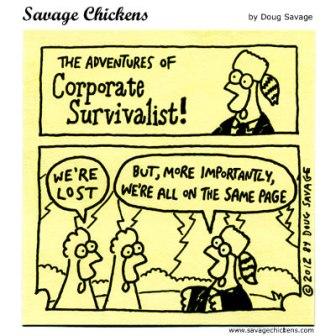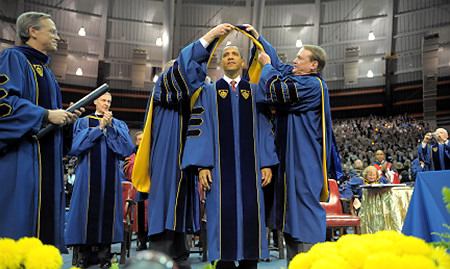
When we are detained, at least we’ll be held “on common ground”.

When we are detained, at least we'll be held "on common ground".Are you making a list of what is at stake in the upcoming presidential election cycle?

This comes from Life Site with my emphases:

Constitutional experts: pro-life ‘terrorists’ could be permanently detained without trial under law

by Ben Johnson

Wed Jan 04, 2012 11:44 EST

WASHINGTON, D.C., January 3, 2012 (LifeSiteNews.com) – Constitutional experts warn a new law that allows the president to permanently detain U.S. citizens without trial could be used against pro-life activists, who have already been defined as potential terrorists in documents by some government agencies, including the Department of Homeland Security.

“This law can apply to pro-lifers, yes,” said John W. Whitehead, a constitutional attorney and founder of The Rutherford Institute. Whitehead told LifeSiteNews.com the National Defense Authorization Act for Fiscal Year 2012 (NDAA) “would allow the military to show up at your door if you’re a ‘potential terrorist,’ and put you in military detention where seeing a lawyer is difficult.”

The NDAA, which President Barack Obama signed on December 31, allows the president to hold enemy combatants in military detention facilities without trial until the end of hostilities, if the person “substantially supported al-Qaeda, the Taliban, or associated forces that are engaged in hostilities against the United States or its coalition partners.” The law allows the president to determine which groups may be considered terrorists without judicial or congressional oversight, although Secretary of Defense is required to “regularly brief” Congress about “covered persons.”

Sen. Carl Levin, D-MI, said the Obama administration specifically asked senators for the power to permanently detain American citizens without trial and to “remove the language which says that U.S. citizens and lawful residents would not be subject to this section.”

Although Section 1022 states, “The requirement to detain a person in military custody under this section does not extend to citizens of the United States,” many contend the law allows detention as an option for Americans captured abroad. Glenn Greenwald of Salon summarized, “For foreign nationals accused of being members of Al Qaeda, military detention is mandatory; for U.S. citizens, it is optional.”

Dana Cody, president and executive director of Life Legal Defense Foundation, said pro-life activists “already are classified as domestic terrorists on some FBI lists.” She said that on one occasion the manager of a Kansas City, Kansas, abortion clinic slammed her client, Mary Ann Sause, to the ground and told the peaceful pro-life demonstrator he was photographing her license plate so he could report her to the FBI.

Cody, who told LifeSiteNews.com her organization is currently studying the NDAA, added that the law states “enemy territory is anywhere.” The Senate rejected an amendment from Dianne Feinstein limiting permanent detention to those captured “abroad.”

“If it’s within the discretion of the government under the National Defense Authorization Act, of course it will be used by the government to intimidate and silence pro-life people, especially those who are in the public forum,” Cody said.

[…]

Read the rest there.
Posted in Dogs and Fleas, Emanations from Penumbras, GO TO CONFESSION, New Evangelization, Our Catholic Identity, The Campus Telephone Pole, The Drill, The future and our choices, The Last Acceptable Prejudice | Tagged , , , , , , , , , ,
33 Comments

QUAERITUR: Joining the Polish National Catholic Church

From a reader:

Some relatives told me they were considering joining the Polish National Catholic Church. I see from what you have previously written they have valid sacraments (that’s good) but they don’t seem to be in union with our Pope in Rome (yikes!). Would their joining be the same as leaving the Roman Catholic Church for say a Protestant denominiation as in is this a sin? I doubt we could go from one to another without some spiritual ramification? Please explain very simply for me. Thanks for anything you can do.

Joining the Polish National Catholic Church (PNCC) is more dire than following priests of the SSPX. Unlike the SSPX, the PNCC is clearly in schism. To join the PNCC, especially formally, would mean abandoning the Roman Catholic Church. The person would likely incur the latae sententiae excommunication found in can. 1364.1 and could result in the eventual denial of funeral rites (can. 1184. 1.1). Mere attendance at a Mass or Masses of the PNCC would probably not rise to the level of a formal act of schism, especially if done as an ecumenical gesture, or solidarity with family. However, outside of the extreme cases mentioned in can. 844.2, a Catholic should not receive sacraments in a PNCC church.

The PNCC’s denies papal authority. The SSPX doesn’t deny it, they just don’t obey it. The PNCC does not have clerical celibacy, which is a bit quirky. Worse than than, however, the PNCC denies the dogma of original sin.

Just keep repeating “canon 1364 … can. 1184 … canon 1364 … can. 1184 … canon 1364 … can. 1184 …”.

Posted in ASK FATHER Question Box, Dogs and Fleas, Our Catholic Identity | Tagged , , , , , ,
25 Comments

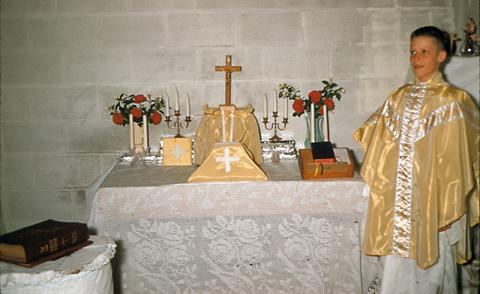
QUAERITUR: Children “playing Mass”

From a reader:

Is it ok for a child to pretend to say Mass? After reading the following post and its comments I was beginning to be concerned (HERE).
I looked it up in Canon Law and saw similar things.

Obviously it would be OK for an innocent little boy to pretend to “say Mass” in his room, but what about a boy who is older than the age of reason and already receiving the sacraments (12, 13, 14)? Obviously they will grow out of it at some point or another, but as long as they know that it isn’t real and are just playing, not actually trying to consecrate hosts, and are not trying to convince anyone that it is real (and aren’t doing it publicly, just in their room) would it be alright and not incur this “interdict” described in Canon Law? If I recall correctly, don’t you have to be at least 16 to incur an excommunication?

In my opinion, it looked like the norms were aiming for those who “celebrate” Mass publicly, trying to convince others that it is real, or, think that it is real. Is that right?

Of course the norms were not aimed at children “playing” or “pretending” to say Mass.  They are aimed at adults who scandalize the faithful and commit a sin by simulating a sacrament.

As far as the age is concerned, parents ought to be watching carefully how and what their children do at every age. If a child is getting older and starts to really think he is saying Mass, that is a deeper problem.

Also, I would discourage girls from ever doing this.  (Yes… yes… I know that under other entries some have said they did this and the world didn’t crumble into ashes.)

Bottom line: Provided everything is done with the respect and care, it is okay for little kids to “play Mass”, although … I can’t imagine it is too fun to play “Novus Ordo”.

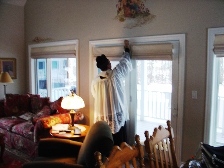
This reminded me of a photo someone sent of himself as a child playing Mass.

QUAERITUR: Children "playing Mass"

Reason #1556578 for Summorum Pontificum.

Posted in "How To..." - Practical Notes, ASK FATHER Question Box, SUMMORUM PONTIFICUM | Tagged , , , ,
44 Comments

QUAERITUR: Can the new Lectionary be used with the Extraordinary Form?

From a seminarian (edited):

Fr. Z, thanks for all you do. [My pleasure.] I have learned much from reading your blog over the last few years, and I continue to come here as a seminarian for trusted commentary on different issues.  I have a quick question which arose from a liturgy class:

Does Universae Ecclesiae Article 26 rescind previous allowances for the use of the Novus Ordo lectionary in celebrations of the Missal of 1962? I have not been able to find any clear information on this.
Thanks for your help!

Peace. Know of my prayers for you.

Again, I like to check these things with a reliable canonist. Here is a response I received:

The pertinent paragraph is Universae Ecclesiae article 28, not 26. Article 28 says that Summorum Pontificum derogates from the provisions of law that are incompatible with the rubrical books of 1962. The use of the new lectionary, suggested by Quattuor abhinc annos, would seem to be incompatible with the rubrical books of 1962. Therefore, since SP came into force, this should not be done.

That said, I would have no problem whatsoever with a priest, after having proclaimed the Epistle and Gospel prescribed for the day according to the 1962 Missal, going up to the pulpit and reading the First and Second Reading, plus the Gospel for the day from the Ordinary Form lectionary at the beginning of his homily. [Which will either make Mass longer or force a shorter sermon!] This would seem to me to be a reasonable accomodation for a busy pastor with an ambiformal (did I just coin a new word?) parish who is reluctant to come up with two homilies each weekend. Since in the 1962 rubrics, the sermon need not be tied to the scriptural readings, this would seem to be a reasonable compromise.

Well!   A reasonable compromise.

Whaddy’all think?

Would you like that sort of solution for the sermon?

Posted in "How To..." - Practical Notes, ASK FATHER Question Box, Liturgy Science Theatre 3000, SUMMORUM PONTIFICUM, Universae Ecclesiae | Tagged , , , , ,
28 Comments

Lessons for surviving in the Church

Just a few changes here and there and it describes an environment closer to the subject matter of this blog.

Lessons for surviving in the Church

Posted in Lighter fare |
3 Comments

The resignation of Bp. Zavala

The blogosphere (and my email) is full of the resignation of LA’s Auxiliary Bishop Most Rev. Gabino Zavala. I don’t have to say much about it. How very sad this all is.

I will only remind you that Bp. Zavala was President of Pax Christi, the USA Chapter of the international “Peace” Movement. In 2008 he was elected chair of the USCCB’s Communications Committee… over Bp. Finn. Bp. Zavala also presided over the closing liturgy of the Three Days of Darkness Education Conference in LA a couple years back. Who could forget those images…those tunes? (HERE)

[wp_youtube]nZ5it20gKqw[/wp_youtube]

The video of that liturgy is broken into parts. Some of them are worth reviewing.

Pray for the people of Los Angeles and for Archbp. Gomez.

Finally, Holy Church is composed of wheat and tares. It has been said that Holy Church is not a spiritual museum for saints, but a hospital for sinners. We are all sinners, every one of us. There is only one Just One.

Posted in Linking Back, The Drill | Tagged
58 Comments

QUAERITUR: Can a priest ad lib the intro to the Lord’s Prayer?

QUAERITUR: Can a priest ad lib the intro to the Lord's Prayer?Here is a serious insider-canon-ball post about something which nevertheless affects a great many people, since it deals with our liturgical worship, namely, the words by which the priest introduces the Lord’s Prayer.

In the new, corrected translation we see:

23. Then the Priest, with hands joined, says aloud:
At the Savior’s command
and formed by divine teaching,
we dare to say:

No leeway.  The priest is to say those words and not something else.  No freedom to ad lib.  We have to say the black and do the red.

Here is something (edited) I received from a priest:

Father,
I have pasted the response of the head of the Diocesan
Liturgical Commission in regards to a question I sent the commission.
I need some perspective please. Blessings and peace to you.

__________________

Here is my actual response regarding the invitation to the Lord’s
Prayer
:

It appears that the Vatican now has a preference for us to use the
intro that appears there. It’s the same one that has always been there
in Latin. HOWEVER:

The vernacular translations added others partly because of a letter
from the Congregation for Divine Worship in 1973
that said in part
this (and I highlighted the pertinent part):

“Among the possibilities for further accommodating any individual
celebration, it is important to consider the admonitions, the homily
and the general intercessions. First of all are the admonitions. These
enable the people to be drawn into a fuller understanding of the
sacred action, or any of its parts, and lead them into a true spirit
of participation. The General Instruction of the Roman Missal entrusts
the more important admonitions to the priest for preparation and use.
He may introduce the Mass to the people before the celebration begins,
during the liturgy of the word prior to the actual readings, and in
the Eucharistic prayer before the preface; he may also conclude the
entire sacred action before the dismissal. The Order of Mass provides
others as well, which are important to certain portions of the rite,
such as during the penitential rite, or before the Lord’s Prayer. By
their very nature these brief admonitions do not require that everyone
use them in the form in which they appear in the Missal. Provision can
be made in certain cases that they be adapted to some degree to the
varying circumstances of the community…”

In the view of a representative of ICEL and Vox Clara, who worked on
the translation both in Rome and here with the USCCB, and whom I
consulted about this question, the 1973 letter is still in force.

Ooookayyyy…. that doesn’t sound plausible to me.

I checked with a good canonist on this. Here is the response I received:

This letter from the CDW is most likely a general executory decree (c. 30ff), or possibly an instruction (c. 34). General Executory Decrees “do not derogate from the law” (c. 33) and “cease to have force by explicit or implicit revocation by the competent authority, and by the cessation of law for whose execution they were issued” (c. 34) Similarly, Instructions “cease to have force not only by explicit or implicit revocation by the competent authority who published them or by that authority’s superior, but also by the cessation of the law which they were designed to set out and execute.” (c. 34, 4).

I would argue that this letter from the CDW referred to the rubrics of the 1970 Missal. Where the current Missal repeats the provisions of the 1970 Missal, this letter would still have force. Since the rubrics of the current Missal do not use the phrasing “with these or similar words” for the introduction to the Lord’s prayer, I do not believe that the provisions of the ’73 letter from the CDW apply, since the item they refer to has been integrally reordered (cf. c. 20).

Whew.

Bottom line. The “liturgist” says that the rubrics in the most recent Roman Missal don’t have to be obeyed because of a letter from 1973. Wrong. The new rubrics have to be followed.

Posted in "How To..." - Practical Notes, ASK FATHER Question Box, HONORED GUESTS, Liturgy Science Theatre 3000, Mail from priests, The Drill | Tagged , ,
58 Comments

REVEREND FATHERS! Epiphany is coming: We have special blessings we can use!

Remember that you can bless Epiphany Water, and chalk, and gold, frankincense and myrrh, and houses….

Lot’s of cool Catholic stuff can be done on Epiphany!

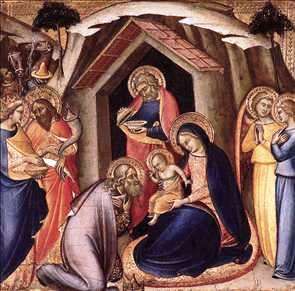
REVEREND FATHERS! Epiphany is coming: We have special blessings we can use!

Posted in Just Too Cool, Liturgy Science Theatre 3000, Our Catholic Identity, SESSIUNCULA | Tagged , , , ,
10 Comments

QUAERITUR: Is Epiphany 2012 a Holy Day of Obligation for those who attend the Extraordinary Form?

QUAERITUR: Is Epiphany 2012 a Holy Day of Obligation for those who attend the Extraordinary Form?Questions have come to my inbox about Epiphany as a Holy Day of Obligation this year.

Apparently, some zealous participants of TLMs are saying that Epiphany is a holy day of obligation and therefore the faithful are bound under pain of mortal sin to attend Mass on Friday, 6 January.

I don’t like at all, by the way, the transferal of the feast.  But I digress.

In the universal law of the Latin Church, the Solemnity of the Epiphany is a Holy Day of Obligation (can. 1246). That same law gives to conferences of bishops (with the approval of the Holy See) the right to abolish (abolere) certain holy days or transfer their observance to a Sunday.

In the United States, the bishops in November 1983 moved the observance of Epiphany to the first Sunday following January 1. This was approved by the Holy See on 13 February 1984.

In transferring Epiphany (and Corpus Christi) to a Sunday, the bishops (with the approval of the Holy See) abolished the obligation attendant to these feasts.

The faithful are already obliged to hear Holy Mass on Sundays. On “Epiphany Sunday”, there is no “double obligation.” This was confirmed on December 13, 1991 when the US conference of bishops decreed:

“In addition to Sunday, the days to be observed as holy days of obligation in the Latin Rite dioceses of the United States of America, in conformity with canon 1246, are as follows:

January 1, the solemnity of Mary, Mother of God
Thursday of the Sixth Week of Easter, the solemnity of the Ascension
August 15, the solemnity of the Assumption of the Blessed Virgin Mary
November 1, the solemnity of All Saints
December 8, the solemnity of the Immaculate Conception
December 25, the solemnity of the Nativity of Our Lord Jesus Christ

Whenever January 1, the solemnity of Mary, Mother of God, or August 15, the solemnity of the Assumption, or November 1, the solemnity of All Saints, falls on a Saturday or on a Monday, the precept to attend Mass is abrogated.”

This decree was approved by the Holy See (Prot. N. 296/84 Congregation for Bishops) on 4 July 1992.

Subsequent legislation, of which we are all sadly aware, also allowed for transferring the solemnity of the Ascension to the Seventh Sunday of Easter, similarly abolishing the obligation. BOOOOO!   But I digress.

Therefore, for Catholics in the United States, the Solemnity of the Epiphany is no longer a holy day of obligation.

In any event, those Catholics who hear Holy Mass according the Extraordinary Form may be able to find a TLM on Epiphany itself, Friday 6 January 2012.  If they can’t, however, they miss out on the rich liturgical celebration of Epiphany.  The following Sunday in the traditional calendar is the Feast of the Holy Family.  There is a lot of disparity between the older and newer calendar.  Let us not forget that the Council Fathers said that no innovations, out of keeping with our tradition should be sought.  The Council also said that changes shouldn’t be made unless they are really for the good of the people.

Nevertheless, those who prefer the Extraordinary Form should not be troubled in conscience in any way about attending Mass on 6 January under pain of mortal sin concerning an obligation.  They are under no obligation to attend Mass on 6 January, nor even to seek out an Ordinary Form Mass (using the Epiphany formulary) on Saturday evening or Sunday morning.

We may respectfully disagree with the bishops decision to alter the traditional calendar.

We may pray earnestly for a return to it.

We may enrich our liturgical and spiritual lives by hearing an a TLM on 6 January, or by hearing both an Ordinary Form and Extraordinary Form Mass on the weekend, or merely by praying the Office for Epiphany alone or with others.

We are not, however, under any obligation to do so.

We must not suggest that others are under such an obligation.

Posted in "How To..." - Practical Notes, ASK FATHER Question Box, Liturgy Science Theatre 3000, Our Catholic Identity | Tagged , ,
30 Comments

Votes matter

The results of the Iowa Caucuses were incredibly close, a virtual tie: Romney by 8 votes… .000065%.

I have friends who have opined that they may opt out of the voting process in this election cycle.

That is a really bad idea.

The stakes of the 2012 election are high.

Your votes count.

As wearisome as the process is, stay engaged with the issues and candidates.

Votes matter.

During the coverage I watched, I heard many references to the Catholic vote, the Catholic demographic in certain counties.

We need an engaged Catholic influence in shaping public opinion and at the polls.

Votes matter.

Your vote counts.

Posted in "How To..." - Practical Notes, The Drill, The future and our choices, Wherein Fr. Z Rants | Tagged , , , , ,
31 Comments