I am coming down with something, a case of the crud. I thought I might dodge it, but it seems to have me in its grip.
A prayer, please.
I am coming down with something, a case of the crud. I thought I might dodge it, but it seems to have me in its grip.
A prayer, please.
The other day a university chapel in Madrid was disrupted and profaned and vandalized.
Now comes this.
From CNA:
Historic Spanish church vandalized with satanic symbols
Almeria, Spain, Mar 11, 2011 / 05:54 pm (CNA).- A 100-year-old church under restoration in the Diocese of Almeria, Spain was vandalized with graffiti and satanic symbols the weekend of March 5.
Workers found the interior of the church vandalized with satanic drawings and graffiti on March 7. Experts said it appeared the intention was to give the impression of a satanic ceremony.
The vandalism took place after the diocese won a long-fought legal battle against a private company that wanted to turn the church into a dance club and tourist site. The diocese was waiting for an official construction permit from local officials to begin renovation.
The Church of Las Salinas de Cabo de Gata, built in 1907, has been closed for worship since 2004 due to its deteriorating structure.
[…]
Will you, with me, pray in a special way for the people of Japan? I think we would do well to offer additional penances for their intention.
Perhaps your Stations of the Cross tonight? Your Friday penance?
The great Ed Peters, Canonman, has offered on his blog In the Light of the Law some observations about the discussion of c. 915 and the Governor of New York.
But first, I ask rhetorically… how many times have I railed against the false dichotomy liberals assert between being “pastoral” and … well… faithful?
My emphases and comments.
Communion, Canon Law, and Pastoral Practice
There is a line of thought emerging in regard to the Cuomo-Communion controversy that runs as follows: “Okay, maybe Peters has a point about the canon law of this case, but c’mon, questions about individual reception of holy Communion are really matters of pastoral practice.”
You know, as if canon law and pastoral practice were two entirely different things.
Let’s think about this.
Certainly, there are many canons in the Code that scarcely impact pastoral practice. It’s difficult (not impossible, just difficult) to see a pastoral application for, say, Canon 141 on priority among successive delegees, or for Canon 707 on residence options for a retired religious bishop, or for Canon 1601 on a judge’s discretion over time limits for filing briefs in tribunal cases. No one seriously argues that the faithful are bound to recall such canons in daily life or at least to think about them during the Communion rite. [Qui bene distinguit bene docet.]
But, while many canons do not have immediate pastoral relevance, many other canons do have obvious pastoral implications, and surely the canons on the reception and administration of holy Communion count among them. Indeed, the whole purpose of Canons 915 and 916 is to direct concrete pastoral practice! [It would be hard to find a pair of canons with greater pastoral significance, given then fact that the duty of a pastor is to care for the Blessed Sacrament and for the souls of those under his care.]
Canons 915 and 916 boast aged, even ancient, nay apostolic, roots, [Perhaps Scriptural? What was it St. Paul said about Communion that was inadequately prepared?] and both norms are illuminated by copious and consistent canonical commentary reflecting many centuries’ worth of . . . . . what? . . . [INSERT ‘JEOPARDY’ MUSIC] . . pastoral practice. In other words, one cannot discuss Canons 915 and 916 without discussing pastoral practice at the same time. The two disciplines are inextricably related. And not because I say so, but because they are. [And when you are right you can’t be wrong.]
Ours is certainly not the first generation to face the serious problem of Catholics whose lifestyle is protractedly and publicly at odds with important Church teachings, nor are we the first to face rampant ridicule and accusations of hypocrisy* for holding Catholics to higher standards for their public behavior than we hold others to. It is precisely because the Church [The greatest expert on human beings there has ever been.] has such extensive experience in dealing with difficult issues that she has set down, for the guidance of pastors and faithful alike, certain norms for behavior in her Code of Canon Law, norms such as Canons 915 and 916.
Obviously, the time to think about what certain canons on pastoral practice might require of bishops and faithful is before controversy arises over them, [Imagine such a thing.] if only because, if fundamental and reasonable norms for conduct are not attended before controversy erupts in the Church, they will be most assuredly be invoked afterward. Like most good lawyers, I think it’s easier to head off problems than it is to solve them; but, like many Catholics of my generation, I think even worse than not solving, once it has arisen, a serious problem in pastoral practice (even problems that we only inherited, instead of ones we cooked-up for ourselves), is our simply leaving it to the next generation to face.
To be clear, I do not think that every pastoral question imaginable has a certain canonical answer. Nor, even in regard to those many pastoral questions that do have, at least in part, a canonical answer, do I think that those answers can be implemented overnight. Moreover, I recognize that bishops have the primary responsibility for governing the Churches entrusted to them (c. 381 et seq.). And I certainly recognize that canon lawyers have no more authority over the application of canon law in the Church than attorneys in a law firm or professors in a law school have authority over the enforcement of civil law. On all of these points, nothing I have ever written supposes otherwise.
But what canon lawyers do have is expertise and ready access to the detailed resources that are necessary to set out, accurately and clearly, exactly what the Church’s legal system says (if anything) about this topic or that, and canonists do that, or should do that, in service to the Catholic faithful who strive to live within the Church’s order and for Catholic leaders who are charged to uphold it.
If nothing else, canonists should correct, I think, any claim that canon law and pastoral practice are simply distant cousins on the Church’s family tree. “Brothers” would be much closer to the truth. + + +
* One of the just-plain-dumbest accusations of hypocrisy made against me is that I only “go after” Catholic Democratic politicians and not Catholic Republicans. Folks, if, among Americans who care at all about politics (and yes I recall enough Plato and Madison to care about politics), if, I say, there is one who cares less about political party affiliation than I do, please, introduce us!
As for those who specifically wonder where I was when Rudy Giuliani was in the news, I was right here (28 April 2008) and before that, I was here (15 March 2007). Where were you?
We were right here, guarding your back and pushing traffic your your blog. Go visit.
KUDOS to Canonman! Dr. Peters!
When it comes to the selection of bishops, finding good candidates, it is the usual practice for the Nuncio, or another figure, to send questionnaires to some priests and, I suppose, lay people, asking for input. This feedback, as well as other information, is used to create a terna, a list of three candidates sent for consideration to the Congregation for Bishops.
The Sydney Morning Herald has this story with my emphases and comments.
Vatican survey to select bishops ‘could be illegal’
Barney Zwartz
March 12, 2011A SECRET Vatican document used to research possible bishops almost certainly breaches Australian anti-discrimination laws and seems designed to ensure only the most conformist candidates can be promoted. [Getting a sense yet of the tone of this piece?]
The questionnaire, sent to trusted clergy and a few laypeople by the Pope’s ambassador, asks about the candidate’s personal qualities, orthodoxy, loyalty to the Pope, commitment to celibacy and opposition to women priests, and his public image. It asks about predisposition to hereditary illness and the family’s “condition”. [Interesting how the writer chooses to emphasize an issue of class. No?]
A workplace law expert, Andrew Stewart of Adelaide University, said most of the questions posed no problem – for example with privacy legislation – but there was “certainly a problem” in the questions on illness and family and, perhaps, appearance.
“It’s hard to see how that could be relevant to doing the job,” Professor Stewart said. [It is? Really? Is that hard? Everything matters when it comes to being a bishop in view of the hostile secular press and workplace lawyers. Also, choosing a man all of whose close relations have died from cancer might not be a good idea.]
He said the matter depended on whether a bishop was regarded as an employee or under a contract of employment. [Not the case, But they want it to be so, so that the assets of the Holy See can be attacked.]
A Greek Orthodox archbishop won a case in the High Court in 2002 that found a contract existed, but in previous cases priests have not been seen as employees.
Professor Stewart said all states had different discrimination laws and in Victoria it was illegal to discriminate on the basis of appearance. Federal law made it illegal to discriminate on the grounds that the person or an associate had a disability.
A copy of the document, marked “sub secreto pontifico” (a papal “top secret”), was given to a progressive activist group, Catholics for Ministry. [Since this is under the “pontifical secret”, that would mean that the person who leaked it should be excommunicated.]
Its spokesman Paul Collins said the document’s deficiencies were more important than usual because several bishops will retire in Australia in the next two years, including the archbishops of Brisbane, Perth and Hobart.
He said the questionnaires were used to assess candidates before the Papal Nuncio (Pope’s ambassador) presented a shortlist to the Pope.
Dr Collins said among the objectionable requirements were fidelity to the “genuine tradition of the church’‘ and ”authentic renewal” promoted by the 1960s reforming Vatican Council, which meant support for the current papal line of reversing these reforms. [Did the writer, putatively a journalist, challenge this presupposition?]
The most iniquitous requirement was adherence to the 1998 Statement of Conclusions imposed on Australian bishops. [“iniquitous”?]
“The Australian bishops were said to be far too egalitarian and laissez-faire. The views of a tiny unrepresentative group were adopted by the Curia and forced on the bishops without consultation,” Dr Collins said. [This Collins is a real piece of work.]
The present system ensured appointed bishops were conformists whose primary gaze was upwards to the Pope rather than down towards the church. Pastoral aspects took a minor place in the questionnaire. [B as in B. S as in S. “Pastoral” is used in such a sloppy manner by liberals that it has come to mean the opposite of what a pastor should actually do.]
[And now this guy lowers himself to the reductio ad Hitlerum.] “The bishops are like Hitler’s generals in that their oath of loyalty to the Pope utterly cripples them. They are unable to take any action contrary to Rome, and seem not to be interested in the local church,” Dr Collins said. [Sounds like a hysteric now.]
”There are a couple of bishops who are exceptionally courageous, but most of them follow Sir Humphrey Appleby’s advice that anything courageous is dangerous.” [The reference is to one of the funniest shows ever on TV, “Yes, Minister.”]
Father Frank Leo, the assistant to Papal Nuncio Archbishop Giuseppe Lazzarotto, first said the document was purely private so to respond would be inappropriate. In reply to the suggestion that if church was breaking the law it was not purely private, he agreed to accept questions by email, but then did not reply to emails or phone calls.
There’s journalism for you.
I don’t know if I have more contempt for
a) the writer
b) Collins
c) the nasty grass who violated the Pontifical Secret
 Not only has Vol. II of Jesus of Nazareth released, it is available.
And it has arrived.
I had the .pdf from the publisher, and now I have the book itself. A kind reader, BAH, had it sent from my wishlist when it could be pre-ordered.
You can still get it well before Holy Week!
I wrote about it here and here.
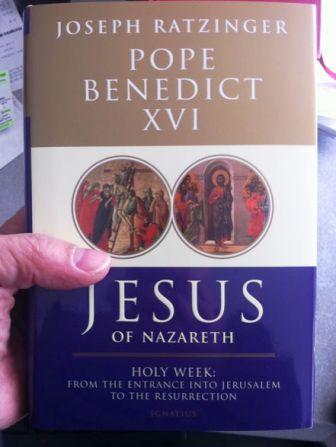
 You can click HERE or the image above to go to amazon (USA) and buy the book at a significant discount before its official release. The USA KINDLE edition is available HERE for even less than the hardback. If you don’t have a Kindle – I am really starting to like using this great tool – you can get a USA version HERE. It will work anywhere, globally. If you are in the UK or Europe, use THIS LINK for the Pope’s hardback and THIS for a Kindle, which will work everywhere. I haven’t found a link for the UK Kindle version of the Pope’s new book. BTW… you can also read the stuff you get for Kindle on your iPhone, iPad, laptop, etc., and they all synchronize.
Fr. Andrew Burnham of the Personal Ordinariate of Our Lady of Walsingham will has Lenten Reflections in the print edition of the Catholic Herald, the UK’s best Catholic weekly.
His column this week is entitled “The secular gospel is our true enemy”.
Here are a couple passages. He takes an interesting cue from texts of motets by great composers of the difficult 15th-16th centuries, Byrd, Tallis:
“The battle between the old religion and the new one is one that constantly reinvents itself. Its modern version is not Catholic versus Protestant. Christians – Catholic and Protestant – are mowadays on the same side of the battlefield. Our common enemy is the secular gospel that puts man at the centre of the universe, wealth as our main objective, and fulfilment as the central aim of our lives.”
“We may take the view – Blessed John Henry Newman certainly did – that Christian life lived outside the Catholic Church will always be overwhelmed by the priorities and values of liberal society. According to this view, the churches will eventually go along with whatever the world wants.
“The Catholic Church, thought Newman, was the only force powerful enough to take on and confront emerging secular society. But Christians of all sorts remain allies in the struggle nonetheless.”
I made this same argument when Pope Benedict was in England.
You can still get the digital edition of the Catholic Herald for a “tenner” (about US$16.00).
Keep in mind that the Pontifical Mass was to be celebrated in honor of the anniversary of the election of Pope Benedict. This year will also bring the 60th Jubilee of the Holy Father’s ordination.
FOR IMMEDIATE RELEASE:
March 9, 2011Contact: Paul King
pking@kingpllc.comWASHINGTON, DC–The Paulus Institute for the Propagation of the Sacred Liturgy regrets to announce that the Pontifical High Mass in the Extraordinary Form scheduled to be offered at the high altar of the Basilica of the National Shrine of the Immaculate Conception on April 9th is cancelled.
The Paulus Institute had organized the Lenten Mass in honor of the Holy Father on the sixth anniversary of his election to the papacy. It was to have been the second such Mass, the first having been offered at the National Shrine last year before a capacity congregation of over 4,000. Unfortunately, this year’s scheduled celebrant, Archbishop Augustine DiNoia of the Congregation for Divine Worship and the Discipline of the Sacraments in Rome, withdrew his acceptance of our invitation as a result of changed circumstances.
Although the Paulus Institute has worked for the past several weeks to proceed with the Mass in the end we were unable to obtain the necessary permission.
“We deeply regret this turn of events,” said Paul King, president of The Paulus Institute. “We are very disappointed, well aware that thousands of Catholics throughout the United States have made plans to attend. Countless others around the world would have watched and prayed with the EWTN broadcast and wanted the DVD.
“This conclusion is most unfortunate, but we are not standing still. We are looking forward to a number of activities and events for the future, both near and long term.”
The Paulus Institute offers its encouragement to those faithful new to the traditional form of the Mass and those familiar with it. As Pope Benedict has said, “what was sacred before remains sacred now.” What nourished the saints of the last thousand years still nourishes us today.
# # #
Contact: Paul N. King
President
pking@ThePaulusInstitute.orgMail: The Paulus Institute
PO Box 30172
Bethesda MD 20824
It seems the Archdiocese of Washington DC did not want the Mass to be celebrated.
I don’t, however, understand how this meshes with the somewhat independent status of the National Shrine of the Immaculate Conception.
Although this year the Mass would originally have been during Lent, and then rescheduling was attempted, this is what the Archdiocese did not permit to be repeated:
[wp_youtube]VaydRX5y0vk[/wp_youtube]
UPDATE 12 March 15:20 GMT:
I received an addendum to the Press Release from the Paulus Institute:
THE PAULUS INSTITUTE
FOR THE PROPAGATION OF THE SACRED LITURGYFOR IMMEDIATE RELEASE
CONTACT: Paul King (pking@KingPLLC.com)
MARCH 11, 2011April 9th Pontifical High Mass – addendum
WASHINGTON, DC— The Paulus Institute would like to clarify that Msgr. Walter Rossi and the Shrine are not at all responsible for the cancellation of the Apr. 9 Mass, and indeed have been very helpful.
For information about forthcoming activities of The Paulus Institute see www.paulusinstitute.org.
I would love to be at this one!
From a reader:
Just in case this hasn’t come to your notice yet. A truly historic event is due to take place at York Minster in little over a fortnight’s time. Nothing less than the first Catholic Mass celebrated at the High Altar since the reign of Queen Mary Tudor over 460 years ago!
Full details of the days events are as follows:
Saturday, 26th March.
National Pilgrimage to York in honour of St. Margaret Clitherow.
Missa Cantata (EF) in York Minster by kind permission of the Dean and Chapter. This is at 1.30pm
Music to include Byrd: Mass for 5 voices + motets Iustorum Animae, Ave Verum Corpus & Ave Regina Caelorum.
Gregorian Chant Proper of a Martyr not a virgin from the Graduale Romanum.
Followed by a procession via the Shrine of St Margaret Clitherow in the Shambles to English Martyrs Catholic Church (on Dalton Terrace) for Benediction of the Blessed Sacrament and Veneration of the relic of St Margaret starting at 4.00 PM.
Over at The Sensible Bond, which I have recommended before, there is a very strong entry about the SSPX and who gets to judge what Catholic doctrine is.
Here is something of what you can find at The Sensible Bond, [edited] and with my emphases and comments.
SSPX methodology: a question for Bishop Williamson
[…]My view is that what Bishop Williamson and the SSPX confuse are the teachings of the Catholic Church and their own theological arguments (which deploy those teachings). […] Indeed, the results of their analysis and the dogmatic premises on which they are constructed are what Bishop Williamson calls ‘Catholic Truth’. When he says that Rome must recognise Catholic Truth and be faithful to it, what he clearly implies is that since there is no questioning of the dogmatic premises on which the SSPX build their criticism of the New Mass, the edifice of their analysis is itself absolutely sound.
But this position is both logically and methodologically unstable.
i) Logically, the authorities on which I base an argument are only part of my final analysis. All the minor premises of my argument must also be sound: my observations, my interpretations of data, the way in which I categorise and conceptualise the problems I am trying to study, etc. In addition, my handling of the major premises must be sound. By way of comparison, Protestant criticism of the Church cannot be justified simply by being based on Sacred Scripture, however Sacred it is. Likewise, the traditionalists can arrive in various ways at a theological view of the New Mass, or of other issues – indeed, one must arrive at the conclusions contained potentially in one’s premises – but they are wrong to treat that view as definitive, however theologically weighty their major premises are. No Council has found the New Mass to be unCatholic; that view is the result of a theological argument. In other words, the fact I bang a big bass drum doesn’t mean there is a brass band following behind me!
ii) Methodologically, this position is also weak because the theologians who have generated it, and their elders who promote it, appear ultimately unwilling to be moderated either by the criticism of their peers (in spite of some contacts in France, are any of the SSPX’s theses being published and discussed in theological journals?) or by the judgment of the Church’s authorities. In the recent doctrinal discussions, there was no sense in which the SSPX took their position to Rome for it to be assessed. They took it to Rome to convince Rome that it was already fundamentally sound, so fundamentally sound in fact that, for the SSPX, it has become the measuring stick for Rome’s orthodoxy (or has put the SSPX in the driving seat, as Bishop Williamson says). Such a conclusion is only possible because the SSPX’s methodology has become, as it were, invisible to the minds of its experts. [Note that.]
We have a crisis in the Church and lots of grave problems. Not everyone agrees with this view, but a lot of sensible people do. The problem is, then: whose reading of the problems should be our guiding light? And which experts can we trust? In the end there is no escaping the conclusion that every expert who is not willing to have his position moderated by Rome is not in fact serving any truth but his own; in the end, it is ironic that making the pastoral Magisterium of the Hierarchy {especially that of the chief pastor} subject to the Magisterium of the Experts involves exactly the kind of modernist assumption that the SSPX has declared itself opposed to. [This is why, HERE, I wryly suggested that the SSPX and Fr. Kung had a lot in common. That proposal is absurd at first glance, but perhaps not at the third glance.] If Bishop Williamson cares about the Truth, as indeed I believe he does deeply, he must ultimately admit that there is a real distinction in re between the teachings of the Church and the results of the analyses by SSPX theologians. Sadly I see no sign of this distinction starting to dawn on him or on any of his colleagues. Let me hereby challenge him respectfully to address the argument.
Unlike a lot of people, I happen to think there is a place for Bishop Williamson and the SSPX in the mainstream, banging their big bass drums for all they are worth. They just have to realise that the percussion section cannot be a law unto itself, and that moving from a march to a waltz does not constitute the abandonment of rhythm. [Great analogy.]
This says well many of the things I have thought for a long while.
When the talks between the SSPX and Rome were going to begin, I made the observation that both parties had to come into the talks with a good attitude. While there is no question of these theological discussions being “negotiations” (“negotiations” might be right concerning juridical structures, etc.). The folks on the Roman side of the table had to be open to discuss points of the documents of Vatican II. Those on the SSPX side of the table had to give up their position that they were there to instruct Rome.
If there has been a hermeneutic of discontinuity and rupture when it comes to Vatican II towards the left (in the manner of Fr. Rahner and Fr. Kung), it is also possible to have discontinuity and rupture the other direction as well.
Like The Sensible Bond I have hoped that there would be a place within the mainstream Church for the SSPX. I have mused that it would be great to see some of these guys elected to diocesan presbyteral councils and going to deanery meetings, sitting on priests personnel boards….
I think that the theological issues which the SSPX and Rome are talking about are so difficult that, the documents of Vatican II being what they are, it is possible to cede to the SSPX a great deal of leeway. I have in mind how some followers of Fr. Feeney were reconciled with the Church concerning “no salvation outside the Church” without having to abandon their position. Issues such as “religious liberty” are even less clearly spelled out than the doctrine of “no salvation outside the Church”. Why could there not be a meeting of minds when it comes to a point like that? Of course “religious liberty” is not the only issue and that debate touches on even deeper theological questions about the theocentric/anthropocentric starting points of some of the teachings in the documents of the Council.


Coat of Arms by D Burkart
 B on Daily Rome Shot 1116: “It just gets worse and worse. The Pope needs to publicly and very clearly put a halt to these shenanigans.…”
 on Daily Rome Shot 1116: “The origin of difference and division, the pharmakos represents evil both introjected and projected. Beneficial insofar as he cures—and for…”
 on Daily Rome Shot 1116: “White to move and mate in 4 Unless I’m missing something, this would seem to fall into the too easy…” on Daily Rome Shot 1115 – Different St. Martin today: “Black to move and mate in 4 1. …Rb2+ 2. Ne2 {or Kg3,Rd2} Rxe2+ 3. Kg3 {forced} Qf4+ 4. Nxf4…”
 on Daily Rome Shot 1116: “This reminds me of something Thomas Pink said in a response to a question fromAndrew Cusak: Many European Bishops are…”
 on Continue the Rome shot posts? I dunno.: “Sometimes I wonder if people who champion for abortion have ever had anything charitable done for them in their entire…”

A Daily Prayer for Priests








They find you a pro-life agent in your area who commits to giving a portion of the fee to a pro-life group!

PLEASE subscribe via PayPal if it is useful. Zelle and Wise are better, but PayPal is convenient.
A monthly subscription donation means I have steady income I can plan on. I put you my list of benefactors for whom I pray and for whom I often say Holy Mass.
In view of the rapidly changing challenges I now face, I would like to add more $10/month subscribers. Will you please help?
For a one time donation...



Help Monks in Wyoming (coffee – UPDATED LINK) and Norcia (beer) and the wonderful "Soap Sisters" of Summit, NJ!


Please follow me on Twitter!










Visits tracked by Statcounter
since Sat., 25 Nov. 2006:


