GOP 2012 hopefuls on what they are giving up for Lent

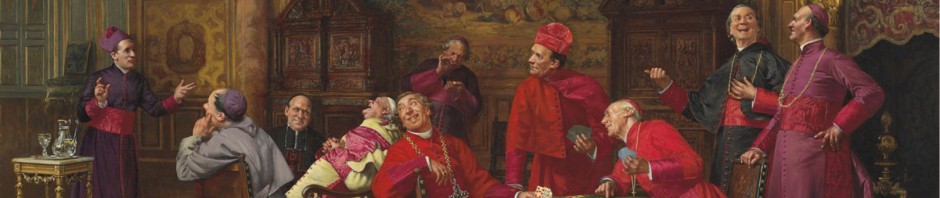
With a biretta tip to Catholic Culture o{]:¬)   I saw this in the Daily Caller:

GOP 2012 hopefuls on what they are giving up for Lent

By Chris Moody – The Daily Caller

The 40-day period of sacrifice before Easter began Wednesday, and some Republican presidential hopefuls plan to whip their way around Iowa and New Hampshire without some of the things they love most.

Catholics, Southern Baptists, Mormons, Born-again Christians and a Lutheran have floated the possibility that they’ll run against President Obama this year. Although Lent is typically a tradition for observing Catholics, The Daily Caller asked if they’re planning to give anything up. Here’s what some of them said:

Fmr. Alaska Gov. Sarah Palin (Non-denominational born-again Christian [but baptized Catholic]): “I do observe Lent, and my family and I have traditionally sacrificed something during these weeks leading up to Easter Sunday. When I was growing up, my Irish Catholic grandfather would remind me that sacrifices offered up during Lent are to be like tithing — if you advertise your ’sacrifice’ and tithe then you negate any spiritual gains. (Or maybe he’d say that because he didn’t want us to know what he gave up!)”

Palin is a protestant, but she told TheDC that her “Catholic baptism and Catechism classes have stuck with me internally.”

Fmr. Arkansas Gov. Mike Huckabee (Southern Baptist): “I think as Baptists we find it hard to give up anything, I’m trying to be a little more health-conscious, I have been less so than I should have been. So that is my primary project right now. ”  [I think that means “No.   Not giving up anything for Lent.”]

Fmr. Pennsylvania Sen. Rick Santorum (Catholic): “I have a regular routine for Lent of attending mass at least 3 times a week plus stations of the cross on Fridays. I also refrain from eating the foods I enjoy the most – all types of breads and sweets.” [I recommend confession too.]

Former House Speaker Newt Gingrich (Catholic): “Dessert,” Gingrich spokesman Rick Tyler told TheDC. [I recommend confession too.]

Radio Host Herman Cain (Southern Baptist): “He believes this is a private matter between him and GOD,” spokesman Scott Toomey said in an email. [I think that may mean “Not doing much about Lent.”] (Fair enough, but TheDC heard from a source close the campaign that Cain does have a fondness for bacon.)

Former New Mexico Gov. Gary Johnson (Raised Lutheran) : “Mr. Johnson will not be observing Lent,” a spokesman said. [There it is!]

http://dailycaller.com/2011/03/09/gop-2012-hopefuls-on-what-they-are-giving-up-for-lent/
Posted in Lighter fare | Tagged
20 Comments

RECENT POSTS OF INTEREST

RECENT POSTS OF INTERESTRecent posts of interest:

I want to send a warm thanks to those of you who have sent things via the amazon wish list.  You know who you are.  I appreciate what you do.  It gives me a boost.  Also, thanks to everyone who has made a donation with the donation button on the side bar! It really helps.

RECENT POSTS OF INTERESTFinally, don’t forget that the Carmelites in Wyoming still benefit when you refresh your coffee supply even if some of you might not be drinking coffee during Lent.  Right now they have for a limited time some coffee from Burundi (whole bean only).  I haven’t tried it but the Carmelites seem all perked up by it.  HERE.

If during Lent you are resolved to be up earlier or stay up a little later praying… well… get the hint?

Even during Lent Mystic Monk Coffee is still swell!

RECENT POSTS OF INTEREST

Posted in SESSIUNCULA |
Comments Off on RECENT POSTS OF INTEREST

QUAERITUR: Deacons and blessings with the traditional Roman Ritual

QUAERITUR: Deacons and blessings with the traditional Roman RitualFrom a deacon reader:

I very much enjoy your blog!
You have written much on the power and effectiveness of Holy Water blessed according to the old rite (which includes salt) [NB: I don’t believe I have ever written that I think Holy Water blessed with the newer rite is not actually Holy Water.  I, however, have never used newer form to “bless” Holy Water.  FWIW.]

My Question:

Can a Permanent Deacon use the old rite to bless Holy Water?
Or is that reserved for the Priest?

I know you have said a “Deacon is a Deacon is a Deacon” and I agree with you.

However, I do not know what rites/blessings are allowed for Deacons under the Extraordinary Form.

Where can I find this information?

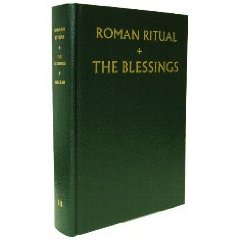
This information is found at the beginning of Titulus IX entitled De benedictionibus in the Rituale Romanum.  Here you will find the general rules.  Rule 1 says, in Weller’s translation, “Deacons and lectors may confer only those blessings which are expressly allowed them by law, in so far as both validity and liceity are concerned.”

The old rite for blessing Holy Water speaks about the sacerdos, which means bishop or priest. It does not mean deacon.   This is probably because the blessings include the exorcism of salt and of water, before they are blessed.   When you tangle with the Enemy, you want the ontological character of sacramental priesthood.  If a rare deacon would baptize in the older rite, he would use water that had been blessed already.

QUAERITUR: Deacons and blessings with the traditional Roman RitualI surmise that deacons cannot bless Holy Water with the older form, even though the newer books may let them do so (De benedictionibus 1087).  The reason why deacons can “bless” the water in the new book is because, so far as I can tell from a close reading of the Latin text, at no point does the celebrant actually bless the water.  He talks about the blessings God could give people who use it, but the rite does not actually specify that the water be blessed.   If someone can show me that I am wrong, can point to the word or gesture I am missing, I will happily be corrected.

Good luck.

The new, dreadful, De benedictionibus – let it be swept away and forgotten – changes the theology of blessings in a way hitherto unimagined.  In a nutshell, the new, post-Conciliar book eliminates – horribile scriptu – the distinction between invocative and constitutive blessings.  The “blessings” in the new book don’t really bless things in the same way that the older ritual intended to bless things.  They talk in a vague way about God’s favor on those who might walk nearby or use the thing.

So, when we talk about the new laws allowing deacons to “bless” certain things, I think we have to read the text carefully and make a decision based on the intention of the blessing.

Posted in "How To..." - Practical Notes, ASK FATHER Question Box | Tagged ,
33 Comments

WDTPRS – Thursday after Ash Wednesday – God crowns His own merits in us

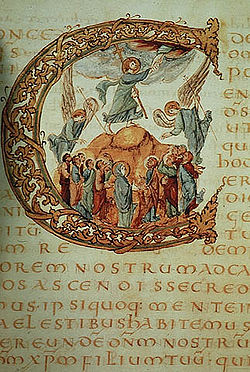
Sacramentary of Charlemagne's son Drogo c. 850

Where does today’s Collect come from? It is present in the Hadrianum and Paduense manuscripts of the so-called “Gregorian Sacramentary“.

“But Father! But Father!”, I am sure you say all the time.  “What on earth is that?”.

The Roman usage over a couple centuries had an influence on Gallican (French) practice. This blending of rites was superseded when the Emperor Charlemagne asked Pope Hadrian for a Roman Sacramentary to impose on lands under his control, for the sake of unity. So, in about 786, Hadrian produced what we know call the Sacramentarium Hadrianum a version of the sacramentary or missal used by the papal court in Rome, called the Gregorian Sacramentary. This formed the basis of the sacramentary produced for use in the Carolingian realm. As a result, our prayer today represents the very best of ancient Roman liturgical tradition. It is elegant, erudite and hand picked for use by Charlemagne in his project to create liturgical unity.

COLLECT (2002MR):
Actiones nostras, quaesumus, Domine,
aspirando praeveni et adiuvando prosequere,
ut cuncta nostra operatio a te semper incipiat,
et per te coepta finiatur.

This is elegant. Note the braiding of the words and concepts.

actio <–> operatio with both secular and liturgical overtones
adspirando praeveni <–> adiuvando prosequere
a te
<–> per te
incipiat
<–> coepta

First, do not be fooled by prosequere, which is an imperative, not an infinitive. Prosequor is deponent and means “to follow” or “to accompany”. It can also be “to follow up”. Neither is it to be confused with Italian prosecco, by the way. On the other hand, praevenio is “to come before, precede” and thus it is “anticipate”. 

Actio can refer to an “action” or, more precisely, to liturgical celebrations of the sacred mysteries. Sometimes the Eucharistic prayer is called an Actio. In a sacristy you might see a little pro memoria card framed for priests indicating the name of the local bishop so that the priest can say his name properly “infra Actionem … during the Eucharistic Prayer”. Interestingly, operatio is not simply a “work” or “labor” but also a “religious performance, service, or solemnity, a bringing of offerings”. That meshes nicely with the deeper Christian meaning of actio and gives us a hint as to how to translate this prayer with something more than just a superficial rendering.

LITERAL TRANSLATION
We beg You, O Lord, by instilling them anticipate our actions,
and by helping follow up on them,
so that our every service always begins from You,
and what was begun is brought to conclusion through You.

This subtle prayer cuts two ways. The words actio and operatio, conceptually related “doing” connected to the verbs ago and operor, both have a connotation of sacred liturgical service. At the same time, they can simply point to our own daily undertakings. These layers of meaning overlap and show us how there must be a continuity between how we participate at Holy Mass and how we act outside of the sacred precincts of the church or chapel we frequent. The highest form of active participation is the reception of Holy Communion in the state of grace following a willed, active receptivity to what has been carried out in the sacred action of the Mass.

Christ is the ACTOR par excellence in the Mass. In the actions of the priest, Christ is acting as the Head of the Body. In the actions and receptivity of the congregation, Christ is in action as the Body, responding to and being directed by the Head. Both together form Christ, Christus Totus, raising sacrifice on high to the Father. Our participation then must be first and foremost active receptivity so that we have what is good to give back to God.

The dynamic implied in active receptivity is also found in the play of the pairings of aspirando praeveni and adiuvando prosequere. God initiates every good thing in us. If we knowingly and willing cooperate with what He initiates, He Himself them brings to conclusion through us by making our hands strong enough to grasp hold of the good things He has given for us to accomplish.

Each good thing we have and do is simultaneously God’s, first and foremost, but also authentically ours. As the great St. Augustine of Hippo (+430) said, God crowns His own merits in us.

Here is some more trivia: Priests who are so inclined as to be a bit old fashioned and recite the classic “Prayers after Mass” will recognize this right away as belong to the conclusion. This prayer was used during the last Synod of Bishops focusing on the Eucharist for the beginning of the 17th General Congregation. The translation on the Vatican web site is: Inspire, we beg You, Lord, our actions and accompany them, so that all our prayers and work always begins with You and through You we have fulfillment. This prayer was also the last of those concluding the Litany of Saints in the older way of singing it, and it is sometimes translated as: “Direct, we beseech Thee, O Lord, our actions by Thy holy inspirations and carry them on by Thy gracious assistance; that every prayer and work of ours may always begin with Thee and through Thee be happily ended.” Another translation I found is: “Go before us, O Lord, we beseech Thee, in all our doings with Thy gracious inspiration, and further us with Thy continual help, that every prayer and work of ours may begin from Thee, and by Thee be duly ended.”

This is a great prayer to recite before beginning a project…. such as we are now doing with Lent!

Meanwhile…

LAME DUCK ICEL VERSION:
Lord, may everything we do
begin with your inspiration,
continue with your help,
and reach perfection under your guidance
.

NEW CORRECTED VERSION:
Prompt our actions with your inspiration, we pray, O Lord,
and further them with your constant help,
that all we do may always begin from you
and by you be brought to completion
.

Posted in LENT | Tagged
11 Comments

Say The Black – Do The Red

Say The Black - Do The RedI had this from a priest friend who is a military chaplain:

A blessed Lent “in capite jejunii” to you! I thought you might enjoy this. The Vicar General of the Archdiocese for the Military Services, in his latest letter, encouraged priests to celebrate the rites of Holy Week correctly saying, “the Sacramentary is clear about the proper form of the liturgies of the Holy Week. Please Do the Red and Read the Black.” I thought it was very encouraging. God bless you and your work!

A very wise priest.  OOH-RAH!

Posted in Just Too Cool, Mail from priests |
12 Comments

QUAERITUR: Rattlers in the sanctuary!

CrotalusFrom a reader:

Our priest and I have recently come into a point of contention. While preparing for the Triduum liturgies, he has denied the use of the crotalus on Maundy Thursday, citing that the General Instruction no longer calls for its use.

As you know, in the Gospel of Mark 16 we read about the handling of snakes.  The crotalus is a particularly festive snake, for it has a great rattle (Latin crotalum, a “rattle” or a kind of castanet). Yet… when picking it up and shaking it repeatedly it can become a little testy.  This makes for a somewhat agitated liturgy and a steady decline in the number of altar boys.

QUAERITUR: Rattlers in the sanctuary!When handling the crotalus, I suggest brushing up also on the use of liturgical beretta.
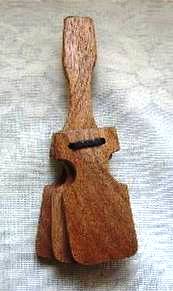
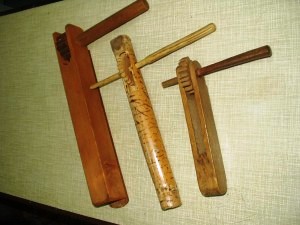
An alternative to the crotalus is the… crotalus, a hand-held gadget which has a ratchet within.  In Italian it can be known onomotpoetically as a raganella.  When rotated it makes a loud ratcheting sound.  These are a sound alternative to sometimes less cooperative snake.

QUAERITUR: Rattlers in the sanctuary!Another instrument for this purpose is a thingie with a little wooden hammer which bangs on a piece of wood mounted on a handle.  Italians call it a “tric troc”.  What that one is called in Latin, I cannot tell.
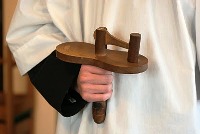
For Holy Week, the last time bells, or organ, can be rung in the Roman Rite is for the first few words of the Gloria of Holy Thursday.  After the beginning of the Gloria there should be no QUAERITUR: Rattlers in the sanctuary!bells, which produce such cheery sounds.  However, even in the older form of the Roman Rite, there is no clear indication in the rubrics that there should be some other noise-maker to substitute the bells at the elevations and during the procession.
That said, it is a strong and venerable custom that noise-maker such as the crotulus or the “tric troc”, clappers, should be used.

I cannot imagine not using some noise-maker if one is available.  The associations of the sounds with the Triduum are deeply part of the way we Catholics do things.  They set a wholly different tone during the Triduum.

It seems to me that they should always be used, whether the GIRM mentions them or not.  They are not mentioned in the rubrics of the Extraordinary Form either but.. there they are!   For centuries used widely in many cultures.   Furthermore, this would be a good and easily example of how you might foster that “mutual enrichment” desired by the Holy Father.

And there is always the liturgical beretta.

Posted in "How To..." - Practical Notes, ASK FATHER Question Box | Tagged
33 Comments

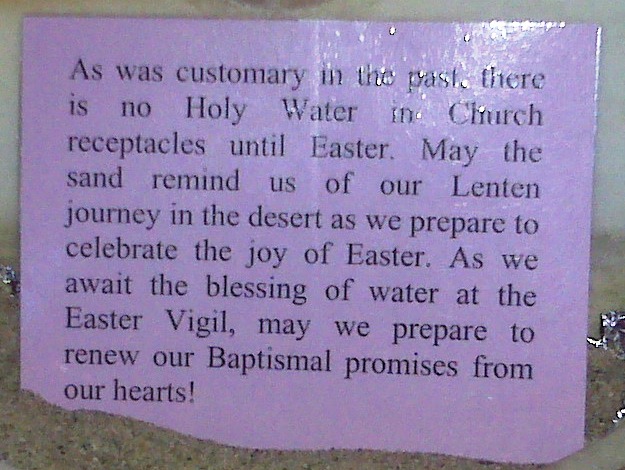
Dumb liberal idea #3464 = Reason #583739 for Summorum Pontificum: Removing Holy Water during Lent

If there are any priests out there who remove Holy Water from the stoops in church for Lent…

KNOCK IT OFF!

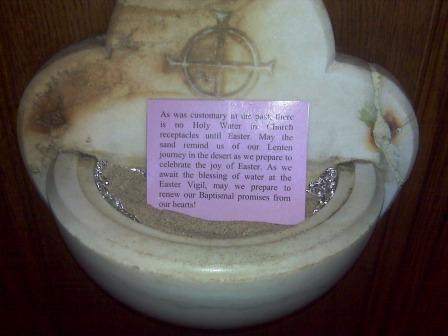
And if you, dear readers, go into a church and you see this idiocy… for the love of God, DON’T bless yourself with SAND.

Dumb liberal idea #3464 = Reason #583739 for Summorum Pontificum: Removing Holy Water during Lent

Dumb liberal idea #3464 = Reason #583739 for Summorum Pontificum: Removing Holy Water during Lent

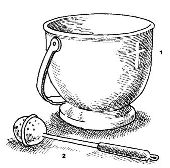
We get the powerful theology of its use in the older Rituale Romanum in the prayers for exorcism of the water and salt used and then the blessing itself.  I wrote about this in an article for the WDTPRS series and it is on this blog.

The rite of blessing holy water, in the older ritual, is powerful stuff.  It sounds odd, nearly foreign to our modern ears, especially after over 30 years of being force fed ICEL pabulum.

You are a soldier and pilgrim in a dangerous world.  What is Lent for? Spiritual discipline and war, right?

So why… why… why would these dopey liturgists and priests REMOVE a tool of spiritual warfare precisely during the season of LENT when we need it the most??

Holy Water is a power weapon of the spiritual life against the attacks of the devil.

Holy water is a sacramental.

It is not a toy, or something to be abstained from, like chocolate …. which is the stuff of a childish Lent.

Holy Water is not to be removed from fonts until after the Mass on Holy Thursday.

This is a response from the Congregation for Divine Worship and Discipline of the Sacraments about this question. Enjoy.

The emphases are mine:

Prot. N. 569/00/L

March 14, 2000

Dear Father:

This Congregation for Divine Worship has received your letter sent by fax in which you ask whether it is in accord with liturgical law to remove the Holy Water from the fonts for the duration of the season of Lent.

This Dicastery is able to respond that the removing of Holy Water from the fonts during the season of Lent is not permitted, in particular, for two reasons:

1. The liturgical legislation in force does not foresee this innovation, which in addition to being praeter legem is contrary to a balanced understanding of the season of Lent, which though truly being a season of penance, is also a season rich in the symbolism of water and baptism, constantly evoked in liturgical texts.

2. The encouragement of the Church that the faithful avail themselves frequently of the [sic] of her sacraments and sacramentals is to be understood to apply also to the season of Lent. The “fast” and “abstinence” which the faithful embrace in this season does not extend to abstaining from the sacraments or sacramentals of the Church. The practice of the Church has been to empty the Holy Water fonts on the days of the Sacred Triduum in preparation of the blessing of the water at the Easter Vigil, and it corresponds to those days on which the Eucharist is not celebrated (i.e., Good Friday and Holy Saturday).

Hoping that this resolves the question and with every good wish and kind regard, I am,

Sincerely yours in Christ,
[signed]
Mons. Mario Marini [Later, the Secretary of the Pontifical Commission Ecclesia Dei, now with God.]
Undersecretary

I suggest little beach chairs made from toothpicks and a drink umbrella would look good in there…. maybe a golf ball?

Some fast sprouting beans and a little water when no one is looking?

Dear readers:

Have sand in your fonts? How about some photos!?

Posted in "How To..." - Practical Notes, Liturgy Science Theatre 3000 | Tagged , ,
81 Comments

ASH WEDNESDAY (2002MR) – NEW! PRAYER OVER THE PEOPLE!

I was delighted that in the 2002 Missale the tradition of the “Prayer over the people” was revived in Lent.  This is an important custom.

Now that we have the new, corrected translation on the way, we can look at these prayers.

The origin of the Oratio super populum is complex and hard to pin down.  Turning to Fr. Joseph A. Jungmann’s monumental two volume The Mass of the Roman Rite: Its Origins and Development we find a history of this prayer at the beginning of the section concerning the close of the Mass (II, pp. 427ff).

Something Jungmann emphasizes that caught my attention is the fact that we are at a “frontier” moment, the threshold of the sacred precinct of the church and the world.  When properly formed we want the influence of our intimate contact with the divine to carry over into the outside world.

The use of this prayer is very ancient, found in both the Eastern liturgies of Syria and Egypt and in the West.

Unlike the Postcommunio, the object of the prayer is not “us”.  Instead, the priest prayers for and over the people, not including himself as he does in the prayer after Communion.

By the time of Pope Gregory the Great this was only in the Lenten season, probably because this is perceived to be a time of greater spiritual combat requiring more blessings.  Indeed it was extremely important for those who were not receiving Holy Communion, as was the case of those doing public penance before the Church, the ordo poenitentium.

How important was this prayer to the Romans?  In 545, when Pope Vigilius (537-55) was conducting the station Mass at St. Cecilia in Trastevere, troops of the pro-Monophysite Byzantine Emperor Justinian arrived after Communion to take the Pope into custody and conduct him to Constantinople.  The people followed them to the ship and demanded “ut orationem ab eo acciperent… the they should receive the blessing prayer from him”.  The Pope recited it, the people said “Amen” and off went Vigilius who would return to Rome only after his death.

ORATIO SUPER POPULUM:
Super inclinantes se tuae maiestati, Deus,
spiritum compunctionis propitius effunde,
ut praemia paenitentibus repromissa
misericorditer consequi mereantur.

SLAVISHLY LITERAL VERSION:
Gratiously pour out, O God, a spirit of remorse
upon those bowing themselves to Your majesty,
so that they may merit mercifully to obtain
the rewards promised to penitents
.

NEW, CORRECTED VERSION:
For the dismissal, the Priest stands facing the people and, extending his hands over them,
says this prayer:

Pour out a spirit of compunction, O God,
on those who bow before your majesty,
and by your mercy may they merit the rewards you promise
to those who do penance.
Through Christ our Lord
.

As we begin our lenten observance, like a soldier on the march, on a mission from your great Captain, be sure you have your objectives clearly defined. Get clear in your head whatever strategies and tactics will win for you your prize.

REMEMBER!  Daily LENTCAzT!

Posted in SESSIUNCULA |
9 Comments

WDTPRS – Ash Wednesday (2002MR) – BATTLE!

The Roman Station for Ash Wednesday is Santa Sabina on the Aventine Hill.

The Collect in the 2002 Missale Romanum, is an ancient prayer found in the Gelasian Sacramentary for the Vigil of Pentecost.

It is also among the prayers for the 4th day of the 4th month, which more than likely involved the traditional fast of the fourth month (there were fasts in the 4th, 7th and 10th months).  This prayer is in the so-called Veronese Sacramentary under the title In ieiunio quarti mensis.

This prayer was in the 1962 Missale Romanum but at the end of the section for the blessing of and imposition of ashes, before the Introit of the Mass itself.

Let’s see what the prayer really says.

COLLECT:
Concede nobis, Domine, praesidia militiae christianae
sanctis inchoare ieiuniis,
ut, contra spiritales nequitias pugnaturi,
continentiae muniamur auxiliis.

Praesidium has a military connotation.  It means fundamentally “defense, protection, help, aid, assistance” and thus it refers to “soldiers who are to serve as a guard”.  Thus, by extension, it comes to mean “any place occupied by troops, as a hill, a camp, etc.; a post, station, entrenchment, fortification, camp”.  Munio is equally military: “to build a wall around, to defend with a wall, to fortify, defend, protect, secure, put in a state of defense”.  As you can imagine pugno, “to combat, give battle, engage, contend”, is a military term.  Are you getting the picture?  Of course auxillium means “help, aid, assistance, support, succor”, but when in the plural it is also “auxiliary troops, auxiliaries (mostly composed of allies and light-armed troops; hence opposed to the legions)”.  Then there is militia, which is “military service, warfare, war” and also specifically in the genitive militiae “in military service, or on a campaign, in the field”.

LITERAL TRANSLATION:
Grant us, O Lord, to commence the defenses of the Christian field campaign by means of holy fasts,
so that, we who are about to do battle against spiritual negligences,
may be fortified by the support of continence.

This is a mighty prayer.

Several things come to mind.

First, most of us when we were confirmed were reminded in some way that we are soldiers in this pilgrim Church.  We must be ready to suffer for the Faith.

Militaristic imagery informs much of the history of Christian spirituality.

Next, while we are soldiers we are on the march, pilgrim soldiers.  We are on campaign.  When the Roman legions were on the march, they would build a fortified camp when they halted.  They took no chances.  We are on the march in a vale of tears where anything and everything can happen to us and around us.

Thirdly, when we make mistakes, the results can be deadly.  The word nequitia means “bad quality, badness” but that is because it is “bad moral quality, of all degrees, idleness, negligence, worthlessness, vileness”.  It usually refers to a lack of attention that duty and prudence require, resulting in negative consequences.  Moreover, the virtue of continence is described with the same word used to describe the auxiliary troops that supported the legion’s regulars.  While it could simply refer to “abstinence”, continence is the virtue which restrains the will from consenting to strong impulses of sexual desire.  So, this prayer could have a special focus.

CORRECTED ICEL:
Grant, O Lord, that we may begin with holy fasting
this campaign of Christian service,
so that, as we take up battle against spiritual evils,
we may be armed with weapons of self-restraint
.

LAME-DUCK ICEL:
Father in Heaven,
Protect us in our struggle against evil.
As we begin the discipline of Lent,
make this season holy by our self-denial
.

Posted in LENT |
4 Comments

QUAERITUR: Can religious read their Office with the older books?

From a religious:

When the motu proprio came out in 2007, it gave permission for clerics to use the older breviary to fulfill their obligation. I belong to the OCDS and many of our members wondered if we could pray the older form of the breviary to fulfill our obligation (Morning and Evening Prayer). We inquired with the provincial delegate but he didn’t seem to understand the motu proprio and couldn’t give a clear answer. What do you think?

As you mentioned:

SP Art. 9 § 3. It is lawful for clerics in holy orders to use even the Roman Breviary promulgated by Blessed John XXIII in 1962.

There is nothing ambiguous about that.  If you are a cleric, and you use the older form of the Office, you fulfill your obligation.  That applies to the Roman Breviary.  I suppose it would apply to the Office for religious orders if they have a proper form.

Also,

Art. 3  If Communities of Institutes of Consecrated Life and of Societies of Apostolic Life of either pontifical or diocesan right which in conventual celebration or celebration of the “community” in their own oratories desire to have celebration of Holy Mass according to the edition of the Missale Romanum promulgated in 1962, this is licit for them. If  an individual community or the whole Institute or Society wants to put into effect such celebrations often or habitually or permanently, the matter is to be determined by the Major Superiors according to the norm of law and the particular laws and statutes.

If this is the case for Mass, why would it not be the case for the Office?

If you want a better answer, you might apply to the Pontifical Commission “Ecclesia Dei”.

Also, I will now invite members of religious orders who may have some experience with this question to sort things out.

Posted in "How To..." - Practical Notes, ASK FATHER Question Box, SUMMORUM PONTIFICUM | Tagged , , ,
7 Comments