ASK FATHER: Priests who do not believe in the Real Presence

Mass_ConsecrationFrom a reader…

It is my understanding that the priest’s intention to consecrate is necessary for transubstantiation to take place. I know that there are Catholic priests out there that do not believe in the Real Presence. If the celebrating priest does not believe he CAN confect the Eucharist, is it possible that he therefore doesn’t INTEND to consecrate, even if he says the correct formula? How can he intend what, to him, is impossible?

Second question:
If a priest intends to consecrate the loaf of bread back in the rectory during the mass, does it happen? I’m wondering if a priest who lost his faith or had malice in his heart towards God for some reason, could he consecrate a whole pita bread factory (assuming that is valid matter) out of malice for the Eucharist?

“I know that there are Catholic priests out there that do not believe in the Real Presence…”

Responding to this sort of speculation is difficult. This line of inquiry is usually unhelpful. Speculative curiosity about hypothetic situations can lead to meditation and contemplative prayer, but it can also lead to a idleness and gossip that is antithetical to the Christian life.

Yes, there may be priests who do not believe in the Real Presence. Yes, of the 400,000 + ordained men currently alive, there are probably some who are horrific sinners of dissipate faith, dissolute life, and dispassionate evil. We should pray for them.

Imagine the horrors of hell.   Then multiply that a hundred fold for a priest who goes to hell.

Imagine, particularly, the pain experienced by a priest who loses faith in the Blessed Sacrament and then dies.

After death, he no longer has need of faith. He has knowledge. He knows, in a manner more full and more acute than the holiest of mystics alive today knows, the reality and profundity of the Eucharist which he once held in his hands.  Now he is for all eternity shut off from the blissful sight of that marvelous gift.

How he must scream in agony.

We should pray for all priests, but especially for priests who have doubts or who have lost their faith and lost their way.

There are multiple stories of perfidious priests and the Eucharist. There is the sad tale of Father Charles Chiniquy, who clashed with the bishop of Chicago in the 1850’s and ended up being suspended and excommunicated for his intransigence. (It’s not good to die excommunicated.) He became a fanatical Protestant who wrote books against the Catholic Church and created horrible lies about the Church’s supposed involvement in the assassination of Lincoln. He, according to some rumors, upon receiving notice of his excommunication, walked out in the street in Chicago and saw a passing bread truck and pronounced the words of consecration over it. The story, as it is told, is full of holes. Other versions of this faux legend surface every few years but there is no proof that it happened.

Were it to happen, woe betide the priest who did it. Suffice it to say that were something like this to happen, the priest would be in a world of eternal hurt in the afterlife.

Happier are the stories of priests who doubted the reality of the Eucharist but became convinced because of an interior or exterior Eucharistic miracle. Consider the miracle of Lanciano, where are kept to this day a monstrance holding the remnants of a Host which was shown to be real flesh and a chalice containing globules of coagulated blood, some thirteen centuries after the miracle took place.

The Holy Spirit is with the Church until the end of time, guiding Her and guarding Her from error. Despite the sinfulness of priests and their perfidious actions (along with the perfidy of laity as well!), Holy Church will continue to provide the real sacraments to the world. That is all we really need to know.
Posted in "How To..." - Practical Notes, ASK FATHER Question Box, Liturgy Science Theatre 3000, Mail from priests | Tagged , ,
29 Comments

Wyoming Catholic College – Missae Solemnes!

There was a fine event at one of my favorite places in these USA, Wyoming Catholic College, located in the burgeoning metropolis of Lander, WY.

As you may recall, WCC is the only school around where students can’t have a cellphone but can have gun.

They have Horsemanship Instructors on the faculty.

They are fortunate enough to have Prof. Nancy Llewellyn there for Latin!

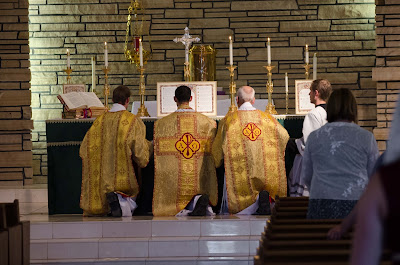
Prof. Peter Kwasniewski has a piece at NLM with photos of Solemn Masses recently celebrated at Holy Rosary parish in WCC, which serves as the chapel of the college.  They had a visiting priest around, which made it possible to have the Missa Solemnis.  If I ever get there again, I hope we might be able to do the same.

Check out the photos.

Here is a sample:

Wyoming Catholic College has great curriculum as well as fine programs during the summer.  My one brief visit left me deeply impressed with the students.

Finally, check out this book by Peter Kwasniewski:

Resurgent in the Midst of Crisis: Sacred Liturgy, the Traditional Latin Mass, and Renewal in the Church  UK link HERE

He also has A Missal for Young Catholics

Also, I recently received another book – from one of you readers – with an intro by PK.  It was briefly out of print.  It must have sold like wildfire.  It is now available again.

Finally in English… The Memoirs of Louis Bouyer: From Youth and Conversion to Vatican II, the Liturgical Reform, and After

15_08_18_Bouyer


I have this on my table in my short, priority stack.

Posted in Brick by Brick, Just Too Cool, SUMMORUM PONTIFICUM | Tagged , ,
9 Comments

Catholic Colleges and Big Business Abortion – Planned Parenthood

I direct the readership’s attention to The Cardinal Newman Society‘s report A More Scandalous Relationship: Catholic Colleges and Planned Parenthood

The CNS has a feed on my side bar.  Watch it daily.

Also, at Crisis see the article on Catholic Colleges and Planned Parenthood: New Proof of Collusion


Posted in Emanations from Penumbras | Tagged , ,
9 Comments

What to do if – when – there are no hosts for Mass?

Premium Quality Cast Iron Corn Grinder For Wheat Grains

Did you see this?

I want you to get your heads into a mental place where, in an economic collapse or some other kind of catastrophic situation, wheat flour and wine are scarce.

Sometimes when I write in a dystopian way about SHTF situations I mention that it would not be a bad idea to stockpile hosts and wine.

Remember: Things always happen to someone else, until they happen to you.

From CNA:

Shortages in Venezuela mean priests are running out of Hosts

Caracas, Venezuela, Aug 15, 2015 / 03:33 pm (CNA/EWTN News).- Venezuela’s ongoing economic crisis has hit the Church in a unique way: the production of Hosts fell 60 percent during the past month, affecting three states in the South American country.

Giovanni Luisio Mass, prior of the Order of Poor Knights of Christ of the Temple of Jerusalem, explained to local media that the shortage of unleavened wheat flour needed to make Hosts has been acute for a month now.

According to Caracol TV, the monthly production of Hosts has dropped from 80,000 to 30,000. This drop, Mass indicated, has affected every parish in three Venezuelan states. He added that they can only send 1,500 Hosts to the parishes in the north of the country, because there is no longer enough flour to make the 8,000 they have always needed.

Several parishes, along with the local communities, have organized to search for the wheat flour needed for the Hosts.

Venezuela is dealing with shortages including food, toilet paper, medicines, auto parts, chocolate, oil, and clothes irons. [If the democrats make any more gains for their agenda, this will be our future.] According to the Central Bank of Venezuela, food prices went up 92 percent last year, and during the last ten years inflation has risen 1,250 percent.

According to the Colombian newspaper El Tiempo, since 2003 the Venezuelan government has imposed price controls on 165 products, including cooking oil, soap, milk, flour, cereals, toilet paper , cleaning products, detergent, diapers, toothpaste, and sugar. The local currency has plummeted in value.

As a result, price-controlled commodities are affordable, but disappear from shelves in no time, often to be resold on the black market at market rates. And the good that are not price-controlled, are unafforable because of the devalued currency.

The government has also instituted policies to control sales, such as distributing tickets for the purpose of taking turns at the supermarkets, and placing digital fingerprint readers in the stores to prevent people from exceeding the allotted amount of products they could buy. [Perhaps signs or implanted chips in the forehead or hand?]

According to the BBC, every day Venezuelans have to form long lines at the supermarkets, but often they do not find the products they need and have to get in another line.

On average, a Venezuelan spends five hours a week shopping. The BBC quoted the Venezuelan polling company Datanálisis that said that in 80 percent of the supermarkets there is a shortage of basic goods. Consequently the black market, where the price is four times higher, has grown, and 65 percent of the people in lines outside the supermarkets are people who will resell what they buy.

Will we be out on the edges of fields picking up the pe’ah?  Will we be gleaning just to make Mass hosts?

It would be worth it.

Not to be flippant, such a scenario could help us reduce the number of people who go to Holy Communion thoughtlessly or in the state of sin.

As I write, I have in my mind’s eye the painting of The Gleaners by Jean-François Millet at the Musée d’Orsay in Paris. It’s realistic details and the size of the painting drive home the plight of the poor workers, toiling to salvage what is left on the edge of the fields. In the background, you see abundance harvested. There is also the ominous figure of a foreman on horseback.

SO001003My home parish in St. Paul has maintained – to my knowledge – the practice of making their own hosts!  Ladies would gather in the rectory basement and fire up the host irons.  It was rather wonderful to use hosts made right there. I like to back communities of nuns who make hosts (like this one HERE), but this could be a good back up option:

  • a grinder for unmilled wheat,
  • sealed cans of flour
  • and host irons.

These parish made hosts tend to be affected quite a bit by ambient humidity and aridity.  You have to be careful with particles.  A ciborium will often have quite a few fragments at the bottom.  Father has to watch carefully while distributing and also keep an eye on the paten, which must be used with great attention.

But… in the face of hosts or no hosts….  easy decision.

Posted in "How To..." - Practical Notes, Global Killer Asteroid Questions, Liturgy Science Theatre 3000, Semper Paratus, Si vis pacem para bellum!, TEOTWAWKI, The Coming Storm, The future and our choices | Tagged , , , ,
46 Comments

ASK FATHER: Latin Instituted Acolytes in Eastern liturgies

From a reader…

QUAERITUR:

I have two Questions concerning the liturgical role of instituted acolytes in the Eastern Rites:

1) May a man who has been instituted as an acolyte according to the ordinary form of the Roman Rite vest and act as a subdeacon in an Eastern Rite Liturgy?

2) Would an instituted acolyte be considered as already having been ordained as a subdeacon in the Eastern Rite Churches or would he have to be ordained a subdeacon in the Eastern Rite before he could function as a subdeacon in the Divine Liturgy?

I asked a priest friend about this, who in turn did some consultation.  Team work!

This is what I received:

I consulted a knowledgeable Eastern friend of mine, Adam DeVille. Adam says, “Usually, yes, though there is nothing formal about this and it would likely depend almost entirely on the discretion of the pastor/main celebrant. Likely, however, he would not in fact vest as a subdeacon (with an orarion or “stole”) but as a simple acolyte (sticharion/dalmatic and no orarion), but even here there would be some variation – Greeks regularly dress up 6-year-old altar boys in the same two vestments as ordained adult subdeacons!
Since 1972, in the Ordinary Form of the Roman Rite, acolytes are no longer ordained, but rather “instituted.” Therefore, a Latin man, who has been instituted as an acolyte, who then transfers to an Eastern ritual Church and seeks holy orders, would have to be ordained in that ritual Church to the minor orders.

If a Latin man had received ordination to the minor orders, in one of the religious communities entrusted to the Ecclesia Dei commission, for example, he would not have to be re-ordained in those orders in the Eastern Church.

All these, and many more questions are answered in a forthcoming book, The Oxford Handbook of Sacramental Theology, particularly the chapter on the Sacrament of Orders by Adam DeVille.

Posted in "How To..." - Practical Notes, ASK FATHER Question Box, Both Lungs, Liturgy Science Theatre 3000, Seminarians and Seminaries | Tagged , , , ,
4 Comments

COMING SOON! The Eleven Cardinals Book and The Ten Africans Book!

The other day I wrote about two upcoming books.  The “sequel” to the Five Cardinals Book™ is coming.  HERE

The Eleven Cardinals Book™ is on its way.

Eleven Cardinals Speak On Marriage and the Family

Eleven Cardinals Book

Edited by Winfried Aymans the Eleven Cardinals Book is slated for release on 25 September (in advance of the Synod on the Family).  For more on the Cardinals, HERE.  The publisher is – who else? – Ignatius Press!

This book has as its focus merciful pastoral ministry to those who are in challenging marriage situations.  It will address marriage preparation, evangelization and conversion, the situation of the divorced and civilly remarried.

Next… slated for release on 28 September (in advance of the Synod on the Family), also from Ignatius Press (who else?)…

Christ’s New Homeland – Africa: A contribution to the Synod on the Family

This is the Ten Africans Book™!

Christs New Homeland Africa

Ten African cardinals and bishops wrote essays about the attitudes of Africans about marriage and the family.   The indomitable Francis Card. Arinze wrote the preface.

Among the cardinals and bishops are

Card. Sarah
Card. Arinze
Card. Tumi
Card. Sarr
Arcbp. Kleda

There will be Kindle versions of both.

Get a Kindle now, if you don’t have one already.  USA HERE – UK HERE

Watch for links on this blog!

Posted in One Man & One Woman, Our Catholic Identity, Synod, The Campus Telephone Pole, The Coming Storm | Tagged , ,
3 Comments

ASK FATHER: Novus Ordo formula for Communion during TLM?

From a reader…

QUAERITUR:

I was told by a reverent, well-formed priest who celebrates the old Mass well and often that the formula for distribution for communion is not specified in the missal.  [Ooops!]

He showed me that in the altar missal itself, there IS no ritual for distribution of communion to the faithful and said that when it became common practice for people to receive communion during Mass the rite from the Ritual was adapted, some using the same formula the priest uses himself, and some using the response “Corpus Christi” which appears in the old Rituale as well as the new rite.  [Ooops!  No.]

It is therefore “perfectly correct”, he says, to say “Corpus Christi” when distributing communion in the old Mass. [No. Sorry.]

Is he correct? Or is there some sort of rubric or governing legislation specifying what the priest should say to communicants?

Father is to be commended for celebrating the Extraordinary Form often!  I hope that often is public and growing in frequency.

That said…

No and Yes.

Father, God bless him, is not correct on this point.  There are rubrics that govern this in the 1962 Missale Romanum.

The manner of distribution of Holy Communion in the Extraordinary Form is described in the 1962 Missale Romanum.  Look in the front sections (the rubrics and calendar and so forth), in the section called “The Rite to be observed in the celebration of Mass”, the Ritus servandus in celebratione Missae, X, 6.  The formula Corpus Domini nostri… etc. is to be spoken for each (unicuique) communicant. Here is the text with my emphases.

6 Si qui sunt communicandi in Missa, …. […. Skipping up to the point where Communion is distributed….] Quibus verbis tertio repetitis, accedit ad eorum dexteram, hoc est, ad latus Epistolae, [NB] et unicuique porrigit Sacramentum faciens cum eo signum crucis super Pyxidem vel Patenam, et simul dicens: Corpus Domini nostri Jesu Christi custodiat animam tuam in vitam aeternam. Amen. Omnibus communicatis, revertitur ad Altare, nihil dicens: et non dat eis benedictionem, quia illam daturus est in fine Missae. Si particulae positae erant super Corporale, extergit illud cum Patena, et si qua in eo fuerint fragmenta, in Calicem immittit. Deinde dicit secreto: Quod ore sumpsimus, Domine, etc., et se purificat, dicens: Corpus tuum, Domine, quod sumpsi, etc., et alia facit ut supra. Minister autem dextera manu tenens vas cum vino et aqua, sinistra vero mappulam, aliquanto post Sacerdotem eis porrigit purificationem, et mappulam ad os abstergendum.

Take note of uniquique.  This is dative of unusquisque (unus + quisque – both elements are declined), meaning “to each one/communicant”.

“… and to each one he presents the Sacrament making with It the sign of the Cross over the ciborium or paten, also saying at the same time: Corpus Domini nostri Jesu Christi custodiat animam tuam in vitam aeternam.”

Here is a shot from my hand 1962 Missale Romanum.  Note that we have a reversal of red and black for rubrics and texts to be spoken!  In this case, Father, Say The Red – Do The Black!

IMG_7774


Father is correct that in the Ordinary of the Mass in the Missale Romanum the manner of Communion for the faithful isn’t described.  But it is in the Ritus servandus!

It is also correct that the method of distribution of Communion to the faithful, perceived as a separate rite, in its own right as it were, was incorporated in the rites of Holy Mass.  There is a separate rite for distribution of Communion outside of Mass, found in the Rituale Romanum.  This is useful for when, for example, the choir could not come down for Communion during Communion time in the Mass, but they would like to receive.  After Mass they come to the rail and Father (or a deacon) can give them Communion using the rite in the Rituale.

Therefore, Father should correct his practice right away.  The whole form is to be spoken for each communicant.

Posted in "How To..." - Practical Notes, ASK FATHER Question Box, Liturgy Science Theatre 3000, Mail from priests, SUMMORUM PONTIFICUM, Universae Ecclesiae | Tagged , , , , ,
12 Comments

The importance – and legitimacy – of ‘ ad orientem ‘ worship

I bring to the readership’s attention a letter that was issued by His Eminence Robert Card. Sarah, Prefect of the Congregation for divine Worship and Discipline of the Sacraments.  A priest friend reminded me of this letter in an email.

It has a couple great points which all of you should know.

Adoremus Bulletin has a translation HERE
Catholic World Report has a translation HERE
Corpus Christi Watershed has a translations side-by-side with the Italian HERE

One of the most important things in the letter is His Eminence’s support of ad orientem worship for Holy Mass.

The Prefect wrote:

Contrary to what has sometimes been maintained, it is in full conformity with the conciliar Constitution—indeed, it is entirely fitting—for everyone, priest and congregation, to turn together to the East during the penitential rite, the singing of the Gloria, the orations, and the Eucharistic prayer, in order to express the desire to participate in the work of worship and redemption accomplished by Christ. This practice could well be established in cathedrals, where liturgical life must be exemplary (cf. §41).

There are no documents which require that the main ad orientem altar of a church be destroyed or that a table be set up in front of it.  As a matter of fact, if the main altar is of note and is clearly the focus of the church and sanctuary, it is absurd and theologically confused to set up a separate altar.

We should all be ready with reasons why ad orientem worship should be reintroduced.

To get up to speed on catechesis you might start by listening to some PODCAzTs (esp. #37, #43, #48, I made about the altar and ad orientem worship.

Every priest needs to have at least these three resources.  Fathers, if you don’t have these books, buy them now with these links.  Readers, get these books.  Start reading groups to study them.  Be the maquis!

Klaus Gamber’s The Reform of the Roman Liturgy.

Michael Lang’s Turning Towards the Lord.

Joseph Ratzinger The Spirit of the Liturgy.


Klaus Gamber thought that the single most damaging change to our Catholic worship and identity after the Council was the switching around of altars.  Surely he was right.

You will also need some clarity about the infamously mistranslated GIRM 299 on the orientation of the altar.  HERE

Good, serious priests, concerned about their flocks and how they are shaped by our all-important sacred worship are making the choice to celebrate Holy Mass ad orientem.   (For example HERE.) Some of them take a lot of heat for it.  Some of them even endure persecution from other priests and even – horribile scriptu – their bishops!  Bishops should be the first to celebrate ad orientem and teach their priests about the value of ad orientem worship.  Of course that means that they will have to, in many cases, learn it themselves and then be willing to feel the heat from liberals who prefer liturgy to be horizontal and closed in on themselves.

These priests need support.  Others need careful, respectful and prudent urging to come around themselves.

Ad orientem!  It just makes sense!


Posted in "How To..." - Practical Notes, Be The Maquis, Decorum, Hard-Identity Catholicism, Liturgy Science Theatre 3000, Mail from priests | Tagged , , , , ,
24 Comments

Instructional Video: How To Argue Like A Liberal

From the amusing folks at Lutheran Satire:

YouTube thumbnailYouTube icon

Posted in Liberals, Lighter fare | Tagged ,
4 Comments

ASK FATHER: Can I send my kids to an SSPX school?

sspx-busFrom a reader…

We live near a private school run by the SSPX. I have no doubt the school eschews educational fads and gives a solid, faith-based education, and because of that it, along with the oddly sectarian-like community around it, seem to be thriving. I’m wondering about the canonical allowability (and general wisdom) of sending our children to this school. One of them already attends an evangelical Protestant school and two others are in the public system; I hardly think the SSPX folks would be any more dangerous as teachers than the Protestants and pagans already teaching my children, although I realise that these other teachers don’t necessarily have as much of an axe to grind about Rome. I’m also wondering about the canonical status of attending their Mass – is it permissible even to attend? Would it be necessary to refrain from Communion?

All things being equal, it is wise to give a wide berth to those groups which are not in unimpaired communion with the Bishop of Rome.

However, as you know, all things are not equal these days. Alas, we live in a time when having “Catholic” on the school or the parish’s sign is no guarantee of sound doctrine.

If one had the option of a solid school, staffed and operated by the Priestly Society of St. Pius X and a solid school, staffed and operated by the Priestly Fraternity of St. Peter, there would be no question of an obligation to support and send one’s children to the FSSP school.

Parents now have to make some very difficult choices.

The fact that the local parish has a school is no longer a guarantee that it’s a school where little Barney and Beatrix will get a solid education and good formation in the Faith. Parents have a serious obligation to educate their children in the Faith.  This is even spelled out in canon law. Canon 226 states, in part,

“parents have the most serious obligation and right to educate their children. It is therefore primarily the responsibility of Christian parents to ensure the Christian education of their children in accordance with the teaching of the Church.”

If solid, Catholic schools in full communion with the Bishop of Rome are not available, then parents must do their utmost to supplement their children’s education in the Faith.

But remember… parents are the FIRST educators of their children!  They must know the Faith so they can hand it on regardless of how solid their parish or school.  Parishes and schools are NOT SUBSTITUTES for the instruction that parents must give.

That said…

It may be that sending one’s children to a Protestant school, which provides good moral training, decent scripture study, and quality overall education, might be an option for some parents, [Since I posted this, I must revised.  Canonist Ed Peters added in the combox the sobering can. 1366: “Parents or those who take the place of parents who hand over their children to be baptized or educated in a non-Catholic religion are to be punished with a censure or other just penalty.”  I suspect that this canon is hardly ever applied.  I had forgotten about it, frankly.] who will then have to take the extra time to teach their children the Catholic dimension they will miss.  They would need to correct Protestant heresies and errors.  They would probably have the difficult task of teaching their children to respect their teachers, but not believe everything those same teachers tell them.  Not a good scenario.

Other parents could choose a public school. They must then shoulder the entire responsibility of teaching the Faith to their kids.

Others may choose a school operated by the Society of St. Pius X.  These parents will also have to supplement their children’s education in the Faith to stress the importance of fidelity to the Bishop of Rome and obedience to proper ecclesiastical authority.  They will have to teach their children to respect all priests and bishops.  It could be, in some cases, a reasonable option to choose.

I would monitor very closely what your children are being taught.  But that rule applies no matter which school they attend!

That said…

I caution against regular participation in Masses offered by the priests of the Society, especially if there are options available in parishes that are in full communion with the local bishop.

I strongly caution against reception of Holy Communion at these Masses, especially in places where the local bishop has made his magisterial opinion known.

Yes, the Masses are valid.  Yes, the Eucharist is validly confected.  Yes, it really is Jesus Christ.  Yes, one can fulfill one’s Mass obligation there.  However, their priest’s do not have faculties validly to receive confessions.  What happens when it is time for little Beatrice’s 1st confession?

Strive always in your actions and prayers to cleave closer and closer in unity with Holy Church’s visible head, the Bishop of Rome.

I look forward to their canonical reconciliation… and soon!

Posted in "How To..." - Practical Notes, ASK FATHER Question Box, One Man & One Woman, Our Catholic Identity, SSPX | Tagged , , , , ,
24 Comments