Two book recommendations: on women in the Church and on homosexuals

Kids heading back to school? HERE  Heading back to college? HERE

Need a Kindle? Yes, is the correct answer. HERE (UK HERE – try the new Paperwhite!)

I have a couple book suggestions for you. The titles should let you know plenty about the topics.

15_08_17_books

I am just getting into them.

First, on the heals of the annual meeting of the LCWR with the Great Swirly, check out Monica Migliorino Miller’s The Authority of Women in the Catholic Church.  UK link HERE  She offers a view of the role of women that doesn’t fall into the trap that virtually all feminists fall into: the trap of seeing authority and roles as power.

Also, a treatment of a burning issue in our time, Living the Truth in Love: Pastoral Approaches to Same Sex Attraction by Janet Smith and Fr. Paul Check of Courage.  UK link HERE.

Get books! Read books. As the that great philosopher Groucho Marx said, “Outside of a dog, a book is man’s best friend. Inside of a dog it’s too dark to read.”

Unless you have a Kindle Paperwhite, I suppose.

Posted in One Man & One Woman, Our Catholic Identity, REVIEWS, Sin That Cries To Heaven, The Campus Telephone Pole | Tagged , , , , , ,
2 Comments

ASK FATHER: A single Mass for 3 or 4 intentions – and stipends

First, a note.  Never … and I mean never send me or any other priest a Mass intention and stipend without asking first whether we are free to take the intention and stipend.  It must be worked out beforehand.  That said…

From a reader…

QUAERITUR:

In my parish each Mass is said for 3 or 4 intentions, with a stipend for each intention. I recently gave a stipend of $20 for a Mass to be said for my wife alone, but another person’s intention was also added.

Is this allowed?

The laws on Mass stipends are clear, though the application of these laws has become convoluted in places because of different salary schemes for priests.

Historically, the stipend for a Mass was intended to be equivalent to a priest’s daily needs.  Yes, priests – secular priests especially – have to pay bills too.

Since a priest could only say Mass once a day, the stipend was intended to cover his food, lodging, upkeep for that day. Provisions were made in the law so that on those special occasions where a priest was permitted to say more than one Mass, he would only be able to keep the stipend for one of those Masses. The extra stipend would go into a separate account, usually for some charitable purpose or the support of seminarians.  (NB: There is a provision in law that a priest can keep more than one stipend on Christmas.)

In addition, some priests obtained benefices, that is, pastoral assignments which provided them with an income, in addition to the Mass stipend. In Europe, for example, many parishes had been endowed over the years with farms, or fields, or even office buildings, the rent or income from which was given to the pastor.

Human nature being what it is, there were problems with that approach.   In Italy I once spoke with a woman who said that her father told he that the pastor used to ride out on his horse to collect rents… with a shotgun.   While I see no problem with Father riding around with a rifle, a shotgun, a handgun, a M134D chain gun, collecting rent a gun point may not be Father’s very best pastoral approach.

In the past 50 or so years, most dioceses have come up with alternative ways by which the priests receive income. In many dioceses in these USA, the priest is paid a salary from the parish to which he is assigned (if he’s assigned to a parish). Any Mass stipends he receives at that parish, then, go to the parish.

Once a stipend has been accepted, there is an obligation to offer Mass for the intention specified by the donor.

If the priest himself is unable to fulfill this obligation, he is to make provision for the Mass to be offered by another priest. The stipend then goes to the priest who says the Mass. Missionary orders often rely on these Mass stipends to pay for the support of their priests.

In these USA $10 Mass stipend might buy a priest’s lunch, but in Gabon $10 could cover a whole day’s costs of living.

On 22 February 1991, the Congregation for the Clergy (which has competence over the issue of Mass stipends in the external forum) issued a decree (HERE), permitting Mass to be offered for multiple intentions in some specific situations.

First of all, this is not to be done more than twice a week in any parish. All parties who offer a stipend for this collective intention are to be informed that their intention is to be merged with other intentions.  Any amount above the ordinary amount received for a Mass stipend is to be sent to the local Ordinary (usually the diocesan bishop) for application to some purpose that the Ordinary has determined (usually some charitable venture). The decree urges another solution to the “problem” of too many stipends: forward the surplus of stipends and intentions on to other priests, or their Ordinary, so that other priests (many of whom need the stipends for sustenance can offer those Masses).

In my early years of priesthood in Italy, I was desperate for stipends just to make ends meet… barely.  When I had a windfall, I tried to share stipends with some priests from the third world.  One African priest, as a matter of fact, use to come to me asking for stipends and I usually found something for him.  He is now a bishop in a very dangerous place.  Would that I had this blog back then, to help people connect with priests who need stipends… but I digress.

As the decree clearly states, these pluri-intentional Masses are not to be the norm. They are exceptional situations.

When would something like this be appropriate?  Take, for example, the situation that arises from the deaths of Ottmar Mergenthaler on 1 October 1999 and Myrna Opdyke on 1 October 2012.  Both families would like a Mass to be offered on the anniversary of their loved one’s death at their same local parish church, St. Christine the Astonishing, where there is only one Mass per day.

Again, these situations are exceptions, not the norm.

Therefore, unless the priest informed you beforehand that your intention was going to be merged with another intention, no, this is not allowed.

I would approach the priest and ask what happened.

If his answer is not satisfactory, contact the local Ordinary.

UPDATE:

I’ve already started getting email both from priests who don’t have stipends and from lay people who – for one reason or another – can’t get their intentions celebrated.

I have often though about how to connect the two.  I had once put together a proposal about a site that would do this – be a matchmaker – and I ran it by a famous canonist.  We determined that it would be very hard to make this work.

We have to be very cautious, scrupulously so, to avoid even the semblance of “trafficking” in Mass stipends (1983 CIC can. 947).  This is serious business.  Can. 1385 says that “a person who illegitimately makes a profit from a Mass offering is to be punished with a censure or another just penalty”.

I don’t think it is impossible, but it would be hard.


Posted in "How To..." - Practical Notes, ASK FATHER Question Box, Liturgy Science Theatre 3000 | Tagged , , , ,
32 Comments

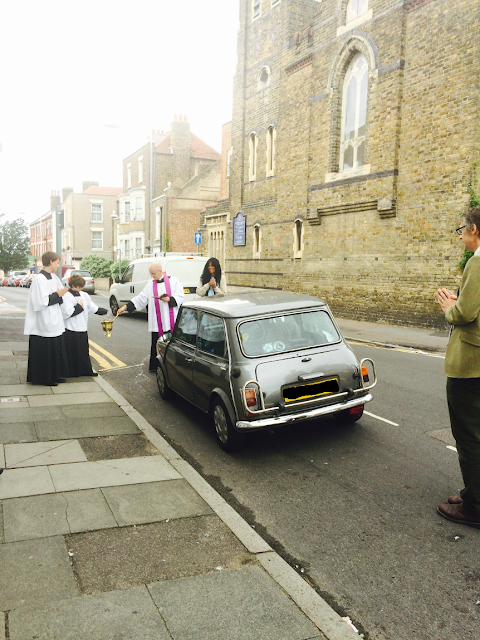
Blessings for important things and things for everyday use

The traditional Roman Ritual has wonderful blessings for all sorts of things we use in our daily life, things and places not designated specifically for sacred purposes.  For example, you can get your grapes blessed, along with your airplanes, mountain climbing equipment, seismographs, sick beds and linens for the sick, and your molten metal (intended for bells).

My friend the mighty PP of Margate, His Hermeneuticalness Fr. Tim Finigan, has a post about blessing a car.

I should interject here that when I bless cars they are often thereafter involved in an accident.  I always warn people about that.  One time, however, a lady came back to me and said: “Imagine how bad it would have been if you hadn’t blessed it!”

The blessings in the Ritual will often be quite poetic, drawing on images and events from Scripture.  The blessing of a car mentions how the Ethiopian Eunuch was tooling along in his chariot when he ran into the Philip the Deacon (cf Acts 8).

The blessing for a fire engine mentions that the youths were unscathed in the fiery furnace (cf Daniel 3).  The blessing for a generator uses Ps 91: His lightnings illumine the world; the earth sees and trembles.

I once used the blessing for mountain climbing equipment for the hardware that went into a knee replacement.

Check out Fr. Finigan’s post.  He even mentions my old friend and teacher, the Latinist Fr. Reginald Foster.

In Italy a few times I stood along the street and blessed cars on the Feast of St. Rita.  I wonder if there was a sharp spike in accidents that day.


Posted in Just Too Cool, Liturgy Science Theatre 3000, Mail from priests, Our Catholic Identity | Tagged , , ,
5 Comments

Coming Soon! The “Eleven Cardinals Book”!

The Italian site La Nuova Bussola has learned that, in advance of the upcoming Synod of Bishops on the family, yet another “Cardinals Book” is being released.

This time, however, its the “Eleven Cardinals Book™”!

This is sure to strike terror in the hearts of the Kasperites!

Eleven Cardinals, as the headline runs, are trying to stop the “Protestantization of the Church”.

In a way this is, but it also isn’t, a sequel to the Five Cardinals Book™, Remaining in the Truth of Christ: Marriage and Communion in the Catholic Church

The names of the Cardinals involved:

  • Carlo Caffarra, Arcivescovo di Bologna;
  • Baselios Cleemis, Arcivescovo maggiore della Chiesa cattolica siro-malankarese e Presidente della Conferenza episcopale dell’India;
  • Paul Josef Cordes, Presidente emerito del Consiglio pontificio «Cor Unum»;
  • Dominik Duka, O.P., Arcivescovo di Praga, Primate di Boemia;
  • Willem Jacobus Eijk,  Arcivescovo di Utrecht;
  • Joachim Meisner, Arcivescovo emerito di Colonia;
  • John Olorunfemi Onaiyekan, Arcivescovo di Abuja (Nigeria);
  • Antonio Maria Rouco Varela, Arcivescovo emerito di Madrid;
  • Camillo Ruini, Vicario generale emerito di Sua Santità per la Diocesi di Roma;
  • Robert Sarah, Prefetto della Congregazione per il culto divino e la disciplina dei sacramenti;
  • Jorge Liberato Urosa Savino, Arcivescovo di Caracas, Santiago de Venezuela

The editor is the German professor of Canon Law Winfried Aymans, at Ludwig-Maximilians-Universität in Munich.

It seems that Cardinals and only Cardinals are the writers.  I am pleased to see Card. Sarah in the list, as well as Caffarra.

It doesn’t say anything concrete about the publisher.  It doesn’t mention the title.  It doesn’t say anything about the languages, though given that this is in an Italian site we can assume Italian is – at least – one of the languages.

The Five Cardinals Book (which everyone ought to have, especially every priest and bishop) came out simultaneously in five languages.  HERE

Also, in the same Bussola piece there is a hint that another book is coming with contributions of 11 bishops and cardinals… all Africans!

You can guess what side of the marriage and the sodomy issues they will be on!

UPDATE 23 August:

My post was picked up in French HERE

Here is an Italian piece by Andrea Gagliarducci HERE

Posted in One Man & One Woman, Our Catholic Identity, Synod | Tagged , ,
15 Comments

D. Fort Worth: New Extraordinary Form parish erected!

This is from a reader…

Fr Z, thanks for all you do. You are one of the top 3 reads every day for me.

Bishop Olson recently erected a personal parish for those who ‘remain attached to the celebration’ of the EF. I was not aware of this. HERE [The parish was formally erected on 1 August.]

I attend St Elizabeth Ann Seton in Keller and I think you would
heartily approve of Monsignor Hart, with his extensive homilies on contraception, abortion, gay ‘marriage’ etc. First parish I’ve attended that uses graduals and introits and chant, though it is Novus Ordo. Recommended if you ever come down, though right now we’re in the blast furnace days.

A few years ago I attended the EF Mass at St Mary of the Assumption with my father on my birthday (as my gift), who remembered it fondly from his childhood. I have no memory of it from my youth.

Having read your blog, I knew to Say the Black and Do the Red.

Thanks!

You are welcome!

I would like to visit someday soon.

And I hope the people there are deeply grateful and that they will pray for their bishop incessantly, and that they will show their gratitude to him and to God by constant spiritual and corporal works of mercy.  Let them win people to membership in their new parish through the beauty of sacred worship, clear doctrine and exemplary charity.

The New Evangelization advances a step.

¡Hagan lío!

That said, there are a couple phrases in Bp. Olson’s decree which struck me as unusual.

First, speaking of those who “remain attached” to the traditional forms is not very accurate.   Many of those who attend are young and many new people are attending the Extraordinary Form.  Of course once they learn of it they “remain”.

Also, the phrase about people who “bind themselves exclusively” to the Extraordinary Form.   This leaves me scratching my head, because many people who might want to belong to such a parish and who prefer the Extraordinary Form also attend reverently celebrated Masses according to the Novus Ordo.  They would also happily attend the Divine Liturgy of Easter Catholics – Ukrainian, Maronite, Ruthenian….

So, I hope that the Extraordinary Form spreads through the whole region.

Posted in ¡Hagan lío!, Fr. Z KUDOS, Hard-Identity Catholicism, New Evangelization, SUMMORUM PONTIFICUM | Tagged , , ,
13 Comments

LCWR Great Swirly Meeting concludes. Fr. Z looks back at a look foward!

In a piece from Fishwrap, aka National Sodomitic Reporter, about the closing the LCWR annual confab in view of the Great Swirly, we find this:

If critics thought the Congregation for the Doctrine of the Faith’s doctrinal Massessment and mandated changes were going to rein in U.S. women religious and get them to focus more on fighting same-sex marriage and abortion and less on serving those at the margins, they were wrong. [In other words, they are going to go as if nothing had happened with the CDF?]

Not only have sisters simply continued to do what they do, but when presented with an open microphone Thursday morning, several called for expanding that work in a way that may be the opposite of what critics were hoping for.

It happened during what was supposed to be an open discussion of the morning’s keynote address by Divine Word Fr. Stephen Bevans. The plan: Tables drawn randomly would send a representative to the mic to share what their table had talked about while processing Bevans’ presentation.

But one sister approached the microphone, saying that her table hadn’t been called but they wanted their voices heard anyway.

We think it’s time we stood for the gay and lesbian community. These people are suffering profoundly,” she told the group. “They are coming to our churches, our programs — when are we going to stand for them?”

Another sister said her table had also sent her to the microphone despite not being called on.

She said that all of what LCWR has learned about contemplative dialogue in the last three years should be put to use in not only ministering to the gay and lesbian community, but in fighting discrimination. It may be easier to stand up to the government than it is to stand up to church leaders, she said, but that does not mean sisters can stand by and allow discrimination to continue.

My response…

I am hereunder reposting something I posted (only) 3 years ago…


The 2020 annual LCWR Assembly

I picked this up from a future edition of the National catholic Reporter.

Breaking down barriers, affirming freedom
by Jamie O’Brien

12 August 2020

HONOLULU (NcR) The 2020 annual national assembly of the Leadership Conference of Women Religious is underway in Honolulu, under the swaying palms and by the sparkling sandy beaches. Once again the gathered sisters have met to affirm each other in their respective callings.

Beth Mackee, LCWR co-mentor, introduced this year’s national assembly speaker Dyna Moore. Moore, the latest in a series of transgendered Daughters of Charity to profess vows, told the assembly in her keynote speech how liberating it was for her now to be a woman.

However, Moore directed the majority of her remarks to the Assembly’s theme, “Age: The Final Frontier“.

Picking up on the assembly’s strong anticipation of President Obama’s fourth term, Moore reminded the group that “much still needs to be done to carry forward the liberation of women from all forms of oppression, especially sexual oppression”.

Congratulating the LCWR for its defeat a decade earlier of the CDF’s attempted 5-year takeover, Moore recalled the women religious who in the meantime “heroically fought the male hierarchy’s strong support of legislation banning polygamous lesbian marriages”.

Yet Moore challenged the assembled sisters to intensify their efforts in support of a national law aimed at lowering the age of sexual consent to 11.

In her talk, Moore, a professor of linguistics at Notre Dame, surveyed the negative history surrounding language concerning women’s rights.

Moore claimed that “terms such as abortion and prostitution and polygamy, and now pedophilia, have been used by men to stigmatize women in their search for sexual liberty”.

After fighting for the right of women of all ages to have abortions without parental knowledge or consent, Moore suggested that women religious should “lead the battle for the relational freedom of females of every age”.

The assembly rose in a standing ovation when Moore declared that “the human right of girls to choose sexual partners regardless of age represents the final frontier of women’s sexual and reproductive freedom”.

While Moore was speaking, members of the Survivors’ Network of those Abused by Nuns, SNAN (formerly known as SNAP) protested outside Honolulu’s most expensive hotel, where the Assembly was held.

“They are compromising the future repressed memories of countless children,” said a SNAN spokesperson.

Prophetic.

One of the commentators under that post offered these as possible future workshops:

Age: The Final Frontier

LCWR Workshops:

  • Dropping the R?
  • Looking ahead: What about the W?
  • Education: Reaching the young remaining in innocence.
  • Recognizing the hormonal effects of contraception begun at 12 in public schools by sight.
  • Cloning: Extending the frontier.
  • Homogenizing gender: makeovers, fashion sense, and hair styling.
  • Retreat planning.
  • Retreats for kids .
  • Latest developments in motorized rollaters, wheelchairs, and vans.
  • Maintaining community life in condocare villages.
  • Music: make your own.
  • Water ballet and hula dancing.
  • Planning and ordering buffets: Baking and storing sweets.
  • Campaigning and coffee hours.
  • Social networking and liberation. b-y-o-tech.
Posted in Linking Back, Women Religious | Tagged ,

8 Comments

“O my Jesus, forgive us our sins, save us from the fires of hell….”

I was alerted to this tweet by His Eminence Oscar Card. Rodriguez Maradiaga, Archbishop of Tegucigalpa, Honduras.  Caveat:  One has to wonder if this is truly His Eminence’s account or if it is someone else’s.

A screenshot of the tweet.

15_08_05_Card_Rodriguez_02

Unless, of course, it doesn’t.

Posted in Four Last Things | Tagged , , , ,

12 Comments

D. Madison: Pontifical Mass at the Faldstool for Assumption of the Blessed Virgin

From yesterday’s Pontifical Mass at the Faldstool for the Feast of the Assumption at St. Mary’s in Pine Bluff, WI.  His Excellency Most Rev. Robert C. Morlino (aka the Extraordinary Ordinary) was the celebrant.  Most the seminarians of the diocese were there, either in liturgical roles in the sanctuary or in choro, some with their new birettas from the biretta project!

Confessions were heard during Mass.

People were asked to pray in a special way for an increase in vocations to the Holy Priesthood.

15_08_15_faldstool_B_06


More…

15_08_15_faldstool_04

15_08_15_faldstool_06

15_08_15_faldstool_05


The bishop is incensed.


15_08_15_faldstool_09

15_08_15_faldstool_03


The Subdeacon, fulfilled by Msgr. Bartylla, Vicar General, heads to his place for the singing of the first reading.

15_08_15_faldstool_04b


Note that the Deacon and Assistant priest are in the act of putting on their birettas.

15_08_15_faldstool_02

15_08_15_faldstool_07


We had a traditional blessing of flowers and herbs, fruits and vegetables before Mass.  Flowers went to the main altar, St. Joseph and, of course, the Blessed Virgin.  Alas, people are so used to seeing flowers on the altar itself, they put the flowers on the mensa of the side altars rather than the gradins.

15_08_15_faldstool_11

15_08_15_faldstool_10

We have good congregational sung responses.  The choir did a fine job with De Victoria’s Missa Quarti Toni, Gregorian chant, and motets.

It was a beautiful Mass in honor of Our Blessed Mother, who, as daughter of her Son, always redirects our gaze back to the Lord, at whose side she is Queen of Heaven, Queen of the Clergy.

UPDATE:

More photos are coming.

15_08_15_faldstool_B_01


15_08_15_faldstool_B_02

15_08_15_faldstool_B_03

15_08_15_faldstool_B_05

Posted in "How To..." - Practical Notes, Just Too Cool, Liturgy Science Theatre 3000, SUMMORUM PONTIFICUM | Tagged , , , , , ,


17 Comments

ASK FATHER: “Blood” omitted from the consecration

From a reader…

QUAERITUR:

Recently at my parish, we had a retired priest say masses while our priest was away. In addition to improvising prayers during the Collect, he changed the wording of the Words of Institution. During the consecration of wine, he said something along the lines of, “This is the cup of the new covenant,” without ever mentioning the word “blood.” Did this invalidate the consecration? Furthermore, if it did, am I under moral obligation as a layperson to warn fellow parishioners that what they hope to receive as the Precious Blood of the Lord remains unconsecrated wine?

There are several issues here.


First, when I see descriptions including “along the lines of” instead of exact wording, my antennas wave.

However, you say that he did NOT say the word “Blood”.

It is possible to screw up or change some elements of the form and still validly consecrate, but if you don’t include the word “Blood” at all… then I say that isn’t a valid consecration.  The Precious Blood was not consecrated.

That means that Mass was not celebrated.

If people receive a Host for Communion, they received the Eucharist.  If they drank from an offered chalice… nope.

There are ramifications for the intention and the stipend for the Mass.

What to do about this?

Doing this once might be a mistake.  Doing this regularly is another matter entirely.  That would mean he means to do it.

I suppose the first thing would be to bring it up to a priest a the parish.  If there isn’t one at all, ask the priest who is doing this about it.  If he blows you off and keeps doing it, then he should be reported IMMEDIATELY to the local bishop and/or the Congregation for the Doctrine of the Faith.    This is grave matter.

Fathers… STICK TO THE BOOK!

Posted in "How To..." - Practical Notes, ASK FATHER Question Box, Liturgy Science Theatre 3000 | Tagged ,
33 Comments

The Flag, Pope Francis, Cuba and Religious Freedom

Look… Pope’s meet with all sorts of people.  That said, I direct your attention to a piece at USA Today by Nichols Hahn of Real Clear Religion.  My emphases.

Havana’s U.S. flag no victory for pope: Column

Secretary of State John Kerry’s historic flag-raising at the U.S. Embassy in Havana on Friday culminates a diplomatic accomplishment for the Obama administration and Pope Francis. But the ceremony has some irony, not all that unlike President George W. Bush’s 2003 “Mission Accomplished” speech.

The island’s dissidents weren’t invited, and the pontiff who helped usher in the new relations might have been expected to side with Cuba’s persecuted faithful. But when asked about Cuba’s spotty record, Francis demurred. “I would say that in many countries of the world, human rights are not respected,” he said during a July in-flight news conference. “Religious liberty is not a reality in the entire world; there are many countries that do not allow it.”

The pope’s answer is in keeping with his May meeting in Rome with Cuban President Raul Castro. The Vatican reported that the meeting was “very friendly.” But not even a prophet could have foreseen what came next.

“If the pope continues this way, I will go back to praying and go back to the church,” the 84-year-old communist leader told an amazed gaggle of reporters after meeting in private with the pontiff for nearly an hour. “I’m not joking,” Castro assured them.

But some in Castro’s Cuba aren’t buying it. “It is a mockery for Raul Castro tell the pope that he may return to the bosom of the church and pray again,” Berta Soler told Spanish radio. Soler is the leader of the Ladies in White, a Catholic opposition movement made up of relatives of jailed human rights activists who attend Mass and silently take to the streets while wearing white.

Soler’s skepticism might have something to do with Castro’s security goons, who continue to harass and detain the Ladies and other dissidents. Just days before Kerry’s visit, the government rounded up about 50 of Soler’s Ladies. The detentions are only “further proof of the Cuban government’s intolerance towards people who think differently,” Soler told the PanAm Post.

If a recent Univision Noticias survey of Cubans is any indication, Soler is not alone in that assessment: 75% of respondents said that when it comes to politics, they “have to be careful about what to say” in public. [Rather like what the present environment in some sectors of the Church is becoming… again.] The Obama administration and Pope Francis hoped a thawing would open the political system, but more than half of Cubans polled believe politics will remain the same. Still more don’t think the Cuban government will allow other political parties to exist after a normalization of relations.

But Castro’s crackdown seems to be more about religious freedom than the ballot box. “Many times, we haven’t been able to get to church,” Soler told the National Review at this year’s Oslo Freedom Forum. “The few who actually do make it to church have been detained for over five hours. They have been beaten.” This might be why Soler is more than a little frustrated with her spiritual shepherd. “The European Union, the USA, Pope Francis — they have turned their backs on us,” she said.

[…]

Read the rest there.


Posted in Religious Liberty, The Coming Storm, The Drill, The future and our choices, The Olympian Middle | Tagged , , , ,
13 Comments