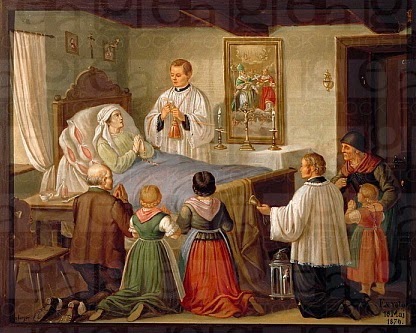
ASK FATHER: The Apostolic Pardon and You

HolyDeath last rites apostolic pardonFrom a reader…

QUAERITUR:

What does apostolic pardon mean?

The Apostolic Pardon, or Benediction, forgives temporal punishment due to our sins, not the sins themselves.

If anything remains from our lives, provided we die in the state of grace, for which we have not done adequate penance, the temporal punishment due to those sins, if we have not done adequate penance in life, is forgiven us through the Apostolic Pardon.  This is why the Apostolic Pardon is often given after the Last Rites of sacraments of penance, anointing, and Viaticum.

The older form of the Apostolic Blessing:

Ego facultate mihi ab Apostolica Sede tributa, indulgentiam plenariam et remissionem omnium peccatorum tibi concedo et benedico te. In nomine Patris, et Filii, + et Spirtus Sancti, Amen.

…

By the faculty given to me by the Apostolic See, I grant you a plenary indulgence and the remission of all your sins, and I bless you. In the Name of the Father and the Son + and the Holy Spirit. Amen.

In the newer form I think the words “et benedico te” were removed.

When it comes to forms of Anointing, Penance and the Apostolic Pardon, I always use Latin.  That’s my choice.  That doesn’t mean that I think that other approved languages are not effective.  Still, why translate when you don’t have to.  Besides, demons really hate Latin.

The ability to give the Apostolic Pardon, or Benediction, is a marvelous faculty, given by Holy Church to the priest so that he can grant this remission of temporal punishment and forgive sins.  Used in conjunction with the Last Rites a soul is well prepared to go on to judgment.  Well prepared.

We cannot force God or force souls, but we have confidence that God’s promises to the Church and the Church’s teaching to us are all true.

Sometimes I am asked: “Why don’t more priests use the Apostolic Pardon?”

I am not sure that they don’t.  I know that my priest friends, my circle, as it were, know what it is and would use it.

Other priests?  Not sure.

If they don’t, then I suspect that it is simply because they may not know about it.

It is possible that, given the state of seminary training over the last decades, they were never taught about the Apostolic Pardon and perhaps their liberal, discontinuity pastors in their first assignments didn’t use it.  As the old not-quite-Latin adage goes, “nemo dat quod non ‘got‘”.

Another reason they may not use it is that they don’t think the circumstances warrant using it, namely that the person isn’t very close to death after all.

But I think that priests, being generally good men and being involved in the sometimes beautiful, sometimes frightening, always awe-filled moment of a person’s dying breaths and last heartbeats, would want to do everything they could to help the person to his or her judgment.  These are not moments to fool around.  I can’t imagine a priest who would not want to use the Apostolic Pardon appropriately – provided he knew it.

All you priests and seminarians out there: Dig into what the Apostolic Pardon entails.  Don’t be ignorant of this powerful aid for a person’s dying challenge.

Therefore, it is not a bad idea to have the card with the prayer on it, just in case.

Idea: Perhaps one of you could work up a printable PDF that could be cut out and even laminated.  A person could keep it in wallet or purse.

Finally: GO TO CONFESSION and DO PENANCE NOW!
Posted in "How To..." - Practical Notes, ASK FATHER Question Box, GO TO CONFESSION, Liturgy Science Theatre 3000 | Tagged , , , , , , , ,
21 Comments

LCWR 2015 ASSEMBLY!

LCWR 2015 ASSEMBLY!I know you have been longing for an update on the doings of the Leadership Conference of Women Religious (LCWR).

Right now they are meeting in Houston at the Hyatt Regency for their annual synergistic convergence! HERE


Sorry… I can’t give you an update.  They have not embraced transparency in their organization and they have rejected me when I applied for credentials to cover the meet.

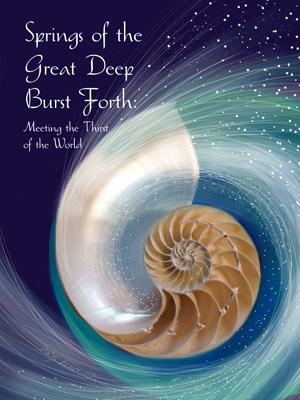
I received, however, a screenshot of their set up. I think this is Facebook:

15_08_12_LCWR_01


They’ve got that swirling shell thing going, the nautilus theme.

I don’t think that refers to exercise equipment.

Their theme this year:

Springs of the Great Deep Burst Forth: Meeting the Thirsts of the World

Over the years, women religious have been drawn to live more deeply out of a contemplative stance. This stance leads us to explore the world with a vision that penetrates below the surface and draws wisdom and insight from those great depths. The assembly theme, “Springs of the Great Deep Burst Forth: Meeting the Thirsts of the World,” comes in part from the account of the creation of the world in Genesis 7:11. As the Israelites named the enormous reservoir of water that they believed was beneath the surface of the earth “The Great Deep,” so we use the same name for the reservoir of wisdom that we believe can be accessed through living a life of contemplation.

This assembly will explore what is being accessed these days from the Great Deep by women religious, as well as what may be drawn from it to meet the many urgent thirsts experienced throughout the world.

There doesn’t seem to be any mention of their Spouse in this.

Who knows what could be going on in there?  Who knows what they are discussion in secret?  Will we ever find out?

Posted in Women Religious |
35 Comments

15 August – Assumption – Blessing of herbs, flowers and fruit


Francesco_granacci AssumptionOn 15 August, Feast of the Assumption, in the traditional Rituale Romanum there is a prayer for the blessing of herbs, flowers and fruits.

These occasional blessings, attached to feasts, help us to experience more fully the rhythm of our marvelous sacred liturgical year.  God gives us gifts in seasonal rhythms.  The Church, the greatest expert in humanity there has ever been, helps us to accept them and use them with gratitude for the good of both body and soul.

Take lots of herbs, flowers and fruits to your parish priest for blessing!  You might have to explain what’s going on.

It’s best to bless in Latin.  The Latin text is the Rituale Romanum (HERE – p. 42*)

V. Our help is in the name of the Lord.
R. Who made heaven and earth.

Psalm 64 is said in full.

V. The Lord will give goodness.
R. And our earth shall yield her fruit. (Ps. 84)
V. Thou waterest the hills from Thy upper rooms.
R. The earth shall be filled with the fruit of Thy works.
V. Bringing forth grass for cattle.
R. And herbs for the service of men.
V. That Thou may bring bread out of the earth.
R. And that wine may cheer the heart of man.
V. That he may make the face cheerful with oil.
R. And that bread may strengthen man’s heart. (Ps. 103)
V. He sent his word, and healed them.
R. And delivered them from their destructions. (Ps. 106)

V. Lord, heed my prayer.
R. And let my cry be heard by you.
V. The Lord be with you.
R. And with thy spirit.

Let us pray. Almighty everlasting God, who by Thy word created from nothing the heaven, the earth, the sea, and all things visible and invisible, and commanded the earth to bring forth plants and trees for the use of men and beasts, and each one to have fruit in itself according to its seed; and in Thy ineffable goodness granted not only that the plants might serve as the food of living creatures, but also that they might profit ailing bodies as medicine; with mind and word we humbly pray Thee that in Thy clemency Thou may bless + these herbs and fruits of various kinds, and pour upon them the grace of Thy renewed blessing, above the natural power which Thou gavest them; so that, when used by men and beasts in Thy name, they may become a defense against every disease and adversity. Through our Lord Jesus Christ, Thy son etc.

R. Amen.

Let us pray. O God, who through Moses, Thy servant, commanded the children of Israel to bear sheaves of new fruits to the priests to be blessed, and to take the fruits of the finest trees, and rejoice before Thee, the Lord their God; in Thy mercy be present to our supplications, and pour forth the abundance of Thy bless+ing upon us and upon these bundles of new fruits, new herbs, and upon the gathering of fruits which we bring before Thee with thanksgiving, and on this solemn feast we bless in Thy name. And grant that they may give to men, cattle, flocks, and beasts of burden a remedy against sickness, pestilence, sores, curses, spells, against the poison of serpents and bites of other venomous animals. And may they bring protection against the devil’s illusions, and devisings and cunning, wherever they or any portion of them are kept and carried, or otherwise used; so that, with the sheaves of good works, by the merits of the blessed Virgin Mary, the feast of whose Assumption we keep, we may merit to be taken up to that place whither She was assumed. Through our Lord Jesus Christ, Thy son etc.

R. Amen.

Let us pray. O God, who on this day raised up to the heights of heaven the rod of Jesse, the Mother of Thy Son, our Lord Jesus Christ, so that by Her prayers and patronage Thou might communicate to our mortal nature the fruit of Her womb, the same Thy Son; we humbly implore Thee, that by His power, and by the glorious patronage of His Mother, with the help of these fruits of the earth, we may be guided through temporal welfare unto everlasting salvation. Through the same our Lord Jesus Christ, Thy son etc. R. Amen.

And may the blessing of almighty God, the Father, the Son, + and Holy Spirit, come upon these creatures and remain always.

R. Amen.

Posted in Just Too Cool, Liturgy Science Theatre 3000 | Tagged , , ,
46 Comments

Wyoming “Mystic Monk Coffee” Carmelites – Progress with their monastery!

Wyoming "Mystic Monk Coffee" Carmelites - Progress with their monastery!I had a note from a priest reader today about the progress the Wyoming Carmelites are making with the building of their new monastery.  HERE

I thought you might appreciate a little note about the Carmelite Monastery in the works in WY — whose coffee you so dutifully promote.

Their plans are well under way, and should be extraordinary when finished.  The monks themselves continue to assist in the work of construction, especially the stone masonry.  I have attached a few pictures below to see the current state of things.  It’s amazing to think that so much has been built in just over a year.  I believe they are hoping to be finished in a little over three years. They are working to have a true monastic enclosure and site — and this is a very well thought-out plan.

They’ve also said that their coffee sales have gone a large way to paying off their expenses — especially all the stone they’ll be using.  They were grateful for your support.

They are a holy, joyful and hard-working group of monks, and it seems the Lord is calling them to great things.  I have little doubt that their monastery will be a pilgrim destination for a long, long time.

Here are some photos which he sent:

01

02


They used a “J”!  UGH!  Thank heaven it isn’t chiseled in…

Oh dear.

03

04

05


WOW!

When you buy Mystic Monk… this is what you are helping to build.

Bean by bean!

The have TEA also!

Wyoming "Mystic Monk Coffee" Carmelites - Progress with their monastery!

Check out all their stuff.


Posted in Just Too Cool | Tagged ,
18 Comments

15 August – Assumption – Madison WI – Pontifical Mass with Bp. Morlino

15_08_10_D_Madison_press_release_AssumptionOn Saturday, 15 August, Feast of the Assumption of the Blessed Virgin Mary, His Excellency Most Reverend 1Robert C. Morlino will celebrate in the Extraordinary Form of the Roman Rite a Pontifical Mass at the Faldstool at 11 AM at the Church of St. Mary in Pine Bluff.  It is the patronal feast of the parish.

A Pontifical Mass at the Faldstool is a solemn way for a bishop to offer the Traditional Latin Mass, although it requires the service of fewer clerics as sacred ministers than Mass at the Throne.  The music for the Mass will include Gregorian Chant and polyphonic motets.

Before the Mass His Excellency will bless flowers, herbs, and fruit brought by the faithful.  On the Feast of the Assumption there is a special blessing in the traditional Roman Ritual that can be conferred on these seasonal gifts from God. These occasional blessings help us to sense more fully the beautiful rhythms of the sacred liturgical year.

Music for the Mass

Proper: Gregorian chant, Missa Signum magnum

Mass Ordinary:

  • T.L. de Victoria, Missa quarti toni (KGSBA)
  • Credo III

Motets:

  • Offertory: G. Aichinger, Assumpta est Maria
  • Communion: F. Soriano, Magnificat sexti toni 


Varia:

  • Salve Regina, tonus simplex
  • “Hail, Holy Queen Enthroned Above” (Salve Regina Coelitum)

The Mass is sponsored by the Tridentine Mass Society of Madison and St. Mary’s Church in Pine Bluff.

St Mary’s of Pine Bluff Catholic Church
3673 Co Hwy P
Cross Plains, WI 53528
(608) 798-2111

Google Maps Link to St. Mary’s HERE


Posted in SESSIUNCULA | Tagged , ,
10 Comments

“The Tears of St. Lawrence” – annual Perseid Metor Shower

The famous Perseid Meteor Shower falls are the time of the Feast of St. Lawrence.  Thus, they are called the “Tears of St. Lawrence”.

From SpaceWeather:

PERSEID METEOR SHOWER–THIS WEEK: Earth is entering a stream of debris from Comet Swift-Tuttle, source of the annual Perseid meteor shower. Forecasters expect meteor rates to peak at 100+ per hour on the night of Aug. 12-13 when our planet passes through the heart of the debris stream. Perseids produce more fireballs than any other meteor shower of the year, so stay tuned for a good show. [meteor radar]

Speaking of the Perseids, check out an engaging  “apocalyptic” series by Steven Konkoly.  It begins with The Jakarta Pandemic (UK HERE).

"The Tears of St. Lawrence" - annual Perseid Metor Shower

It goes on with The Perseid Collapse (UK HERE)

"The Tears of St. Lawrence" - annual Perseid Metor Shower

Posted in Look! Up in the sky!, Semper Paratus, Si vis pacem para bellum!, TEOTWAWKI | Tagged , , , , ,
2 Comments

Your Good News

Do you have some good news to share with the readership?

Let us know!

Posted in SESSIUNCULA |
13 Comments

Implore “pardon for the sins committed against the world”? Wherein Fr. Z rants.

The Church will observe a “World Day of Prayer for the Care of Creation” on 1 September, as has been the custom in the Orthodox Church for some time.

Pope Francis, in his letter about this event to Card. Turkson (President of the Pontifical Council for Justice and Peace) and Card. Koch (President of the Pontifical Council for the Promotion of Christian Unity) made a statement about this day which left me scratching my head a little. HERE

In the statement the Pope said…

[…]

The annual World Day of Prayer for the Care of Creation will offer individual believers and communities a fitting opportunity to reaffirm their personal vocation to be stewards of creation, to thank God for the wonderful handiwork which he has entrusted to our care, and to implore his help for the protection of creation as well as his pardon for the sins committed against the world in which we live.

[…]

“Sins committed against the world”… what does that mean?

I think in most languages there is an idiomatic understanding of “the world” as being “everyone”, that is “all people”.   But that doesn’t seem to be what this is all about.

We are to have a care for creation around us – which includes people. Is that the main thrust in this statement?  It seems to me that he is talking about the non-human environment.

Of course Laudato si‘ tries to bring the two together.

Sometimes when we talk about sin, we say we sin against a virtue (charity) or against neighbor.  However, if we stray from truth and charity, or if we harm our neighbor our sin is truly against God.  As the Catechism of the Catholic Church points out…

1850 Sin is an offense against God: “Against you, you alone, have I sinned, and done that which is evil in your sight.”122 Sin sets itself against God’s love for us and turns our hearts away from it. Like the first sin, it is disobedience, a revolt against God through the will to become “like gods,”123 knowing and determining good and evil. Sin is thus “love of oneself even to contempt of God.”124 In this proud self- exaltation, sin is diametrically opposed to the obedience of Jesus, which achieves our salvation.125

122 Ps 51:4. 123 Gen 3:5. 124 St. Augustine, De civ. Dei 14,28:PL 41,436.  125 Cf. Phil 2:6-9.

A sin against a virtue (an abstraction) is a sin against God.  A sin against neighbor is a sin against God.

Do we sin against some creature which isn’t a person?  Clods of dirt, plants, and critters are not persons. We cannot sin against a critter, a plant or a clod (of dirt, that is).

If we commit vandalism against a sacred thing, such as a chalice, a church or a cemetery, we do not sin against those things but rather against God, the one to whom those sacred things are dedicated with special consecration.

If we sin by pouring unreasonable, dangerous, extreme quantities poisons into the earth or air or water or by mistreating animals, we do not sin against the earth, air or water or against the animals.  We sins against our neighbor, for making his life miserable, but, more fundamentally, we sin against God by violating His will when He made us creation’s stewards.

We do not sin against the world we live in.

Unless… we think the world is god.

There are those immanentists out there who verge on pantheism.  There are immanentists in the Church, as a matter of fact!  Lots of them!  Some of them wear Roman collars, many wear lapel pins and polyester, most wear flipflops and shorts (at least in church).  Come to think of it, immanentists come in all shapes and sizes and they are often well dressed. Most modern immanentists of our acquaintance suffer from what I call “Immanentism Lite”, that is, they don’t deny the transcendence of God, they simply never think about it.

God is, first and foremost, transcendent.  That’s a harder way of grasping God.  Since it is harder, it isn’t as easily communicated.  This is why the traditional, Extraordinary Form is so important.  It provides the necessary hard elements, the apophatic elements, which help us to an experience of awe and the detachment from self which is critical if we want to overcome life’s “daily winter”, our fear of death.  This is the very purpose of Religion.  Our liturgical worship must help us to be purified of distractions that keep us from confronting our fear of death and that prevent us from encountering mystery. We need in our worship a measure of privation, hunger and longing for that which in this life we can only darkly as if through Paul’s mirror or the cleft in Moses’ rock.

The Church herself, in many cases, has inflicted immanentism on these folks through decades of shoddy, horizontal self-enclosed liturgy, poor catechesis, feckless leadership, and secular propaganda (not lacking within the Church).

So, to be clear, even if our language gets a little loose, we sin against God and God alone and not the world we live in.

Posted in Creation and Environment Stuff, Our Catholic Identity, The Drill, Wherein Fr. Z Rants | Tagged , , ,
20 Comments

ASK FATHER: Viaticum and how many we can receive Communion in a day

last rites extreme unction anointing viaticum 02From a reader…

QUAERITUR:

I understand that we can receive Holy Communion twice a day, but the second reception must be made at Mass. Can. 917 says this “without prejudice to Can. 921, §2.” I’ve read that this is understood as allowing for the day’s 2nd reception of Communion outside the Mass through Viaticum. However, should this provision also be understood as allowing for a 3rd reception if one had already received twice (the 2nd at Mass) during the day? For example, if I received at a Communion service, then at Mass, could I also receive Viaticum should I have the grace of a provided death? Many thanks.

Since I haven’t had this question for a while, we can review.

First, a provided death means that you – at least – died in the state of grace.  In most instances this can mean that as you were dying a priest gave you absolution.  In more ideal situations, it means that the priest absolved you, anointed you, gave you Viaticum, and, the Apostolic Pardon.  May God, please, give us the grace for this sort of death.

Viaticum, an adjective, is Latin for “of or belonging to a journey, resources, provision for a journey (via)”.. “one for the road” as it were..  In early Latin it was used by Plautus as “a parting farewell meal”.  In military imagery – and we are soldiers on the march in this Church Militant – it was the prize money a soldier made in war.  Communion is also called a pignus, a “pledge” of future glory.  So, in one sense, Viaticum is the moment of being paid out at your soldierly discharge as you step into the patria.

Catholics in the state of grace can receive twice in one day.

The 1983 Code of Canon Law says:

Can. 917 – Qui sanctissimam Eucharistiam iam recepit, potest eam iterum eadem die suscipere solummodo intra eucharisticam celebrationem cui participat, salvo praescripto Can. 921, § 2.

…

Someone who has already received the Most Holy Eucharist can receive it again (iterum) on the same day only within the Eucharistic celebration [i.e. Mass, not a Communion service] in which the person participates, with due regard for the prescription of can. 921 § 2.

Can. 921 § 2 says that if a person is in danger of death, he may receive Communion even it is not in the context of Mass.  That is Viaticum.

That iterum does not mean “again and again”, but merely “again, one more time”.

Also, that “Eucharistic celebration” in the canon does not mean just any service involving Communion.  It means Mass. That was cleared up by the Holy See in an official response to a dubium.

So, say in the morning you attend a Novus Ordo Communion service wherein you receive Communion, or you went to a Mass in either Form.  Later in the day you stumble into a church where Mass about to be celebrated and decided to stay for it.  At that Mass you can receive Communion again (iterum).  This would be even if you were, say, visiting a Maronite Catholic Church, or a Ukrainian Catholic Church and their Divine Liturgy was about to get under way.

However, if you were at Holy Mass in the morning and then stumbled into a Communion service at a priest-less parish in the afternoon, you could NOT receive again because a Communion Service isn’t Mass.  If you were at Mass in the morning and then in the afternoon when you were visiting your auntie in the hospital when the chaplain came, you could not receive even if the priest invited you to do so (which in my opinion he should not).  However, if you stayed for another Mass immediately following, you would be able to receive.

Canon 917 tries to walk the line between promoting frequent reception of the Eucharist and a superstitious or excessive frequency, which – I can assure you – some people fall into.

The key here is that the second time must be during a Mass, and you may not enter the Mass at some late point merely in order to receive.

Viaticum, which is Communion in the context of Last Rites for someone in danger of death, is a separate issue.

Even if a person has received twice in a day, if the person is in danger of death, he can – of course – be given Viaticum.

At this most important moment of life, a person needs everything that can be given to help him on the way to a happy judgment and the promise of heaven.

At that point, the Church, whose highest law is the salvation of souls, gets “tunnel vision”, as it were, and focuses on the dying person in that moment.

Another way we can see this great concern, is that when someone is dying, any and every priest who was ever validly ordained has – in that moment – the faculty to hear the dying person’s confession and/or give absolution validly.  As most of you know, it is not enough that a priest be validly ordained.  He must also have the Church’s permission granted through legitimate authority to receive sacramental confessions and given absolution validly.  Thus, in the case of a person dying on the street from, say, a car accidents or a freak bow and arrow incident, even an ex-priest who had been convicted of horrible crimes and “laicized”, stripped of his ability to function as a priest for the rest of his life, could, were he present, validly absolve the dying person.

So, under normal circumstances a person can receive Communion twice in a day, so long as the second time is in the context of Mass.  If he tries to die during the same day, he can receive Communion again, as Viaticum.

This doesn’t apply to priests, who must consume both species no matter how many times they say Mass in a day.  Ideally a priest celebrates Mass once.  In some circumstances he celebrates twice (bination).  Under pressing circumstances, he celebrates thrice (trination).  He really isn’t suppose to celebrate more than that but, sometimes, it happens that he has to.  In that case the good of the faithful kicks in and Father takes care of business!  But bination and trination are matters for a different post.

Posted in "How To..." - Practical Notes, ASK FATHER Question Box, Four Last Things, Hard-Identity Catholicism, Liturgy Science Theatre 3000 | Tagged , , ,
7 Comments

Your Sunday Sermon Notes

Was there a good point in the sermon you heard for your Sunday Mass of obligation?

Let us know!

Posted in SESSIUNCULA |
10 Comments