ASK FATHER: “Baptismal Stoles” or “Confirmation Stoles”

From a reader…

QUAERITUR:

I heartily agree with you regarding cassocks and surplices on “altar girls”. [More on that HERE] But I have another concern, and I wonder if I am right. I also do not believe that “Baptismal Stoles” or “Confirmation Stoles” should be conferred on those receiving these Scaraments. This happens in my parish at the Easter Vigil when several adults are Baptized and/or Confirmed. The following is from the Catholic Encyclopedia:

The stole is worn only by deacons, priests, and bishops. For deacons and priests it is the specific mark of office, being the badge of the diaconal and priestly orders. The wrongful use of the stole by subdeacons, therefore, would imply the usurpation of a higher order, and would constitute an irregularity. (…) As a liturgical vestment, the stole signifies the “yoke of the Lord” whose “burden is light.”

If the wearing of a stole by a subdeacon (which order is now suppressed) constituted an “irregularity” how much more so does it constitute an “irregularity” for a lay person to wear one? The wearing of the stole by a lay person. regradless of age, it seems to me would demonstrate a confusion of roles. The argument is presented to me that this just a manifestation of the “common priesthood of the laity”? I emphatically say, NO! There must remain a clear distinction of roles, and wearing a stole in the manner of a sacramental priest simply confuses those roles. But I get shouted down on this issue and also regardiong our “altar girls” attire, which is, ugh, the cassock and surplice.

It seems to me that the “confirmation stoles” and “baptism stoles” are an even more egregious error than young girls in cassocks and surplices.

The use of these stoles confuses the royal priesthood of the faithful with the ministerial priesthood of the ordained.

Since bishops possess the fullness of the priesthood, shall we give little miters to the newly baptized? Of course not!

The mark of the royal priesthood of the faithful is the anointing, which is already done in baptism and confirmation.

Furthermore, putting stoles on laypeople like that just seems… condescending.  It is as if the cleric is saying, “Aren’t you cute, you good little lay people.  I’ll dress you up like me!”

The baptized and confirmed laity have their own dignity.

Posted in "How To..." - Practical Notes, ASK FATHER Question Box, Liturgy Science Theatre 3000 | Tagged ,
21 Comments

ASK FATHER: Altar girls also Communion ministrices

From a reader…

QUAERITUR:

I went to Mass today in the diocese of [removed] as a visitor. The priest had 4 teen age alter girls and I actually received communion from one of them. This brought tears of sorrow to my eyes. I have never even seen an alter boy serve communion, let alone a girl. I am so shocked, I am thinking of writing a letter to their new bishop to let him in on this. What to you advise?

I presume the author is asking about “altar girls” rather than alter girls, or worse, altered girls.

While this is possibly permissible, it is unusual.

Leaving aside the issue of females serving at all, if the girls are confirmed, then they fit the minimum requirement for Extraordinary Ministers of Holy Communion.  Hmmm… feminine of minister is ministrix, so, plural ministrices.

Those on the Left usually harp on and on about not “mixing ministries”, namely, lectors should not distribute Holy Communion, ushers should not serve Mass, puppeteers should not ply their tambourine skills, etc.

The new bishop of [that diocese] has many, many challenges on his plate.  Pray for him.

I suspect that this situation, while odd, would not amount to something he could begin to attend to.

How about writing to the new bishop of [that diocese], saying that you recently attended Holy Mass in his diocese and became aware of how much work he has before him. Instead of mentioning specific problems, could you promise him a daily decade of the Rosary for the next year?

Posted in "How To..." - Practical Notes, ASK FATHER Question Box, Liturgy Science Theatre 3000 | Tagged
16 Comments

Luke 19: Zacchaeus

I think we could benefit from a discussion of the moment in the Gospel of Luke when Zacchaeus meets the Lord.  The Pope recently used this pericope when addressing the UN delegation.  It made me scratch my head.  The Pope was advocating “legitimate redistribution of economic benefits by the State”.

Of course you know that Zacchaeus was a publican, a tax collector, a representative of the State, the Romans.

As I read Luke, the lesson to be learned from the Zacchaeus encounter is that if even a Roman collaborator tax collector can convert and receive the kind words of the Lord, then anyone can be saved.  What I find puzzling is how this episode can bolster an argument for State redistribution of wealth.

In any event, Luke 19:1-10 has Zacchaeus telling the Lord, using Greek present tense verbs (Latin Vulgate also has present tense), about his giving to the poor and his restoration of money to those whom he cheated.

Authors are divided about whether Zacchaeus was already giving half his wealth to the poor before the Lord came along or whether he made the decision in the Lord’s presence to give to the poor in the future.

On the one hand, the language is fairly clear.  But the context suggests that Zacchaeus is making an on the spot decision.

The Greek of the dialogue in Luke 19 says in 19:8:

σταθεὶς δὲ Ζακχαῖος εἶπεν πρὸς τὸν κύριον Ἰδού, τὰ ἡμίση τῶν ὑπαρχόντων μου κύριε δίδωμι τοῖς πτωχοῖς καὶ εἴ τινός τι ἐσυκοφάντησα ἀποδίδωμι τετραπλοῦν

The verbs δίδωμι and ἀποδίδωμι are both “present”, though Greek present doesn’t necessarily mean that the action is exactly contemporaneous.

RSV:

1 He entered Jericho and was passing through. 2 And there was a man named Zacchae’us; he was a chief tax collector, and rich. 3 And he sought to see who Jesus was, but could not, on account of the crowd, because he was small of stature. 4 So he ran on ahead and climbed up into a sycamore tree to see him, for he was to pass that way. 5 And when Jesus came to the place, he looked up and said to him, “Zacchae’us, make haste and come down; for I must stay at your house today.” 6 So he made haste and came down, and received him joyfully. 7 And when they saw it they all murmured, “He has gone in to be the guest of a man who is a sinner.” 8 And Zacchae’us stood and said to the Lord, “Behold, Lord, the half of my goods I give to the poor; and if I have defrauded any one of anything, I restore it fourfold.” 9 And Jesus said to him, “Today salvation has come to this house, since he also is a son of Abraham. 10 For the Son of man came to seek and to save the lost.”

Douay-Rheims

1 And entering he walked through Jericho. 2 And behold, there was a man named Zacheus, who was the chief of the publicans: and he was rich. 3 And he sought to see Jesus who he was: and he could not for the crowd, because he was low of stature. 4 And running before, he climbed up into a sycamore tree, that he might see him: for he was to pass that way. 5 And when Jesus was come to the place, looking up, he saw him and said to him: Zacheus, make haste and come down: for this day I must abide in thy house. 6 And he made haste and came down and received him with joy. 7 And when all saw it, they murmured, saying, that he was gone to be a guest with a man that was a sinner. 8 But Zacheus standing, said to the Lord: Behold, Lord, the half of my goods I give to the poor; and if I have wronged any man of any thing, I restore him fourfold. 9 Jesus said to him: This day is salvation come to this house, because he also is a son of Abraham. 10 For the Son of man is come to seek and to save that which was lost.

VULGATE

1 et ingressus perambulabat Hiericho 2 et ecce vir nomine Zaccheus et hic erat princeps publicanorum et ipse dives 3 et quaerebat videre Iesum quis esset et non poterat prae turba quia statura pusillus erat 4 et praecurrens ascendit in arborem sycomorum ut videret illum quia inde erat transiturus 5 et cum venisset ad locum suspiciens Iesus vidit illum et dixit ad eum Zacchee festinans descende quia hodie in domo tua oportet me manere 6 et festinans descendit et excepit illum gaudens 7 et cum viderent omnes murmurabant dicentes quod ad hominem peccatorem devertisset 8 stans autem Zaccheus dixit ad Dominum ecce dimidium bonorum meorum Domine do pauperibus et si quid aliquem defraudavi reddo quadruplum 9 ait Iesus ad eum quia hodie salus domui huic facta est eo quod et ipse filius sit Abrahae 10 venit enim Filius hominis quaerere et salvum facere quod perierat

Again, the tricky part here is to determine what the Greek “present” is doing.

Once again, many commentators think that Zacchaeus already was giving to the poor and restoring to those who were defrauded.

Perhaps we can have some intelligent investigation.

Posted in "How To..." - Practical Notes, The Drill | Tagged ,
37 Comments

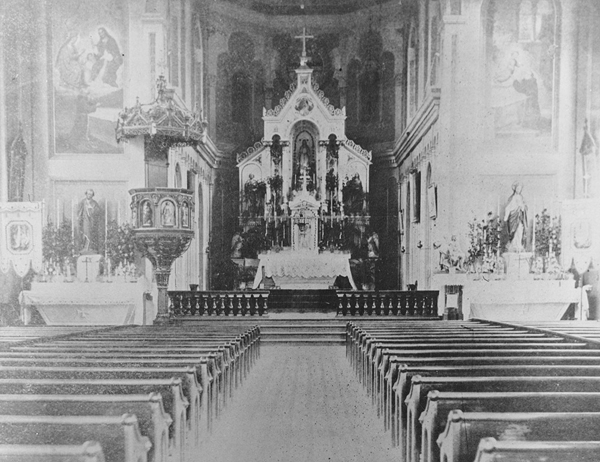
The Vandals would be impressed: Univ. of Dayton chapel

I received a link to an article at Catholic Beat about the slated renovation of the chapel at the University of Dayton.

There are before and after pictures which are striking.  The Vandals couldn’t have done a better job of destroying this chapel.

The upcoming renovation is rather strange in some of its aspects.  For example, the tabernacle will be removed from sight:

According to the flier put together by concerned students, who say they are not a formal group, the carved wooden altar will be moved toward the transept and the tabernacle will be placed behind it (accessed by a door to be cut in the center of the altar) for a “reservation chapel” with room for a handful of adorers. The walls of the apse will be moved out, requiring the demolition of the painted ceiling and the removal of the wooden pulpit, parts of which will be used to clad a baptismal font. The choir loft will be lowered, and the cast iron pillars holding it up removed, along with the church’s organ.

Have a look at the plans.

I’ll bet that the students would want a restoration rather than a wreckovation.

What the place looked like before the wholesale devastation of the 1970’s.

The Vandals would be impressed: Univ. of Dayton chapel

Posted in Liberals, Liturgy Science Theatre 3000 | Tagged
34 Comments

Another liberal writer turns on Pope Francis

The repulsively lefty Maureen Dowd has a piece in the Irish Times… it’s like a perfect storm, no?… in which she lays into Pope Francis.

This is how the Liberal catholic Left will be talking about Francis before too long.

Let’s have a peek at her green-inked piece with my emphases and comments:

American nuns at rough end of Pope Francis’s mixed messages

So much for all the cozy hugs and soothing cold calls and fun selfies and humble gestures and talk of mercy, love, inclusion, equality and justice. Pope Francis appears guilty of condoning that most base Vatican sport: bullying nuns.  [We don’t, of course, accept her absurd premise.  But we are sure that she believes what she wrote.] The cool pope suddenly doesn’t seem so cool, allowing Rome’s grand inquisitors to torque up the derogation this Mother’s Day [Ummm… Maureen?  This happened some days before Mother’s Day.] of the American sisters who have mothered so many – even as an endless parade of ghoulish priests were shielded as they defiled vulnerable kids in their care. [She conveniently leaves about the part about nuns who violated children.]
Pope Benedict XVI’s Vatican was determined to rein in American nuns inspired by Vatican II, accusing them of pushing “radical feminist themes” [which is true] and caring for the sick instead of parroting church teaching opposing contraception, gay relationships and the ordination of women. [“parroting”?  Fidelity to the Church’s teaching is mindless repetition, it seems.]
Although some conservative American bishops have politicised the abortion issue, [HAH!  There she goes!  Now she is parroting liberal talking points.] punishing liberal pols who were pro-choice, [“punishing” liberal pols?  Name 10 who have been “punished”.] they were furious that some uppity nuns supported the president’s healthcare plan, including his compromise on contraception for religious hospitals.  [She has conflated various issues into one, hasn’t she?  The Holy See’s CDF recently addressed the LCWR leadership about doctrinal and spiritual issues.  That is not the same thing as concern about how some American nuns gave cover to pro-abortion politicians so that they could betray their Faith and vote for ObamaCare.  BTW… has your insurance been cancelled yet?]
On Monday, we learned that German cardinal Gerhard Müller, the Vatican orthodoxy watchdog, upbraided the officers of the largest group of American nuns, [I doubt Maureen actually read Card. Müller’s remarks.  In no way can he be fairly described as having “upbraided” them.] the Leadership Conference of Women Religious, which has been investigated and reprimanded by Rome.
He objected to their plan to honour Sr Elizabeth Johnson, a Fordham theology professor, who has written that women are uncomfortable with “the dominant images of God as father, lord and king” and would prefer “non-authoritarian” female language for God. [But, Maureen, try to follow… that’s not all she wrote.]
Last year, Francis said he would let the Vatican’s coercive reform of the nuns’ group continue. And this past week, he was silent after Müller’s mauling of the nuns. [So?] The odd thing, as his biographer Paul Vallely told me, is, “He basically agrees with the nuns.” [Now turn the sock inside out.  If someone like Pope Francis wants his deputy to talk to you like that, then how far off the rails are you?] The new pope’s focus on the poor and social justice, his “Who am I to judge?” cri de coeur on gays, [I suspect Dowd has no clue about the actual context of that remark.] his critique that the church has become too “obsessed” with abortion, gay marriage and contraception [That is a mischaracterization.  He has never said that “the Church has become too ‘obsessed’ with abortion”.] – all these shocking and refreshing moves echo the Gospel-infused spirit for which the nuns are being punished.

Butterfly of delight
“This latest slapdown raises a big question about Pope Francis’s character,” said Kenneth Briggs, the author of Double Crossed: Uncovering the Catholic Church’s Betrayal of American Nuns. “Is he content projecting a Mr Nice Guy image while giving the green light to the Vatican big boys to pursue a hard line? Is he the butterfly who delights everybody, or is he also the strong arm?” [The Left are turning on Francis.]
Although the 77-year-old pope has said that women could gain greater power in the church, other comments have been typically atavistic. While praising women for their “sensitivity,” “intuition” and mothering skills, he said flatly that women’s ordination to the priesthood “is not a question open to discussion”.

It is fitting that she ended with that last point.

The holy grail of the catholic Left is the ordination of women.  They will never be content until that happens.

It is never going to happen.

Posted in Francis, Green Inkers, Liberals, Women Religious | Tagged ,
29 Comments

Summorum Pontificum. It won’t be stopped.

Here is some news to cheer you in these otherwise chaotic and troubling times.

From HPR:

Seven Years after “Summorum Pontificum”: Nearly 500 North American Churches Offer the Traditional Latin Mass

For those Catholics who are seeking even more regular access to the Traditional Latin Mass, sacraments, and accompanying parish and liturgical life, there are 75 parish locations that offer this access daily [Such as that perfectly located, spiritual oasis Holy Innocents in Manhattan] … the ideal and ultimate goal for Catholics who desire to truly live out the liturgical life of the Church in its fullness.

The upcoming seventh anniversary of the implementation date of Summorum Pontificum has been noted with nary a whisper from likely traditional-minded media outlets and blogs. [Maybe we aren’t talking about it much – yet – because it will be, after all, in September?] I suppose with both the mainstream and Catholic media’s feeding frenzy on covering Pope Francis’ every waking moment, movement, and spoken word, this shouldn’t be a surprise.
Has it really been seven years since that momentous date that provided juridical recourse to Catholic laymen directly with their parish priest to provide access to the Traditional Latin Mass and sacraments? What kind of results have we seen in the United States (including Puerto Rico) and Canada in dioceses and parishes offering the Traditional Latin Mass?
The Coalition in Support of Ecclesia Dei, keeps a comprehensive list of these locations, and their data are used for this story. At last count, in 191 dioceses in North America, there are about 485 parishes that offer the Traditional Latin Mass with some frequency (monthly, twice-per-month, or weekly). There are 335 parish locations that offer a weekly Traditional Latin Mass to Catholics albeit, more often than not, in afternoon or evening time slots. But still, 335 weekly offerings in 191 total North American dioceses seem to be a positive commentary on the fruits of Pope Benedict’s motu proprio.
For those Catholics who are seeking even more regular access to the Traditional Latin Mass, sacraments, and accompanying parish and liturgical life, there are 75 parish locations that offer this access daily (or close to daily, sometimes with the summer being an exception, for instance). This is, of course, the ideal and ultimate goal for Catholics who desire to truly live out the liturgical life of the Church in its fullness. And of those 75 parish locations, a total of 38 are provided for by the Priestly Fraternity of St. Peter (FSSP), and another 13 by the Institute of Christ the King Sovereign Priest (ICR).
This brings us to the heart of this article. That leaves a mere 24 diocesan, or other, venues (such as St. John Cantius Canons in Chicago) where the Traditional Mass is regularly offered daily (again, noting some occasional exceptions).

[…]

This article will focus on a diocesan parish offering the Traditional Latin Mass in one of the most unlikely of places—what is often referred to as “the buckle of the Bible Belt”—Greenville, South Carolina (more broadly, the Greenville-Spartanburg-Easley-Anderson “Upstate” area). While Prince of Peace is a parish without the benefits of a personal parish served by a group of priests such as the FSSP or ICR, the parish’s evangelical liturgical approach is beginning to attract national and international attention.
Following is an interview with Rev. Christopher Smith, the pastoral administrator at Prince of Peace Catholic Church, which serves nearly 2,000 families in Taylors (Greenville), South Carolina. Not only is this parish attracting families seeking access to doctrinal and liturgical sanity in the wasteland of the postconciliar debacle, it is beginning to be recognized by even the non-Traditional Catholic audience as perhaps a beacon of the “New Evangelization” due to the number of converts and reverts it attracts, but with methods and techniques borrowed from the “Old Evangelization.” Of course, the apparent irony here will not be lost on longtime readers of The Remnant. Average daily Mass attendance (Monday through Saturday) hovers around 40 with weekly Sunday Mass attendance edging as high as 200-plus, but with regular attendance around 170.
Note that Prince of Peace also has a burgeoning school, a round-the-clock adoration chapel, and numerous other flourishing apostolates one would expect from a parish with parishioners on fire for the faith. Prince of Peace is also home to numerous processions on special feast days and adoration and benediction of the Blessed Sacrament.

[…]

Read the rest there.

I have been saying for decades, not years, that the real impact of the older form of the Roman Rite will be felt across the whole breadth of the Church when diocesan priests take it up and implement it in parishes.

As much as I like and appreciate the good work of groups such as the FSSP and the ICK, they are specialists, in a sense.  Diocesan priests – let’s call them “garden variety” priests although so many of them are also exceptional – make the greatest impact simply because they are far greater in number, they have parishes, and they are more stable within a region.  Would that they were also more stable in assignments.  This 6 year thing… well… don’t get me started.

The good news is this: everywhere I go, the large majority of young priests and seminarians I meet tell me that there is great interest in the traditional forms amongst their ranks.  Seminarians, especially, have related that almost all their classmates are now at least open to the learning how to use the Missal of St. John XXIII.

As a matter of fact, the men who are well along in their formation, or actually preparing to be ordained would, if they could, say their 1st Mass in the traditional Roman Rite.

This will spook liberals something fierce.   I know of a bishop who actually quizzes deacons about what form of Mass they will use for their 1st Mass: the implication being that it had better not be a TLM and that their ordination may depend on it.  Nice, huh?

You know, while I would rather have a somewhat smoother path in the growth and implementation of Summorum Pontificum, maybe it is – in the large scheme of things – good that we can from time to time report that some bishop or even curial official actively oppresses people who want the traditional forms.  Yes, it hurts.  Yes, it is unjust.  Yes, we wish it weren’t so.  BUT… in doing that they only serve to toughen up those who will, in the end, undo their liberal catholic agenda.

Go ahead and tell seminarians that they can’t attend the old Mass anywhere.  Go ahead and threaten them.  All you are doing is making them want it even more.  Deny them the chance to learn the older Mass in classes in the seminary, will you?  Fine, they will learn it in their rooms, with the help of young priests who are already using it.  Bully them all you want.  It won’t work.  They are the maquis and you can’t stop them.

It is possible to get mired in all the bad news or in the news about strange and controversial things that this or that highly ranked churchman might spout on a bad day.

What I have seen, and what encourages me, is that a lot of the younger guys, young priests and seminarians, are really not paying a whole lot of attention to goofy prelates and mixed messages.  These men do not lug around a lot of baggage.  They do not have the scars of the wars that some of us who are older have gained.  They really took notice of what Pope Benedict did and they took it on board.  In turn, this has a knock on effect among their peers.  As the newer seminarians come in, they will see that the older guys, whom they admire, are learning, and saying, the older Mass and they will want to do so too.

Do everything you can to encourage seminarians and young priests to learn and say the Extraordinary Form.  A good first step could be to make sure that they all have the Missale Romanum of St. John XXIII.  Be ready to send them off to a workshop.

¡Hagan lío!  This cannot be stopped.

Posted in "How To..." - Practical Notes, Be The Maquis, Benedict XVI, Hard-Identity Catholicism, Liturgy Science Theatre 3000, Mail from priests, Our Catholic Identity, Priests and Priesthood, Seminarians and Seminaries, SUMMORUM PONTIFICUM, The future and our choices, Wherein Fr. Z Rants | Tagged , , ,
40 Comments

Card. Burke with do’s and don’t’s of parish, church closures

Card. Burke with do's and don't's of parish, church closuresHearts can break when churches close. But if the church cannot be repaired, or if people are not paying the bills… what to do? Sometimes they must close.

However, I think there are many case in which a church does not have to be closed… but it is closed all the same for one “reason” or another. There are, in fact, parish churches which could be revived with, for example, the use of the older form of Mass.

In any event, one of the Church’s greatest jurists, His Eminence Raymond Card. Burke has comments about law and closing churches.

From Catholic Review with my emphases:

Hew to canon law when closing churches, Cardinal Burke says
May 09, 2014

By George P. Matysek Jr.

When considering the suppression of parishes or the closing of church buildings, bishops should hew closely to canon law not simply because it’s a legal requirement of the church, Cardinal Raymond L. Burke said, but because it helps foster unity.

In a May 7 interview with the Catholic Review, the prefect of the Supreme Court of the Apostolic Signature, the Vatican’s highest court, said following proper procedures helps ensure legitimate decisions.

“When we don’t follow the requirements of the law, then people rightly claim that they’ve been aggrieved by this,” said Cardinal Burke, who was a featured speaker at the Eastern Regional Conference of the Canon Law Society of America, held May 6-8 at the Hotel Monaco in Baltimore. The cardinal’s presentation was closed to the media, but he granted a brief interview to the Catholic Review.

“(When) we do follow the requirements of the law,” he said, “even if we take a decision that’s unfavorable to people, at least they know that it was taken legitimately with respect to what the church requires for that decision.”

According to canon law, a bishop has the authority to suppress (close) a parish when there is a “just” reason. [That’s the kicker, ain’t it?  What is a “just” reason?] He must consult with his diocesan presbyteral council, and parishioners have the right to make their views heard.

Closing a church building, a process canon law refers to as relegating it to “profane, but not sordid use,” requires that a bishop have a grave reason for the closure.

Cardinal Burke noted that when discerning whether to reduce buildings to profane use, dioceses should “avoid presuppositions that are not correct,” including the notion that a parish can have only one church. It is possible for a parish to have two or more church buildings, he said. Although a parish may be suppressed, its buildings may continue to be used as part of another parish.

If a church is being closed because the parish doesn’t have the means to keep up more than one church, Cardinal Burke said, “then you have to demonstrate that, in fact, there aren’t the means there for the church to be maintained.” [So, if there are means, that is, the place is paying its bills and keeping the place up, then that can’t be used legitimately as an argument for closing it.]

The cardinal, a former bishop of La Crosse, Wis., and a former archbishop of St. Louis, added that sometimes a church is in “such a terrible state of deterioration” or has suffered some calamity that has left it so seriously damaged that it would be a burden for a parish to maintain.

“All those things simply have to be documented,” he said.

The laity plays a key role in the health of churches, Cardinal Burke said.

“Especially in this country (the United States), the existence of churches depends on the generosity of the laity,” he explained. “If the laity aren’t contributing generously, these churches can’t continue.”  [If you want your church to stay open you have to pay for your church to stay open.]

Maintaining multiple churches within a single parish requires a strong commitment from the laity, he added, who are often entrusted with the maintenance and care of church buildings.

“In my own experience as a bishop, I found the lay faithful to be exemplary in this,” Cardinal Burke said. “In the first diocese I served, there were a number of these churches, and they were kept up, cared for completely by the laity and they did good work.”

Cardinal Burke said he knows no bishop “in his right mind” who would want to close a parish unnecessarily. He acknowledged that it is always “a source of a lot of suffering for the lay faithful.”  [I believe His Eminence is being kind.  I think there are bishops who want to close certain parishes for ideological reasons, not because the place is too run down or isn’t paying the bills.]

“The bishop and the priests have to provide as best they can for the spiritual needs of the parishioners with the material goods that they have available,” he said.

Bishops must be good stewards, he said, and use “prudential judgment” in how material resources can be best used. He cautioned that there shouldn’t be a prejudice against keeping church buildings open.

“The bishop needs to have before him all the factual information in order to know the best way to decide with regard to a particular church,” Cardinal Burke said.  [I think that the lay people who pay the bills need that information as well.]

Posted in "How To..." - Practical Notes, Our Catholic Identity, The Drill | Tagged ,
22 Comments

Day 20: And they returned home, tired but happy.

My view for a while:

20140510-144408.jpg

Posted in On the road, What Fr. Z is up to |
5 Comments

19 Oct: Beatification of Paul VI (Canonization of Vatican II)

19 Oct: Beatification of Paul VI (Canonization of Vatican II)As I thought… the next phase of the canonization of Vatican II will occur 19 October.

I wrote something about the miracle attributed to Paul VI the other day.  Amazing, as they often are.  HERE

From Vatican Radio:

(Vatican Radio) Pope Francis has approved the promulgation of the decree for the cause of beatification of his predecessor Pope Paul VI. The approval was announced Saturday.

The beatification ceremony is scheduled to take place October 19, 2014, at the conclusion of the III Extraordinary General Assembly of the Synod of Bishops on the family.

The Holy Father received Cardinal Angelo Amato SDB, prefect of the Congregation for the Causes of Saints on Friday afternoon, and authorized the Congregation to promulgate the following decrees :

– The miracle attributed to the intercession of the Venerable Servant of God Paul VI (Giovanni Battista Montini) , the Supreme Pontiff; born September 26, 1897 in Concesio (Italy) and died August 6, 1978 at Castel Gandolfo (Italy);
– The miracle attributed to the intercession of the Venerable Servant of God Luigi Caburlotto , diocesan priest, founder of the Institute of the Daughters of St. Joseph ; born in Venice (Italy) June 7, 1817 and died there July 9, 1897 ;
– The heroic virtues of the Servant of God Giacomo Abbondo, diocesan priest ; born in Salomino (Italy) August 27, 1720 and died in Tronzano (Italy) February 9, 1788 ;
– The heroic virtues of the Servant of God, Giacinto Alegre Pujals, professed priest of the Society of Jesus; born in Terrassa (Spain) December 24, 1874 and died in Barcelona (Spain) December 10, 1930 ;
– The heroic virtues of the Servant of God Carla Barbara Colchen Carré de Malberg , mother of a family, founder of the Society of the Daughters of St. Francis de Sales ; Born in Metz ( France), April 8, 1829 and died in Lorry- les -Metz (France) January 28, 1891 .

Again, in honor of Paul VI, Pope Francis should, at the beatification, bring back the sedia gestatoria, far humbler than the expensive Popemobile and far greener.

If it was good enough for St. John XXIII and Bl. Paul VI, it is good enough for any Pope!

Posted in Francis, Saints: Stories & Symbols, Vatican II | Tagged , , ,
81 Comments

The Outstanding Benedictines of Norcia!

Tonight I am at a gala and fundraiser for the wonderful community of Benedictine monks at Norcia in Italy. They are in Italy. We are in Connecticut.

Look them up! Click HERE

Card. Burke is here. I had a chat with him earlier.

I can’t speak highly enough of these good people.

Some shots.

20140509-192729.jpg

20140509-192740.jpg

20140509-192807.jpg

20140509-192945.jpg

20140509-193904.jpg

Did I mention the incredible beer?

20140509-194046.jpg

Fr Nivakov gave a charming intro.

20140509-201739.jpg

Fr Cassian prayed for our meal and then gave a talk about the monastery.

20140509-204132.jpg

20140509-204143.jpg

20140509-205525.jpg

20140509-205746.jpg

20140509-213637.jpg

Auction time. With Al Barber.

20140509-214740.jpg

20140509-214753.jpg

20140509-215940.jpg

Posted in On the road, The Campus Telephone Pole, What Fr. Z is up to |
12 Comments