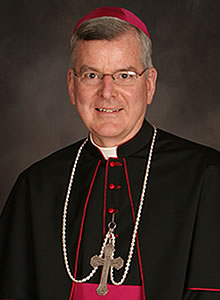
Archbp. Nienstedt and the defense of true marriage

Archbp. Nienstedt and the defense of true marriageIn this week’s number of The Catholic Spirit, the newspaper and site of the Archdiocese of St. Paul and Minneapolis, His Excellency Most Rev. John Nienstedt has a column about the Minnesota Marriage Amendment, that is, a defense of real marriage, which can only – by God’s design evident in our human nature – be between one man and one woman.

Marriage amendment deserves our support

June 9, 2011 10:53 am
Archbishop John C. Nienstedt

Our state House and Senate have placed a constitutional amendment on the November 2012 ballot that will define marriage in the State of Minnesota as the union between one man and one woman.

Regrettably, the media and some secular commentators have chosen to mischaracterize this measure as anti-gay, mean-spirited and prejudicial. This is not the case or the intent behind the initiative.

Good reasons

The Minnesota Catholic Conference, made up of the seven Catholic bishops from the state, support this amendment not for prejudicial or political reasons, but rather for reasons that are theological, biological and pastoral.

Theologically, the definition of marriage predates any government or religious denomination. As we read in the Bible, it reflects God’s plan for man and woman to share in his creative power of bringing new life into the world (Genesis 1:27-28). This is ratified by Jesus himself in Matthew 19:8-9. It is a truth that is also evident in light of the natural moral law, which grounds our understanding of the dignity that belongs to each human person.

In addition, the very biological, not to mention spiritual, complementarity of the two sexes defines the reproductive nature of their relationship which, in turn, enhances the well-being and joy of that union. The enfleshed oneness of a man and a woman is indeed a communion of life and love.

Pastorally, children flourish best in the context of having both a mother and a father. Every scientific study confirms this reality. We know that many single parents strive mightily to raise children in as normal a context as possible — and many do an excellent job at this.  Nevertheless, it is a proven fact that boys and girls develop better with the influence of a mother and a father, living in the same home.

It should also be remembered that the teaching of the church is always meant to uphold and enhance the inherent dignity of the human person as a son or daughter of God.  In this regard, I publish here with his permission an article written by Archbishop Timothy Dolan of New York. His argumentation is hard to refute:

‘Marriage: the core of every civilization’

It was one of the more uncomfortable moments in my life.

Outside of St. John the Evangelist Cathedral in Milwaukee, where I, as archbishop, was celebrating Sunday Mass on an otherwise magnificent Wisconsin autumn day, were a couple dozen very vocal protesters, representing some off-brand denomination, shouting vicious chants and hold­ing hateful signs with words I thought had gone the way of burning crosses and white hoods.

This frenzied group, taunting the people as they left Mass, were rabid in criticizing the Catholic Church, especially her bishops, for our teaching that homosexuals deserve dignity and respect.

To be more precise, this group was yelling at us because, they objected, the Catholic Church was so friendly, welcoming, and defensive of gay (they used other foul words) people.

They waved placards explicitly quoting and condemning #2358 of the Catechism of the Catholic Church, which affirms the dignity of those with same-sex attraction, and warns against any form of prejudice, hatred or unjust discrimination against them, and insists that homosexual acts, not persons, are not in conformity with God’s design.

Never have I faced such a vitriolic crowd, blasting the church for simply following the teaching of Jesus by loving and respecting people regardless of anything, including their sexual orientation.

When a reporter asked me for a comment, I replied, “They’re right: we do love and respect homosexual people. These protesters understand church teaching very well.”

I’ve been recalling that episode often of late, because now I hear Catholics — and, I am quick to add, Jews, other Christians, Muslims and men and women of no faith at all — who have thoughtfully expressed grave disapproval of the current rush to redefine marriage, branded as bigots and bullies who hate gays.

[Here’s the key.] Nonsense! We are not anti-anybody; we are pro-marriage. The definition of marriage is a given: It is a lifelong union of love and fidelity leading, please God, to children, between one man and one woman.

History, natural law, the Bible (if you’re so inclined), the religions of the world, human experience and just plain gumption tell us this is so. The definition of marriage is hardwired into our human reason.

To uphold that traditional definition, to strengthen it and to defend it is not a posture of bigotry or bullying. Nor is it a denial of the “right” of anybody. As the philosophers remind us, in a civilized, moral society, we have the right to do what we ought, not to do whatever we want. Not every desire is a right.

To tamper with that definition, or to engage in some Orwellian social engineering about the nature and purpose of marriage, is perilous to all of us. If the definition of marriage is continually being altered, could it not in the future be morphed again to include multiple spouses or even family members? [Pets?]

Nor is it “imposing” some narrow outmoded religious conviction. One might well ask just who is doing the “imposing” here: [a] those who simply defend what the human drama has accepted from the start, a belief embedded in nature and at the core of every civilization — the definition of marriage — [b] or those who all of a sudden want to scrap it because “progressive, enlightened, tolerant culture” calls for it.

Sadly, as we see in countries where such a redefinition has occurred, “tolerance” is hardly the result, as those who hold to the given definition of marriage now become harassed and penalized.

If big, intrusive government can re-define the most basic, accepted, revealed truth that marriage simply means one man + one woman + (hopefully) children, in a loving family, then, I’m afraid, Orwell’s works will no longer be on the fiction shelf. As someone commented to me the other day, “Wouldn’t it be better for our government to work on fixing schools than on redefining marriage?”

And resistance to this rush to radically redefining the ingrained meaning of marriage cannot be reduced to an act of prejudice against people with a same-sex attraction.

God love you!

WDTPRS KUDOS to Archbishop Nienstedt.

Posted in Biased Media Coverage, One Man & One Woman, Our Catholic Identity, The Drill, The future and our choices, The Last Acceptable Prejudice, Throwing a Nutty | Tagged , , , , ,
16 Comments

An Arizona Analogy

A friend sent this.

People will surely have differing views on the Arizona illegal-immigrant legislation, but you have to hand it to Gov. Jan Brewer for this response.

Arizona governor vs. Phoenix Suns owner – I’d say she makes a
pretty good case with her analogy!!

The owner of the Phoenix Suns basketball team, Robert Sarver,
came out strongly opposing AZ’s new immigration laws.

Arizona’s Governor, Jan Brewer, released the following statement
in response to Sarver’s criticism of the new law:

“What if the owners of the Suns discovered that hordes of people
were sneaking into games without paying? What if they had a
good idea who the gate-crashers are, but the ushers and
security personnel were not allowed to ask these folks to
produce their ticket stubs, thus non-paying attendees couldn’t
be ejected.

Furthermore, what if Suns’ ownership was expected to provide
those who sneaked in with complimentary eats and drink? And
what if, on those days when a gate-crasher became ill or injured,
the Suns had to provide free medical care and shelter?”

– Arizona Gov. Jan

Posted in Lighter fare | Tagged , ,
34 Comments

Tip of the Day

Check all the pockets before you wash clothes.

No.  Really.

[CUE MUSIC]

It also helps to have lot’s of hot Mystic Monk Coffee.  This morning I was listening to Bill Bennett’s radio show – and doing laundry – and in the first hour Dr. Bennett was talking about Mystic Monk Coffee!  It seems the Wyoming Carmelites sent some to them.  Bennett talked about them through the morning and even played a clip of Gregorian chant… between the Gorden Lightfoot tunes.

FWIW, the Monks seem still to be selling a lot of their Pascha Java.  Perhaps the word “bourbon” in the description has something to do with its popularlity?

Or tea!  It makes great sun tea.  It looks like Earl Gray is trending right now.

Tip of the Day

It’s swell!

(Today I am using my “Save The Liturgy” mug.)

Posted in "How To..." - Practical Notes | Tagged
32 Comments

Digital camera, memory card, and wifi

Any of you readers into digital photography?

I was wondering about a way to transfer photos from my camera, a Canon EOS 20D, to my computer wirelessly.

Looking around a bit I found a cool flash memory card with integrated wifi called Eye-Fi Pro X2.

My camera – I believe – is too old to handle this new and very cool card.

Any other ideas?

Otherwise, I suppose one of these days I will need to deal with my camera, which has some … well… duct tape involved.

Posted in "How To..." - Practical Notes | Tagged , ,
11 Comments

Ribs that stick to your supper

I simply had a hankering for some pork ribs and sour kraut.

This is stimulated by, among other factors, the absurdly low sale price on the spare ribs.

So… some juniper berries, kraut, tarragon and rosemary, an onion, ribs.

20110608-092737.jpg

Brown your ribs on both sides.

20110608-092752.jpg

Remove the ribs to a plate and brown your onions.

Add well… well-drained kraut, the berries, the herbs.

You have to drain the kraut really well, or this gets soupy.  You can replace the moisture with something more interesting.

I add either dry white wine or hard cider.  Tonight, cider.

20110608-092812.jpg

Don’t forget to put the ribs back in.

20110608-092834.jpg

I put the lid onto the French oven and put it into the oven at 325 F for about a half hour and then lowered the heat to 285 F for another hour and a half.

I started this at about 4:30 pm and ate at about 7 pm.

My garnish was some mustard I whipped up from dry, powered mustard from Penzy’s.  Zippy stuff.

20110608-092853.jpg

They fell apart.  The bones just slide away.

This is so flexible.  You can use just about any amount of kraut and onion.  Go a bit easy with the juniper till you get to know it.  Juniper and pork team up very well.  I have often used gin to deglaze a frying pan in which I have done pork chops.   Just as pork is good with fruit, such as apples, so too it is good with browned onions.  Onions have a lot of sugar in them, which caramelizes as you brown them. If you are entertaining, this is a good main course.  Just keep the temperature low.  They could even be better the next day.

The cooking time can be long and patient.

So, some comfort food, and it isn’t even a cold winter night!

Posted in Fr. Z's Kitchen | Tagged , , ,
30 Comments

Dennis Prager: High School Principal’s Manifesto

In my email I received a forward of a piece written by American radio show host Dennis Prager, one of the smartest guys on the air.

It may shock some of you to know that I am rather conservative.  When I listen to talk radio, and I occasionally do but only when recorded so I can skip the breaks and therefore save time, I listen to Rush (less these days, but still the standard), Mark Levin (great on constitutional questions – his website and audio downloads are free!  If you think I rant, you should hear Mr. Levin!), Bill Bennett (excellent for cultural issues and a genuinely nice guy – I used to be on his show with some frequency), Hugh Hewitt (who has a special interest in religion in the public square)… if you get my drift.

This is what Mr. Prager would announce were he a High School Principal.  This needs no emphases or comments from me.

To the students and faculty of our high school:

I am your new principal, and honored to be so. There is no greater calling than to teach young people.

I would like to apprise you of some important changes coming to our school. I am making these changes because I am convinced that most of the ideas that have dominated public education in America have worked against you, against your teachers and against our country.

First, this school will no longer honor race or ethnicity. I could not care less if your racial makeup is black, brown, red, yellow or white. I could not care less if your origins are African, Latin American, Asian or European, or if your ancestors arrived here on the Mayflower or on slave ships.

The only identity I care about, the only one this school will recognize, is your individual identity — your character, your scholarship, your humanity. And the only national identity this school will care about is American. This is an American public school, and American public schools were created to make better Americans.

If you wish to affirm an ethnic, racial or religious identity through school, you will have to go elsewhere. We will end all ethnicity-, race- and non-American nationality-based celebrations. They undermine the motto of America, one of its three central values — e pluribus unum, “from many, one.” And this school will be guided by America’s values.

This includes all after-school clubs. I will not authorize clubs that divide students based on any identities. This includes race, language, religion, sexual orientation or whatever else may become in vogue in a society divided by political correctness.

Your clubs will be based on interests and passions, not blood, ethnic, racial or other physically defined ties. Those clubs just cultivate narcissism — an unhealthy preoccupation with the self — while the purpose of education is to get you to think beyond yourself. So we will have clubs that transport you to the wonders and glories of art, music, astronomy, languages you do not already speak, carpentry and more. If the only extracurricular activities you can imagine being interesting in are those based on ethnic, racial or sexual identity, that means that little outside of yourself really interests you.

Second, I am uninterested in whether English is your native language. My only interest in terms of language is that you leave this school speaking and writing English as fluently as possible. The English language has united America’s citizens for over 200 years, and it will unite us at this school. It is one of the indispensable reasons this country of immigrants has always come to be one country. And if you leave this school without excellent English language skills, I would be remiss in my duty to ensure that you will be prepared to successfully compete in the American job market. We will learn other languages here — it is deplorable that most Americans only speak English — but if you want classes taught in your native language rather than in English, this is not your school.

Third, because I regard learning as a sacred endeavor, everything in this school will reflect learning’s elevated status. This means, among other things, that you and your teachers will dress accordingly. Many people in our society dress more formally for Hollywood events than for church or school. These people have their priorities backward. Therefore, there will be a formal dress code at this school.

Fourth, no obscene language will be tolerated anywhere on this school’s property — whether in class, in the hallways or at athletic events. If you can’t speak without using the f-word, you can’t speak. By obscene language I mean the words banned by the Federal Communications Commission, plus epithets such as “Nxxxxx,” even when used by one black student to address another black, or “bxxxx,” even when addressed by a girl to a girlfriend. It is my intent that by the time you leave this school, you will be among the few your age to instinctively distinguish between the elevated and the degraded, the holy and the obscene.

Fifth, we will end all self-esteem programs. In this school, self-esteem will be attained in only one way — the way people attained it until decided otherwise a generation ago — by earning it. One immediate consequence is that there will be one valedictorian, not eight.

Sixth, and last, I am reorienting the school toward academics and away from politics and propaganda. No more time will devoted to scaring you about smoking and caffeine, or terrifying you about sexual harassment or global warming. No more semesters will be devoted to condom wearing and teaching you to regard sexual relations as only or primarily a health issue. There will be no more attempts to convince you that you are a victim because you are not white, or not male, or not heterosexual or not Christian. We will have failed if any one of you graduates this school and does not consider him or herself inordinately lucky — to be alive and to be an American.

Now, please stand and join me in the Pledge of Allegiance to the flag of our country. As many of you do not know the words, your teachers will hand them out to you.

It’s nice to dream.

I’ll leave the combox open for as long as people can exercise a measure of self-editing and civility.

However, I ask that you do NOT… do NOT… engage EACH OTHER.

Make your points, briefly, and let other people make theirs.

Don’t intimidate, name call, or attack personally.

Posted in "How To..." - Practical Notes, The future and our choices | Tagged , , , , , ,
76 Comments

QUAERITUR: Why don’t priests use the Apostolic Pardon for the dying?

QUAERITUR: Why don't priests use the Apostolic Pardon for the dying?From a reader:

I understand that the Sacrament of the anointing is not the same as the apostolic pardon. Why is it that some priests do not say those words for this pardon and give both the blessing and the pardon? I had a card with the words on it and told my girlfriend who just died and she told the priest she wanted the apostolic pardon which he did give her and now she is in heaven without purgatory.

Thanks for being concerned about the good death of your friend.  We have to help each other.

We have great confidence that by using Holy Church’s sacraments, and also her authority to bind and loose, the “power of the keys”, we can even at the moment of death be forgiven both all of our sins, in the Sacrament of Penance or Anointing, and all of the temporal punishment due to sin with the Apostolic Pardon.

Of course we propose these things, but God disposes them according to His will.

The Apostolic Pardon, or Benediction, forgives temporal punishment due to our sins, not the sins themselves.  If anything remains from our lives, provided we die in the state of grace, for which we have not done adequate penance, the temporal punishment due to those sins, if we have not done adequate penance in life, is forgiven us through the Apostolic Pardon.  This is why the Apostolic Pardon is often given after the Last Rites of sacraments of penance, anointing, and Viaticum.

The older form of the Apostolic Blessing:

Ego facultate mihi ab Apostolica Sede tributa, indulgentiam plenariam et remissionem omnium peccatorum tibi concedo et benedico te. In nomine Patris, et Filii, + et Spirtus Sancti, Amen. … By the faculty given to me by the Apostolic See, I grant you a plenary indulgence and the remission of all your sins, and I bless you. In the Name of the Father and the Son + and the Holy Spirit. Amen.

In the newer form I think the words “et benedico te” were removed.

When it comes to forms of Anointing, Penance and the Apostolic Pardon, I always use Latin.

This is a marvelous faculty, given by Holy Church to the priest so that he can grant this remission of temporal punishment and forgive sins.  Used in conjunction with the Last Rites a soul is well prepared to go on to judgment.  Well prepared.  We cannot force God and force souls, but we have confidence that God’s promises to the Church and the Church’s teaching to us are all true.

Why don’t more priests use the Apostolic Pardon?

I am not sure that they don’t.  I know that my priest friends, my circle, as it were, know what it is and would use it.

Other priests?  Not sure.

If they don’t, then I suspect that it is simply because they may not know about it.  It is quite possible that, given the state of seminary training over the last decades, they were never taught about the Apostolic Pardon and perhaps their liberal, discontinuity pastors in their first assignments didn’t use it.  As the old not-quite-Latin adage goes, “nemo dat quod non ‘got‘”.

Another reason they may not use it is that they don’t think the circumstances warrant using it, namely that the person isn’t very close to death after all.

But I think that priests, being generally good men and being involved in the sometimes beautiful, sometimes frightening, always awe-filled moment of a person’s dying breaths and last heartbeats, would want to do everything they could to help the person to his or her judgment.  These are not moments to fool around.  I can’t imagine a priest who would not want to use the Apostolic Pardon appropriately – provided he knew it.

Therefore, it is not a bad idea to have the card with the prayer on it, just in case.

Also, for all you priests and seminarians out there, dig into what the Apostolic Pardon entails.  Don’t be ignorant of this powerful aid for a person’s dying challenge.

Posted in "How To..." - Practical Notes, ASK FATHER Question Box, The Drill | Tagged , , , , , , , ,
28 Comments

Critics of the new, corrected translation would have, back in the day, resisted also the King James Bible

It is often said, by liberals, that because in ancient Rome there was a shift from Greek to Latin for the Roman liturgy, and since Latin was the vernacular back then, we should abandon Latin now and use the vernacular which is English, pray the way people speak today.

The flaw in that argument is that when the shift was made away from Greek, the Latin that was adopted for the ancient Roman liturgy was not at all the “vernacular”.  The Latin used in liturgy was not the way people spoke in daily life.  The Latin was highly stylized, though remaining terse, with words used in a very different way than that which had been common, if the unlettered had ever even heard them at all.  Romans would have know that what was being said was Latin, and they would have heard intelligible prayers, but they would have been challenged to know what they meant without explanations.  Eventually, they would have become used to a new style of prayer and new vocabulary with the new concepts the vocabulary communicated.  Just as there was a sacral Latin style for prayer in the pagan era, Christian Romans would have recognized a Latin style for sacral use, for prayer.   It was more demanding.

I now see this in the UK’s best Catholic weekly, The Catholic Herald.  My emphases and comments.

The King James Bible, like the new Mass translation, would have been condemned as ‘inaccessible’

Both translations seek to avoid “Gas Board English” and create a suitable language to express transcendent truths

By Fr Alexander Lucie-Smith on Wednesday, 8 June 2011

This year we are all supposed to be celebrating the 400th anniversary of the King James Bible, otherwise known as the Authorised Version. It is four centuries since King James VI and I (as he should properly be called) commissioned what was to become the standard English translation of the Bible. Of course the King James Bible is a Protestant Bible, and its publication stirred the Catholic Church into producing the Douai Bible for English Catholics, or so the story goes, but in fact the Douai Bible precedes the Authorised Version by several years, and may well have been an influence on it. Again, while the King James Bible dates from 1611, it drew on the work of Miles Coverdale and William Tyndale, who had worked about 80 years earlier. Moreover, as I have discovered through reading an excellent book produced to mark the anniversary, this drawing on older sources was done quite deliberately. In other words, the translators of the King James Bible did not want to use up-to-date English, but deliberately chose archaic language.

Critics of the new, corrected translation would have, back in the day, resisted also the King James BibleThe book I have been reading is called Celebrating the King James Version and consists of a series of devotional readings and commentary by Rachel Boulding, who is the deputy editor of the Church Times. The book makes a good case for the idea that the King James anniversary is more than just a matter of Anglican celebration; insofar as the King Kames Version is a masterpiece of English prose, it is to be celebrated by everyone who speaks the language. The King James Version shows us to what heights language can rise. It is the opposite of what Ms Boulding calls “Gas Board English”.  [What would be an equivalent in the USA?  “Cereal Box English”?  “High School Graduate”?  “Social Security Administration”?  “Sit-Com”?  Rather different styles, but each incomprehensible and execrable.]

Ironically, though of course he would not see it that way, even Professor Dawkins is celebrating, though he does warn us that “It is important that religion should not be allowed to hijack this cultural resource”. [ROFL!]

The mention of Gas Board English is particularly significant for Catholics right now, facing as we do the imminent new translation of the Roman Missal. As the bishops’ recent pastoral letter made clear, the new translation is trying to do what the King James translators did so well, namely create a suitable language that will express transcendent truths. This is by no means easy, but it can be done. [And we shall see if the new, corrected translation does it.  But let’s not fool ourselves.  It ain’t King James English.] It is interesting to note that those who seemingly [?] oppose the new translation would presumably also have opposed the King James Version as archaic and no doubt “inaccessible”: [Of course they would have!] but, and here is the key point, the King James Version, which has lasted 400 years, is anything but inaccessible. It has been a huge success, and opened up the Bible to countless generations. [“anything but inaccessible”… well… I wonder if that is true today.  I do know, however, that with greater exposure to it would be gradually more accessible than at first glance or hearing.]

Let us hope that the new translation of the Roman Missal may do the same and open up the transcendent mystery that is the Mass to people of our own time, as well as to many generations to come.  [Do I hear an “Amen!”?]

Well done!

Discuss.

Posted in "How To..." - Practical Notes, Brick by Brick, New Evangelization, The Drill, The future and our choices | Tagged , , , , , , , , , ,
32 Comments

PRAYERCAzT/PODCAzT: Pentecost – the whole nine yards – WDTPRS POLL

I inflict my singing on you for most of this project.  There is also a POLL.  This is also PODCAzT 120.

Quite a while back I started a PRAYERCAzT series, wherein I read and/or sang the prayers and readings for upcoming Sundays and Feasts for the Extraordinary Form.  I meant to be helpful to men who were faced with singing the texts and who were, perhaps, not so familiar with what to do.  It was also meant to help people in the pews get the sounds of the Latin into their ears so that their participation at Mass would be more comfortable and fruitful.

Not long ago I received a very useful new book which published by the Canons regular at St. John Cantius in Chicago.  The book is called Canticum Clericorum Romanum, and it is the first volume.

In the celebration of the older, traditional form of Holy Mass in the Roman Rite, the Extraordinary Form, when Mass is celebrated with greater solemnity, the texts are sung.  The prayers or orations, the readings, the preface, every thing is sung.  This volume has all the texts for all the Sundays of the year and most major feasts in Gregorian musical notation.  Not only that, since there are different tones or melodies we can use to sing texts, the book has the alternative tones as well.

Some time ago I started an audio project, especially intended for priests, who might have to sing the texts during the Extraordinary but who may not be very familiar with these old Roman ways.  Priests, deacons (actual deacons and priests who serve as deacons), laymen who serve as “straw subdeacons”… must sing texts, which for some men is nerve wracking enough.  You wind up looking at examples of paradigmatic texts in, say, the Liber Usualis, and then you look at the Missale, perhaps making a photocopy, perhaps penciling in lines under the vowel where you are supposed to go up….

This new book from the canons in Chicago book has it all laid out.

What I do in this audio project is sing through all the texts of the Mass, in the different alternatives, for Pentecost Sunday.  For the collect there will be a festive tone and a solemn tone.  The epistle, from Acts, has its own tone.  There are three possibilities for the Gospel, the tonus evangelii, tonus antiquior, tonus ad libitum.  There is no tone, of course, for the Secret because it is silent.  And then the two tones we had for the Collect also used for the Post Communion.

This book does not have prefaces, which are in the Missale Romanum.  But there are three tones for the preface of the Holy Spirit, the most usual of which for Pentecost is the solemn tone. There is, however a more solemn tone, or tonus solemnior.  There is a ferial tone, which you would not probably use on Pentecost.  It would more likely be sung for a votive Mass of the Holy Spirit.

PRAYERCAzT/PODCAzT: Pentecost - the whole nine yards - WDTPRS POLLSo, first I’ll sing through the prayers and texts using the new book from the canons.  Then I will switch books and sing all three versions of the Preface of the Holy Spirit. You will notice the different introductory dialogues.  I suggest before singing the tonus solemnior that perhaps you could start with the tone for the tonus solemnis, which people are more likely to know, and then switch seamlessly into the tonus solemnior.  That way, you don’t have chaos at the beginning.

I am doing this so that people can hear the different tones, with the same texts, and, if some priest or deacon out there finds them useful as he looks at the texts and wonders how to sing them, well… this is a public service as it were.


PRAYERCAzT/PODCAzT: Pentecost - the whole nine yards - WDTPRS POLL

The little music clips the Grandes Heures Liturgiques à Notre-Dame de Paris by the Maitrise of Notre Dame in Paris.  I don’t think this is easily available.

PRAYERCAzT/PODCAzT: Pentecost - the whole nine yards - WDTPRS POLLVeni Sancte Spiritus from Pomerium’s Musical Book of Hours.

Arvo Part’s Veni Sancte Spiritus from his fantastic album I Am The True Vine.

And I am very curious about the tones for the prayers, the Gospel, and the preface you prefer.

First, the orations or prayers such as the Collect and Post Communion.

Which tone for the orations (e.g., Collect) do you prefer?

View Results

Loading ...

Second, the tone for singing the Gospel.

Which tone for the Gospel do you prefer?

View Results

Loading ...

Lastly, the tone for the Preface, keeping in mind that the Ferial Tone, isn’t to be used on feasts and Sundays.

Which tone for the Preface you prefer?

View Results

Loading ...

Feel free to use the combox to say why you like one tone or the other.

Posted in "How To..." - Practical Notes, ASK FATHER Question Box, Brick by Brick, Our Catholic Identity, POLLS, SUMMORUM PONTIFICUM | Tagged , , , , , , , , , , , , , ,
3 Comments

Your iPhone: where chicken entrails, dice and Magic 8 Balls converge

Superstitious practices have abounded for as long as we have been around.  Even the snake in the garden, I suppose, was tempting our first parents into a sort of superstition when it, The Enemy, suggested that we could be as gods, knowing, plotting choosing our own courses, looking in a way inappropriate for creatures to have a grasp on the unknowable.

Baseball players are perhaps exempt from the sinful nature of most superstitions, because of the divine favor that rests on baseball.  Otherwise, the horoscope and fortune cookie thing is mostly still, except when it isn’t.

In ancient times, the Romans would look to the patterns of the flights of birds to discern divine favor on an endeavor.  Other celestial or weird phenomenon were taken as omens.  You could find out of a day was propitious for some undertaking by scattering grain in a pen of sacred chickens or, for a more intimate look, disembowel the chickens and read their entrails.

You could also cast lots.  People still do this when they flip a coin or consult their Magic 8 Ball.  A coin toss is fine for a kickoff, but anyone who makes real decisions based on the Magic 8 Ball deserves what happens next.

Sometimes people practiced bibliomancy, by opening a book, often Virgil, later the Bible, and reading the first passage they saw.   What Augustine did in the garden isn’t too far from that.  Divine inspiration?  Maybe.  I guess it depends on why you did it and how it turns out.

With that as a preamble, chicken entrails, rolls of the dice and Magic 8 Balls can now converge in your very own ancient Roman iPhone.

Into ancient omen gazing, divinizing?  There’s now an app for that.

I found here a story that amused, but left me feeling a little odd, given that this sort of thing can also – and I am not making this up – provide an entree to your life for the Enemy of your soul who desires your eternal suffering.

Astragalo, Greek and Roman Art of Divination for the iPhone and iPad

[prMac.com] Rome, Italy – Independent app developer Giampiero Rossi is glad to introduce the update to Astragalo for iOS. The Astragalomancy, Astragalomanteia in Latin, also known as Astragyromancy or Cleromancy, is an ancient Greek and Roman art of divination, performed by rolling dice. According to a Greek myth known thanks to the Proverbs Zenobia, first century A.D., it is said that Athena invented this art.

Near the altar of Aphrodite Ourania in Athens, marked astragali have been found, suggesting Astragalomancy was performed near the altar after about 500 BC. The emperor Tiberius often went to see the Oracle of Geryon at the Baths of Abano, where a priest foresaw the future by three golden dice. The systems in use in Roman times then passed in the Middle Ages.

Now with this modern version, you can consult the oracle and seek advice from the gods. Think and ask a question, shake your iPhone or your iPad and see the response. If you like dice games and prophecies, Astragalo is your app!

$0.99, O Quirites!

Posted in Lighter fare | Tagged
3 Comments