You, too, can write like a Pope!

I know that some people out there, in the real world or the blogosphere… certainly no one here… writes as if she had magisterial authority. She may consider herself to have the same authority as, say, popes or bishops. You know about the Magisterium of Nuns, of course.

If you want to write like a Pope, you now can!

I was looking through some fonts which can be purchased (I like that sort of thing).  I was looking for a font like the chancery hand that was once used in the Roman Curia.  I know what it looks like, but not what it might be called.  Anyway, as my eyes were scanning down a page filled with different styles of fonts that emulate handwriting, one fleetingly caught by eye. I scrolled back and, sure enough, I know why it caught my eye.

You can write like John Paul II with the JP2 Font!

JP2 Font

And in the example of text they provide, yes… it looks like his writing.

Of course there is no guarantee that what you write with that font will be worth reading, but you too can write like a pope!

Posted in Just Too Cool | Tagged
5 Comments

If lay people “assist” at Mass, what does the priest do? Fr. Z rants.

A reader sent me a link to a blog I had never seen, Priest’s Secretary for an especially irritating entry.   The entry wasn’t irritating because the blog itself is loony.  Rather, the story recounted in the entry was loony, and did I mention irritating?  The blog was just reporting it.  As a matter of fact, Priest’s Secretary boiled it down from another blog, Cleansing Fire.

I thought this sort of …. codswallop was fading out.  I guess it hangs on among the liberal dinosaurs.

It dredges up memories of the pure heresy we were fed at my US seminary many years ago.

Did I mention this was irritating?

Here it is:

Blogger looks at growing complacency in priest shortage

From CleansingFire.comCharlotte Bruney, who has been serving as the lay pastoral administrator of St. Vincent De Paul in Churchville for nearly 12 years, comments in her most recent column about the departure of Fr. Cosgrove from weekday Mass assistance [“assistance”…?!?  Right!  Father, er um… sorry… “Just call me Bob!” only helps a little at “liturgy”.] at her parish. In this piece, Ms. Bruney appears all too comfortable without a regular priest to offer weekday Masses. Sadly, this is a problem I see becoming more widespread each day in this diocese [Rochester, NY].

[…]

Perhaps my concern will be better appreciated if one recalls what Ms. Bruney wrote in her brief article [this explains a few things…] printed in Bishop Matthew Clark’s lay ministry apologeticForward in Hope:

“an eighty-year-old gentleman who was a regular at daily liturgy pulled me aside one morning and announced: “We’ve been talking and we’ve agreed that we don’t want you working so hard to get us a priest for weekdays. We’ve decided that you should say Mass for us!” Stunned, I laughed aloud and then realized that he was perfectly serious. I asked him if he wanted to have me excommunicated; he replied, “We’ll just pull down the shades. No one will have to know but us!“”

Equally problematic is the following passage, also from Ms. Bruney’s piece in Forward in Hope:

“This small, but faithful, community gathers every weekday morning for either Mass or a Scripture and Communion service (at this point, it matters not which it is)”

Read more

I think it does matter.  And it would matter a great deal to the Congregation for the Doctrine of the Faith if someone was simulating Mass there.

We hear language about lay people “assisting” at Mass.  That is not what priests do.  Priests don’t assist.

Bad theology trickles down form the sanctuary and pulpit into the pews.   It is subtly but inexorably conveyed with vocabulary, attitude, tone of voice and outright statements.   Change the words of how we pray, for example, and you will change what people believe.

There was some dreadful theology about priesthood and lay people and ecclesial roles from influential authors such as the late Fr. Eduard Schillebeeckx which we still need to clean up today.

Lay people cannot simply be “called forth” from a community to “preside” at Mass (let’s say “Mass”, not “liturgy”).

The sharing in the priesthood of Christ which the baptized have is not the same as the priesthood the ordained priest has.  They are different qualitatively.  A thousand million billion lay people could say the words of consecration over bread and wine and, at the end of the day, bread and wine would be on the altar.  A priest, without a lay person in sigh, would consecrate the Body and Blood of Christ.   Priest’s don’t “assist” at Mass.  And I am not entirely sure that “assist” is the best word to describe the participation of lay people.   That word implies something that is, in a sense, impossible, unless perhaps we are talking about their “active participation” properly understood.

Pay attention to the words people use and the subtle clues they give.  What do you hear these days?

Ministry?  Minister applied to nearly everyone?

Priest?  Presider?

Mass?  Liturgy?

Participate at Mass/liturgy?  Assist?  Attend?  Hear Mass?

Posted in Liturgy Science Theatre 3000, Our Catholic Identity, Wherein Fr. Z Rants | Tagged , ,
52 Comments

St. Haggai, prophet, and a note about a calendar

St Haggai, prophetMany Old Testament figures are accounted as saints by the Catholic Church.

Today is the commemoration of St. Haggai, one of the twelve prophets of the Old Testament.

Here is his entry in the Roman Martyrology:

1. Commemoratio sancti Aggaei, prophetae, qui, tempore Zorobabel ducis Iudae, populum admonuit, ut domus Domini reaedificaretur, in quam venturus erat thesaurus cunctarum gentium…. The commemoration of St. Haggai, prophet, who, in the time of the leader Zorobabel, admonished the people that the house of the Lord, in which the treasure of all the peoples would come, should be rebuilt.

I don’t know if the Congregation for Divine Worship is closely involved in the preparation of the Vatican wall calendars (I chuckle at the very thought, actually), but there is an error on the Vatican calendar today.  On the Vatican wall calendar, with tear off sheets (I don’t know about the monthly calendar) today there is indicated St. David, king and prophet.  This was also, I think, wrong last year as well.  David is, I believe, 29 Dec.

Closer.

Yep, that’s David alright.  On the wrong day.

I suspect this is about the time the new calendars are being prepared for printing, I think, since they are never ready before the new year comes.   What sense would it make for them to be available before the year begins?   I imagine the Congregation is involved somewhat because of the addition of new saints.  In any event, someone should provide whomever it is who proofs the calendar with a copy of the 2005 Martyrologium Romanum.

Posted in Saints: Stories & Symbols, The Drill | Tagged ,
3 Comments

What’s going on with the Legionaries of Christ?

At Sandro Magister’s place there is an article about what is going on with the correction of the Legionaries of Christ.  Here is the preamble:

ROME, December 16, 2010 – The order is binding. All the houses of the Legionaries of Christ must be emptied of photos of the founder, Marcial Maciel Degollado, the man of “foolhardy, wasted, bizarre” life whom Benedict XVI called in his recent book-interview “a false prophet.”

Not only that. They must no longer call him “Our Father.” They must no longer celebrate his anniversaries, but only pray for him on the anniversary of his death. They must no longer display or sell his writings. In Cotija de la Paz, Mexico, where he is buried, his grave must no longer have any distinguishing marks. Next to the spiritual retreat house there must be built “a place dedicated to reparation and expiation.”

These provisions were issued on December 13 to all the Legionaries in the world by their director general, Álvaro Corcuera, by the order of Cardinal Velasio De Paolis, the pope’s delegate to get the congregation back on the right track.

[…]

You can read the rest there…if you want.

Posted in Clerical Sexual Abuse, The Drill | Tagged ,
13 Comments

Cable guy: Do it yourself!

I have a very long ethernet cable that had broken connectors.

It was time to make a change.

I have had a cable crimper and tool for a long time and some connectors.

Hack off the bad connector.

In examining the cable carefully I realized that this was a cross-over not a straight-through cable. I wanted a cross-over cable.  No power-over-ethernet stuff to worry about.  What this meant, however, is that once I did one end of the cable, I had absolutely to do the other end as well to be sure.   The straight and the cross-over have a different order of the little wires.

Untwist the twisted pairs.   Which… now that I think of it… is a good slogan for the present day culture wars.

Got them into the right order and them trimmed them down to the right length.

Stuck them into the crimper and, well, crimped ’em.

Yes, indeed, I need to do the other end too.  Sip some Mystic Monk Coffee (it’s swell!) and repeat the process.

I don’t have an ethernet cable tester, but I carefully double-checked the order of the wires.   It works just fine.

I have spool of cat-5, some connectors, a crimper.   Ready to go.

Need cables?  Do it yourself.

Posted in "How To..." - Practical Notes | Tagged
19 Comments

A study in contrasts

From one side….

And from the evil side….

Posted in Emanations from Penumbras, The future and our choices | Tagged , ,
17 Comments

WDTPRS Ember Wednesday “Missa Aurea” Collect: solace for the lonely

Today, Ember Wednesday of Advent, those who have the use of the older, traditional Roman Missal, offer worship to God with the so-called Missa aurea, the “Golden Mass”.

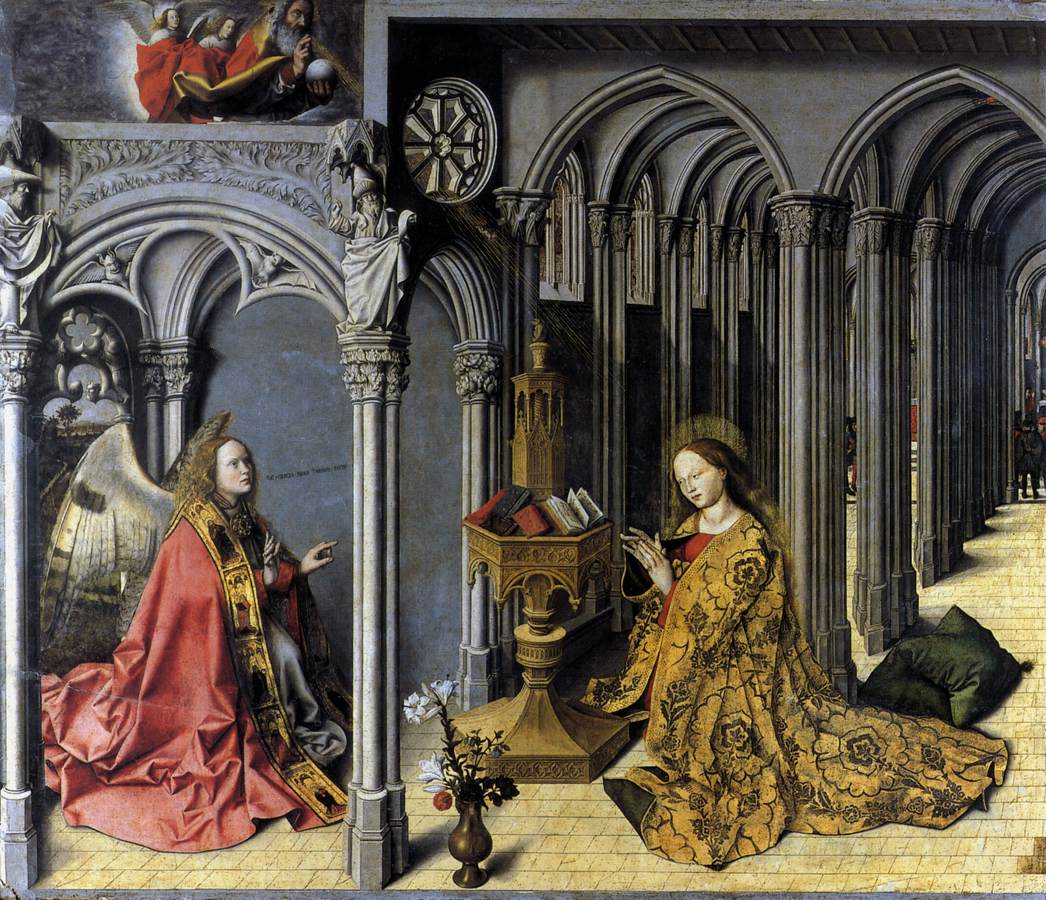
There is a strong Marian overtone to today’s Mass formulary.  The Roman Station for today is St. Mary Major.  the Gospel is the Annunciation.

The illuminated missals and sacramentary of centuries past presented the Gospel or at least its initial capital letters in gold, whence our nickname Missa aurea.

And the Gospel pericope begins Missus est angelus Gabriel….  It was once celebrated with a solemnity nearly approaching a feast day.

Missa aurea also refers to little dramas in medieval times in which the Annunciation was acted out.  It is thus not just “golden Mass” but “the golden sending“, which of course refers to the moment in which Our Lord becomes incarnate in the womb of the Virgin and His work for our salvation begins a new phase.  Missa aurea comes to be used in the terminology of art history also for paintings of the Annunciation, which often contain dramatic elements associated with the tableaux struck in the dramatic presentations of the mystery.  Doves would be lowered and an old man would be placed in a loft wearing an alb and cope.  Angels would come vested in dalmatics.  The Arena or Scrovegni Chapel in the 13th c.  Giotto’s frescoes echo this tradition as do many paintings of the Annunciation.

The Advent Ember Days were timed to follow St. Lucy’s feast (13 Dec.).  St. Lucy was an important saint for our forebears.  Her name, derived from the world for “light”, is tied to our awareness in the northern climes of the deepening darkness of our December days and that those days will soon be getting longer again.  Listen for the urgency within the threefold “command” we are issuing to the Lord (festina… ne tardaveris… impende).

COLLECT:

Festina quaesumus, Domine, ne tardaveris,
et auxilium nobis supernae virtutis impende;
ut adventus tui consolationibus subleventur,
qui in tua pietate confidunt.

This Collect, an ancient prayer found in such manuscripts as the 8th c. Liber sacramentorum Gellonensis, survived the snipping and pasting experts of Fr. Bugnini’s Consilium in a somewhat truncated form, to be prayed on 24 December in the Novus Ordo: Festina, quaesumus, ne tardaveris, Domine Iesu, ut adventus tui consolationibus subleventur, qui in tua pietate confidunt.

That form tardaveris is a perfect subjunctive of tardo, “to tarry, loiter, linger, delay”, paired here with ne to form a kind of imperative.  That ne tardaveris is found in the Latin version of the Psalms.

Impendo is “to expend, devote, employ, apply”.  Pietas, when it refers to man has to do with “duty”, but when applied to God, it becomes “mercy… pity”.  Remember that adventus here is a genitive with tui.   Sublevo means, basically, “to lift up from beneath, to raise up, hold up, support”, but it comes to mean, “to sustain, support, assist, encourage, console any one in misfortune”.  The perfect way to describe this vale of tears in which we journey.

LITERAL VERSION:
Hurry, we beseech You, O Lord, tarry not,
and expend upon us the help of heavenly power;
that those who rely upon Your mercy
may be sustained by the consolations of Your Coming.

You can feel in this prayer the growing Christian sense of urgency and longing.  Advent seems to pick up speed and become more anxious for resolution as we plunge headlong into physical darkness and cold, the reminders of our inevitable appointment with death.

This oration looks simultaneously back to the Nativity of the Eternal Word made man, but also forward to the Second Coming, which gives us consolation.  Christians in the state of grace can feel great consolation at the thought of the Coming of the Lord, in history and in the time to come.  We need not be afraid when we are in the state of grace.  Therefore, the Christian always eagerly says “Come, Lord Jesus.  Maranatha.   Come.”

This prayers rings with consolation.

May the Lord’s coming and promise of return console any of you who are burdened with sorrow. Many people feel at times inconsolable.

This time of year can be a annual trial of despair and sadness for so many who are alone and suffering.

In gratitude for the Lord’s promises, console others.

Think of this as a “golden rule”.
Posted in ADVENT, WDTPRS | Tagged , ,
7 Comments

REVIEW: 2011 Ordo from Angelus Press

The nice people at Angelus Press sent me a 2011 Ordo… the Ordo Divini Officii Persolvendi Missaeque Sacrificii Peragendi Pro Anno Domini 2011.

Ordo

This Ordo is in accordance with the rubrics established by John XXIII in Rubricarum instructum of 25Jul 1960.

This is the usual paper-bound affair which will be sturdy enough to last the whole year even with a bit of flattening to get it to lie open.

It starts with the calendar year at January 2011 instead of the liturgical year at Advent in December.  Odd.  It makes the book less useful.   I think they should reconsider that.

US feasts are included in this Ordo.

There is an amusing bit in the front of the book, by way of a preface.   It has something of that combative spirit we expect from the SSPX!

Contrary to the assertions of some persons, there is nothing substantially different between earlier versions of the Missal/Breviary and the 1962 editions.  Nothing contrary to the traditional Roman Catholic Faith is either contained or insinuated in the 1962 Missal and Breviary.  No reputable theologian or liturgical expert of any standing has made any such assertion in this regard.  With supplements and the [Ordo for Holy Week], the older editions of those liturgical books can easily continue to suffice for saying Mass and the Divine Office.

A conversation starter to be sure.   Then, at the end of the preface…

Many older priests, having fewer duties and obligations, continued to say the additional orations and used the oler Breviary as before.  In those days, nobody was upset or critical that they did.  Who would complain if they did so today?

Who indeed?

I appreciate having this Ordo.  I haven’t had one of their ordos in the past, so it will be interesting to see how it differs from others I have seen.

Some helpful information is included.  For example, the texts for the blessing of throats on St. Blaise Day.

I chuckled a bit at the note on p. ix under the excerpts from 1960 rubrics, where I read:

82. According to conditions and customs varying from one church to another and from one place to another – of this matter the local ordinary is the judge….

I wonder how often the SSPX priests are calling the local chancery for a ruling on processions are to be conducted on 24 April.  I’d like to hear that conversation.

Also, during January there is the Octave of Christian Unity.  They include some intentions for each day, such as “The submission of Anglicans to the Authority of the Vicar of Christ.”.   Timely, but a little ironic.

In the back there are Appendices with the feasts for Dioceses of Canada and for Great Britain.

“But Father! But Father!” I can hear some of you saying even as you are reading to the end of this rather specialized entry. “Why aren’t you using an FSSP Ordo?  Should you be supporting Angelus Press?”

Angelus Press prints good things and they send them to me.  The FSSP hasn’t sent me an Ordo.  If they had, I would be reviewing it.  I have used the FSSP Ordo in the past.

Posted in "But Father! But Father!", REVIEWS | Tagged ,
30 Comments

Simple pleasures

Sometimes it’s the small things.

  • Filling up a large black garbage bag with clutter
  • Cleaning up your computer’s “desktop”
  • Not screwing up the chicken
  • The return of the chickadees after the blizzard
  • Getting your office finished at more or less the right hours of the day
  • Good coffee
  • The snap of a mousetrap
  • Getting a call from someone you haven’t heard from in a while
  • Locating that quote
  • Having sunshine for a change
Posted in Lighter fare |
31 Comments

Just some photos

I just liked the way this turned out.

Last night I stuffed and roasted a chicken which was on a super sale.  I almost never stuff chickens.  Usually when I make a chicken I just use rosemary and lemon.  Sadly, I didn’t have my memory stick in my camera, duh, during the preparation.  But here is the final product.

I was so pleased, I had some coffee.

And my little jasmine tree, which came inside for the winter, is flowering.

Now I have to fix my digital thermometer, which died.  I think it just needs a new battery.

Posted in Fr. Z's Kitchen |
13 Comments