 From a reader…
QUAERITUR:
Father, I am a fairly new convert to the Church and while I have studied theology, which led me here, I sure do get confused at times.
It seems Catholics, hesitate at studying the scriptures but jump on any and all mystical revelations. I am in a Bible study about Blessed Mary and 1 person kept bringing up Emmerich’s book which I found was at odds with historical facts..is this book of revelations accepted I thought it had been discredited because the poet who wrote down supposed dictation made it up
Please help my confused mind
Welcome to the Church!
Now that you’ve been received into Holy Mother Church, we can let you in on a little secret. We’re all a bit confused at times. Don’t tell anyone, but it’s true.
Depending on where you are and what circle you hang with, you’ll discover a vast variety of interests among Catholics.
Some people, indeed some parishes, are gangbusters about Scripture study. Some are into biographies of saints (hagiography), or even dogmatic (though that’s now a bad word, I guess) theology. Within these categories, you’ll find a wide range of variations.
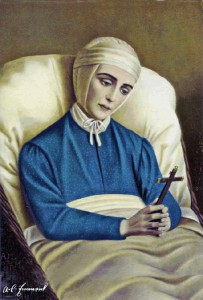
Blessed Anne Catherine Emmerich was a holy woman. She was a religious who suffered with poor health. She received the stigmata and had numerous visions throughout her life. Clemens Brentano, a poet, visited her over the course of several years and took notes of their conversations regarding her visions. Brentano and Emmerich spoke different dialects. Many of his notes were written well after his visits. Ten years after Blessed Anne Catherine’s death, Brentano completed his notes for publication. The last three volumes, on the life of Christ, were published after Brentano died. Fr. Karl Schmoger produced these volumes after editing Brentano’s notes.
So, there are problems with attributing the books to Blessed Anne Catherine, who never even had a chance to look them over.
The Congregation for the Causes of the Saints excluded the books from their examination of the life of Bl. Anne Catherine. They made the recommendation to St. John Paul II for beatification on the basis of her life alone. What portion of the books can be safely attributed to Bl. Anne Catherine is unknown.
Private revelations are tricky. We know, definitively, that the age of Revelation ended with the death of the last Apostle (John). All that is necessary for salvation has been revealed to the Church.
That doesn’t, of course, prevent God from revealing further things. We cannot place limitations on God.
When the Church rules that a private revelation has indeed taken place, She merely declares that nothing in the revelation is contrary to faith or morals and that the circumstances of the revelation are such that it appears to be valid. No obligation is placed on the faithful to believe the content of the revelation.
The nature of private revelation is precisely that: private. God reveals something to that specific person or those persons. Were God to have wanted to impose the obligation of belief in some particular matter on all mankind, He would have done so through universal revelation (which, as stated above, ended with the death of the last Apostle).
Private revelations can sometimes help other people, bystanders like you and I, grow in faith. They can be hindrances. Their utility is, first of all, for the one to whom the revelation occurs.
The old Catholic Encyclopedia, available at New Advent, has a good explanation of private revelation: HERE
In the meantime, welcome again to the confusion of Holy Mother Church. You’ll never get used to it. You’ll never be bored by it. You’ll may wind up adding to it yourself. Christ is at the helm of our barque. We can rest confidently knowing we’re headed for the right destination, provided we don’t pitch ourselves off the deck and into the cold drink on either the starboard side or to port (that’s right and left for those of you in Columbia Heights).

 It’s about 8:30 a.m. and I have already had four phone calls about stuff having to do with the Synod and other related things.








 Greg Hlatky on Some notes for your Sunday Mass in the Vetus and the Novus Ordo: ““By pursuing perfection we will achieve excellence.” – Vince Lombardi”




























