Wm. Oddie on the upcoming Synod: no change in doctrine

At the UK’s best Catholic weekly, The Catholic Herald, William Oddie has his say about Card. Kasper, his odd notions about Communion for the divorced and remarried, the upcoming Synod and Pope Francis.

Read the whole thing HERE, but I can bring you in in medias res:

So why am I so sure that the Pope does support Cardinal Müller’s insistence that there will be no change in the teachings of the Church, despite his warm words about Kasper’s speech? [Remember?  Tolerated but not accepted?] For a start, Kasper’s speech is such that you could find it interesting, even to be commended as an intellectual exercise, without agreeing with a word of it. It’s tentative, speculative; I didn’t exactly find it “serene” (incidentally, I seriously wonder if the Holy Father wasn’t teasing Cardinal Kasper when he said that “It is pleasant to read serene theology”; he’s known for his sense of humour) and if Pope Francis had actually agreed with it, wouldn’t he have used rather different wording?

In an interesting opinion piece in the New York Times on Kasper’s proposal, which is roughly that a second “marriage” might be tolerated but not accepted, Ross Douthat comments that “whatever individuals and pastors decide to take upon their own consciences, declaring the reception of Communion licit for the remarried-but-not-annulled in any systematic way seems impossible without real changes — each with its own potential doctrinal ripples — to one or more of three theologically-important Catholic ideas: The understanding that people in grave sin should not generally receive the Eucharist, the understanding that adultery is always a grave sin, and/or the understanding that a valid sacramental marriage is indissoluble.”

If he actually did effect some change of the kind being fondly touted by liberal Catholics, Pope Francis would be either dissolving important Church teachings into incoherence, or else changing them in a way that mainstream Catholics firmly believe that the Pope, any pope, cannot do. [Yep.]

Anyway, I confidently predict that there will be no change and that the Holy Father is NOT preparing the way for one. It’s a matter of his entire attitude to the Church’s doctrinal tradition. Not once has he cast any doubt on his support for what the Church teaches. [As I have been saying.] I draw your attention to one of his little sermons, preached at his daily Mass in the chapel of the Casa Santa Marta in January, and reported on this site but otherwise unnoticed, in which he made it quite clear that fidelity to Church teaching is a fundamental part of belonging to the Church and that we cannot, in his words, use Church doctrine “as we please.”

He defined the three “pillars” of belonging as “humility,” “fidelity” and “special service.” He said that fidelity was the “second pillar: “Fidelity to the Church, fidelity to its teaching; fidelity to the Creed; fidelity to the doctrine, safeguarding this doctrine. Humility and fidelity. We receive the message of the Gospel as a gift and we need to transmit it as a gift, but not as a something of ours: it is a gift that we received.”

[…]

Read the rest there.  There is a great Chesterton quote.

Posted in One Man & One Woman, Our Catholic Identity, The Drill | Tagged , , , , ,
11 Comments

Dublin’s Archbp. Martin criticizes young traditional priests

Across the pond at RU-486 (aka The Pill aka The Tablet), we find this:

‘Conformist’ younger clergy wary of Francis – Dublin archbishop

Pope Francis’ courage is causing disquiet among those with “a very conformist and closed Catholicism” the Archbishop of Dublin has warned.

In a speech given in Melbourne, Archbishop Diarmuid Martin referred to a young curate who recently told his parish priest he was not at all happy with some things the Pope had said.

The young priest felt they “were not in line with what he had learned in the seminary” and he suggested that they were “making the faithful insecure and even encouraging those who do not hold the orthodox Catholic beliefs to challenge traditional teaching.”

The archbishop warned conservative and progressive Catholics [“conservative and progressive”?  Watch what happens now…] against becoming “closed in” within our own ideas. He also acknowledged that Irish Catholicism had a strong tradition of strict teaching.

Responding to the comments, Fr Seamus Ahearne of the Association of Catholic Priests said the Archbishop’s words were “apt” and that the Church in Ireland needs to hear more comments like this. [The Ass of Catholic Priests wants more warnings for progressives?]

He said the archbishop’s concern about the “young curate” was a familiar one as many were concerned that the few young priests there are in the Irish Church [Get that?] appear to embrace a very traditionalist view of Church.

They are “so locked into a past model of priesthood” he commented and said this manifested itself in “the way that they dress up, the way they celebrate Mass, and in their views.” [A “past” model of priesthood.  Imagine what he means by that.]

They didn’t, I notice, find a priest on the other side of the issue, a conservative or traditional priest, to react.   Conservatives get an additional pounding, but the progressives?  They get a pass.

Meanwhile, Ireland’s seminaries are empty.

At this point, I remind the readership about Pope Benedict’s heartfelt Letter to Catholics in Ireland.  The Pope was reacting to how Irish priests had abuse so many children, thus creating hurt and havoc in the Church there.  In paragraphs 14ff, Benedict asked for a return to traditional practices which had fallen away.  He saw the practices as a remedy for the many ills the Irish had experienced, which suggests that the dropping of those practices in way contributed to the problem.

Dublin's Archbp. Martin criticizes young traditional priests

The Tablet: Bitter Pill or Sour?

View Results

Loading ...
Posted in "How To..." - Practical Notes, Benedict XVI, Biased Media Coverage, Hard-Identity Catholicism, Our Catholic Identity, Sin That Cries To Heaven, The Drill | Tagged , , , ,
48 Comments

GUEST POST: “Ten Commandments of Reverence for the Most Blessed Sacrament”

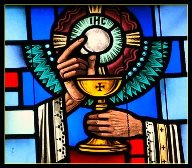
GUEST POST: “Ten Commandments of Reverence for the Most Blessed Sacrament”An old friend of mine, Msgr. Charles Mangan noticed my answer about safeguarding the Blessed Sacrament and sent me this to share with you.

“Ten Commandments of Reverence for the Most Blessed Sacrament”

Monsignor Charles M. Mangan

1. Attend Holy Mass on Sundays and Holy Days of Obligation, even daily if possible.

2. Prepare well for every Mass by: abstaining from food and drink (medicine and water may be taken) for at least one hour before receiving Holy Communion; going to Confession to a priest and stating any and all mortal sins that you have not confessed before (a mortal sin is a thought, word, desire or action that concerns grave matter carried out with sufficient reflection and full consent of the will); praying before Holy Mass and performing acts of charity and self-denial Furthermore, only those persons who are practicing Catholics, who believe as the Church does regarding the Most Holy Eucharist and whose marriages are recognized as valid by the Holy Catholic Church may receive Holy Communion.

3. Genuflect when entering and leaving the Church and whenever passing before the Tabernacle or the Altar on which the Body and Blood of Christ rest. Dress modestly—avoiding revealing and sloppy clothes—and do not chew gum. Speak accurately about the Most Holy Eucharist, never referring to It as “bread and wine.” And if you assist with the sacred music in your parish, do all you can to ensure that the texts reflect the truth about the Real Presence.

4. Refrain from useless chattering before the Tabernacle before, during and after the Holy Mass in order to adore Him and to concentrate attention on the Risen Lord Jesus. Talking unnecessarily in the holy presence of the Most Blessed Sacrament destroys a golden occasion to learn at the Feet of the Master.

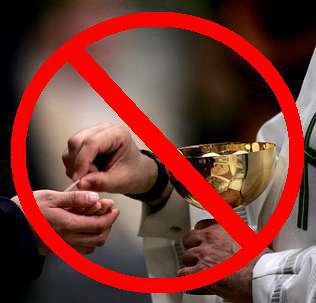
5. Receive Holy Communion with joy and fervor. We receive Jesus on our tongues or, in a country where it is permitted by the Episcopal Conference, in our hands (a profound bow before receiving Holy Communion is very appropriate). When we receive Jesus on our tongues, we simply say “Amen” and permit the priest, deacon or installed acolyte to place Christ there. If we receive in the hand, then we make a throne for the Lord, placing our “stronger” hand on the bottom and our “weaker” hand on top. Proclaiming “Amen,” we receive the Host (rather than lunging for It), take a step to the side, stop and place the Host in our mouth using the stronger hand underneath. We must never receive the Sacred Host “on the run.” [I’ll just add to this my hope that people will stop receiving in the hand altogether.  There.  I said it.]

6. Pass time with the Eucharistic Jesus outside of the Holy Mass. The Eucharist is always to be adored—before, during and after the Mass, whether exposed in the Monstrance or reposed in the Tabernacle.

7. Make frequent Spiritual Communions in which we invite the Lord into our souls in a similar manner as when we sacramentally receive Holy Communion. These may be made anytime and anywhere.

8. Cultivate a special relationship with Mary, the Woman of the Eucharist. Pray her Most Holy Rosary. Wear her Brown Scapular and her Miraculous Medal. Ask her for the virtue of chastity for yourself and in all your dealings with your neighbors. Purity is vital. If you fall grievously, go to Confession before receiving Holy Communion. [GO TO CONFESSION!]

9. Develop a friendship with the Saints who are remembered for their incredible love for the Holy Eucharist. To become aware of their affection for Holy Communion stimulates our capacity to develop in love for and adoration of Our Eucharistic Jesus.

10. Request the Holy Sacrifice of the Mass to be offered for the living and the dead. There is no gift more beautiful and effective than the Holy Mass.

Posted in "How To..." - Practical Notes, HONORED GUESTS, Liturgy Science Theatre 3000, Mail from priests, Our Catholic Identity | Tagged , , ,
6 Comments

“The priest has his back to the people!” (Not.) VIDEO

From Joseph Shaw of the Latin Mass Society in England.

Play video

Posted in Liturgy Science Theatre 3000, SUMMORUM PONTIFICUM | Tagged , , ,
6 Comments

Muslims are crucifying Christians who refuse to convert to the Religion of Peace

From the Quran:

“The punishment of anyone who fights against Allah and His apostle and do mischief in the land is to be killed or crucified or to have their hands and feet from opposite ends or be banished from the land.” (Quran: The table spread – Sura 5:33)

Won’t convert?  Won’t pay your fine for being an infidel? You have 4 punishments options: public execution (Qatl), crucifixion (Salb) and amputation of one hand and one foot from opposite sides (Yuqata’ Aydihim wa-Arjulihim) or exile (Nafy).

At Christian Post:

Christians ‘Crucified Again’ for Refusing Islam

To the awe of its readership, a recent Daily Mail article reports that the “jihadist Islamic State of Iraq and Levant [ISIL],” [ISIS] which is currently entrenched in Raqqa, Syria, “publicly crucified two Syrian rebels in northeastern Syria in revenge for a grenade attack on members of their group.”

While the Daily Mail is to be commended for exposing these barbaric acts-along with posting photos of the crucified-it nonetheless minimized their significance, in two important ways: 1) by repeatedly saying things like “even al-Qaeda is distancing itself from ISIL,” and so implying that the act of crucifixion is some wild aberration that even the poster-child of jihadi terror, al-Qaeda, wants nothing to do with it; and 2) ignoring the much “sexier” story that Christians in Syria are also being crucified simply for refusing to embrace Islam (as opposed to the rather mundane but politically more correct story of Islamic jihadis crucifying each other in the context of vendetta killings).  [A link to hideous photos HERE.  Don’t click, if you don’t have a strong stomach.]

Consider the atrocities earlier committed in Ma’loula, Syria, an ancient Christian village where the inhabitants still spoke Aramaic, the language of Christ.

According to recent Arabic news media, “a Syrian nun testified to the Vatican news agency that some Christians in Ma’loula were crucified for refusing to convert to Islam or pay jizya” (tribute subjugated Christians are required to pay to their Islamic conquerors in order to exist as Christians, per Koran 9:29).

Incidentally, they were crucified by the al-Qaeda linked Nasra Front (so much for Daily Mail’s portrayal of al-Qaeda “distancing” itself from the apparently “extra-extremist” ISIL for crucifying its victims).

Sister Raghad, the former head of the Patriarchate School in Damascus who currently resides in France, told Vatican Radio how she personally witnessed jihadi rebels terrorize Ma’loula, including by pressuring Christians to proclaim the shehada-Islam’s credo that there is no god but Allah and Muhammad is his messenger-which, when uttered before Muslim witnesses transforms the speaker into a Muslim, with the death penalty for apostasy should the convert later “renege” by returning to Christianity.

According to the nun, those Christians who refused to embrace Islam were killed in atrocious and violent ways that cannot be described. If you want examples, they crucified two youths in Ma’loula for refusing to proclaim Islam’s credo, saying to them: “Perhaps you want to die like your teacher [Christ] whom you believe in? You have two choices: either proclaim the shehada or else be crucified. One of them was crucified before his father, whom they also killed.”

In fact, according to earlier media reports from October 2013, soon after Ma’loula fell to the jihadis, one “shaky voiced” elderly Christian man had reported that he heard the invading jihadis shouting, “Convert to Islam, or you will be crucified like Jesus.”

It is, of course, a documented fact that some Christians in Ma’loula were put to death for refusing to convert to Islam, such as Minas, an Armenian man, while other families succumbed to pressure and converted to Islam at the tip of the sword.

But it is not clear whether the two crucified Christians mentioned by the nun are among the three men in Ma’loula who, according to Asia News, “refused to repudiate their religion” and thus “were summarily executed in public”-so many and varied were the barbaric acts, including beheadings, rape, and infanticide during the rebel occupation, not to mention the other massacres in other Christian regions the mainstream media failed to report on.

These three were declared martyrs by the Syrian Greek-Catholic Church, or as Patriarch Gregorios III explained to Pope Francis in a meeting: “Holy Father, they are true martyrs. Ordered to give up their faith, they proudly refused. Three others however gave in and were forced to declare themselves Muslim, but later returned to the faith of their ancestors.”

For his part, and according to a May 3rd Arabic report, Pope Francis recently said, “I wept when I saw reports saying that Christians were being crucified in some non-Christian countries.”

The fact is, crucifixion is a prescribed form of punishment in the Koran (5:33) and occurs throughout the Islamic world with much greater frequency than suggested by the Daily Mail. For example:

Iraq, June 2008: A Canadian parliamentary committee heard about how “militant Muslims” were crucifying Christian children [children] in order to terrorize Christians into fleeing Iraq: “Since the war began in 2003, about 12 children, many as young as 10, have been kidnapped and killed, then nailed to makeshift crosses near their homes to terrify and torment their parents.”

Ivory Coast, May 2011: Two Christian peasant brothers were “brutally crucified” on “the example of Christ” by Muslim forces accusing them of being supportive of the ousted Christian president. One died, while the other survived: “The pair were badly beaten and tortured before being crudely nailed to cross-shaped planks by their hands and feet with steel spikes.”
Egypt, August 2012: Multiple media agencies reported that during one uprisal against Islamist president Muhammad Morsi, Muslim Brotherhood operatives crucified some protesters on trees. Earlier, a Salafi MP in Egypt called for the penal codification of crucifixion.
Yemen, August 2012, a video of a man crucified on the accusation of spying for the U.S. appeared on video. A sign placed above his head quotes Koran 5:33: “The recompense of those who wage war against Allah and His Messenger and do mischief in the land is only that they shall be killed or crucified or their hands and their feet be cut off from opposite sides, or be exiled from the land. That is their disgrace in this world, and a great torment is theirs in the Hereafter.”
Of course, if one delves into Islamic history, one learns that crucifixions were extremely common. For example, Witnesses For Christ: Orthodox Christian Neomartyrs of the Ottoman Period 1437-1860 lists crucifixion as one of the many forms thousands of Christians were executed by the Muslim Turks.

And in her memoir, Ravished Armenia, Aurora Mardiganian described how in the early twentieth century in the city of Malatia, she saw 16 girls crucified, vultures eating their corpses: “Each girl had been nailed alive upon her cross, spikes through her feet and hands,” wrote the Armenian survivor. “Only their hair blown by the wind covered their bodies.”

Prescribed in the Koran itself, crucifixions are as old as Islam and, with the global revival of the latter, are returning with increased frequency. And, although it is more politically correct to report on jihadis crucifying other jihadis-other terrorists or “spies”-the fact is, many more innocent Christians are being crucified again, including simply for refusing to embrace Islam and thus renounce Christ.

What has Pres. Obama done about this?

I’d send the Marines.  All of them.


Posted in Modern Martyrs, The Coming Storm, The future and our choices, The Religion of Peace | Tagged , , , ,
29 Comments

Of the residences of bishops

CNN has posted what an only be called a cheap shot at American bishops.

This is yellow journalism.

The story, HERE, is about the “lavish” residences of some bishops.

The piece starts out with an rookie … or rather unprofessional… error, that is, the suggestion that the personal residence of the Holy Father, Pope Francis, is some sort of studio apartment over the local mercado.  It cost a hell of a lot of money to get the building ready for the Pope to live in, and it ain’t cheap to provide security there.  But poverty can be expensive.

In any event, Fishwrap took this tack a while back.  HERE

The idea CNN and Fishwrap are proffering is that unless His Excellency (or just plain “Bill”) lives in a box over a grate and drinks from puddles on the sidewalk, he must be some sort of heartless sybarite. The hitch is that, no matter how humbly an American bishop would choose to live, his life couldn’t possibly suck enough for liberals and dissidents.  The next article would be “ARCHBISHOP HAS LAVISH DRINKING PUDDLE”.  “Why?”, they would cry “Why was this puddle not sold for three hundred denarii and given to poor undocumented children?”

Meanwhile, I await the CNN and Fishwrap article which praise His Excellency, the Extraordinary Ordinary, Robert C. Morlino, Bishop of Madison, whose residence, though still of almost rococo elegance, is in a less than opulent neighborhood.

Note the elegant (power) lines, the superb architraves which caress the windows, the balustrade and corbels of the balcony with its subtle and yet insouciant jut, the whimsy of the kitchen’s stove-hood vent:

Of the residences of bishops

MADISON's PALATIAL EPISCOPAL MANSION

Posted in Green Inkers, Liberals, You must be joking! | Tagged , ,
40 Comments

4 August: Dominic and Jean

According to the traditional Roman calendar, today is the feast of St. Dominic. Happy feast to all Dominicans and Dominics.  I have his first class relic.

I am pleased to have a 1st class relic of St. Dominic. Many observe his Mass today.

20140804-003130-1890313.jpg

I work systematically through my list of intentions for Holy Masses each day.  Today especially His Eminence Raymond Card. Burke.

Also, where I say Mass on Sunday there is a relic of St. Jean Vianney is on the altar.

From the 2005 Martyrologium Romanum:

Memoria sancti Ioannis Mariae Vianney, presbyteri, qui, quadraginta amplius annos paroeciae ipsi commissae in vico Ars prope Bellicium in Gallia actuosa praedicatione, oratione et paenitentiae exemplo mirum in modum ministravit et cotidie pueros et adultos catechizans, paenitentes reconcilians atque ardenti caritate e sacra Eucharistia velut e fonte hausta refulgens tantopere provexit, ut longe lateque consilia sua diffunderet et permultos ad Deum sapienter duceret.


Posted in Saints: Stories & Symbols |
3 Comments

ASK FATHER: Parish priest doesn’t guard Eucharist from profanation. What to do?

ASK FATHER: Parish priest doesn't guard Eucharist from profanation. What to do?From a reader…

QUAERITUR:

Dear Father, I serve regularly at a large shrine which attracts vast numbers of non Catholics. Several of us have to be ‘on guard’ on Sundays to ensure that (mostly Hindu) friends of Catholics or just visitors don’t either try to take the sanctissimum away as a ‘lucky charm’ or receive it when they are not Catholics. Our priest seems reluctant to clamp down on this though the vast numbers and unaware visiting clergy make it more complicated. Yesterday was particularly bad. I need to raise this formally with the PP. Is there a ruling that I can quote to warn him, in a friendly way, that my next stop is the bishop?

It is the job of the pastor to be vigilant lest the Blessed Sacrament be treated disrespectfully and to guard against abuses (can. 528, 2). The question seems to be:  What should be done when the pastor is not doing his job?

Reminding him of his responsibility seems to be the logical first step. Doing his job for him is not a reasonable option. Self-appointed guardians, however well-meaning, seldom help.  They often hurt the cause of respect for the Blessed Sacrament.

If the pastor is not doing an adequate to ensure that the Blessed Sacrament is not profaned, a letter to the bishop is more than appropriate. Such a letter should be carefully written.  It should be written even with prayer and meditation before the Blessed Sacrament. St. Paul in Romans 12:10 urges us to outdo each other in showing honor. That applies very much to this situation.

If the Blessed Sacrament is being profaned and disrespected pray, you, and perhaps others, would do well to make reparation with sacrifices and fasting. Do this quietly, without a lot of show.  That may do more than you know to strengthen the heart of the pastor, the parish priest, to be more vigilant, or even to move the heart of the bishop to reprove a priest who may have grown lax.

Remember that all the faithful are involved in safeguard the sacred and the sacraments.  In Redemptionis Sacramentum we read:

6. Complaints Regarding Abuses in Liturgical Matters

[183.] In an altogether particular manner, let everyone do all that is in their power to ensure that the Most Holy Sacrament of the Eucharist will be protected from any and every irreverence or distortion and that all abuses be thoroughly corrected. This is a most serious duty incumbent upon each and every one, and all are bound to carry it out without any favouritism.

[184.] Any Catholic, whether Priest or Deacon or lay member of Christ’s faithful, has the right to lodge a complaint regarding a liturgical abuse to the diocesan Bishop or the competent Ordinary equivalent to him in law, or to the Apostolic See on account of the primacy of the Roman Pontiff. It is fitting, however, insofar as possible, that the report or complaint be submitted first to the diocesan Bishop. This is naturally to be done in truth and charity.

Thus, bring this to the parish priest’s attention first.  Then, if necessary you and others could address your concern to the local bishops.

I’ll add this from Redemptionis Sacramentum, for it is good – for priests and bishops – to review and reflect on this:

[186.] Let all Christ’s faithful participate in the Most Holy Eucharist as fully, consciously and actively as they can, honouring it lovingly by their devotion and the manner of their life. Let Bishops, Priests and Deacons, in the exercise of the sacred ministry, examine their consciences as regards the authenticity and fidelity of the actions they have performed in the name of Christ and the Church in the celebration of the Sacred Liturgy. Let each one of the sacred ministers ask himself, even with severity, whether he has respected the rights of the lay members of Christ’s faithful, who confidently entrust themselves and their children to him, relying on him to fulfill for the faithful those sacred functions that the Church intends to carry out in celebrating the sacred Liturgy at Christ’s command. For each one should always remember that he is a servant of the Sacred Liturgy.

Posted in "How To..." - Practical Notes, ASK FATHER Question Box, Hard-Identity Catholicism, Liturgy Science Theatre 3000, Our Catholic Identity | Tagged , , , , , , , ,
8 Comments

Your Sunday Sermon Notes

Your Sunday Sermon NotesGood points… good points from the sermon you heard for your Sunday obligation Mass…. Let us know what they are!

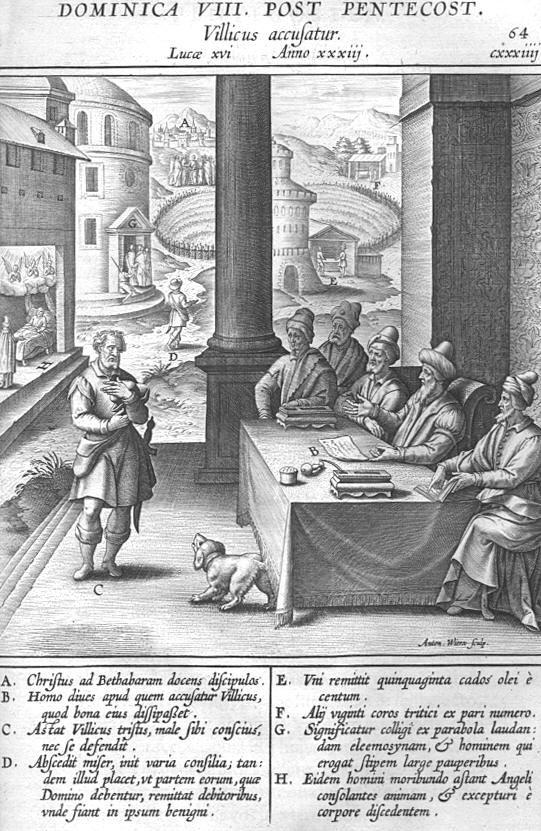
Today, 8th Sunday after Pentecost, I spoke of the Lord’s parable of the wicked steward in Luke as an admonishment to give alms.  Everything we (the wicked steward) have is from God (the rich man, the master).  We must give an account as what we have done with all we have been given.  Our Lord did not praise the fraud and theft of the wicked steward, who cut what people owed to his master in order to curry favor.  The Lord pointed out that, if the children of the world act with cleverness and decisions and plans in worldly matters, how much more should the children of the light work to attain heaven with plans and decision and cleverness: prudence?  His admonishment to “make friends of mammon of iniquity” isn’t an order to get to know rich people who got their wealth through who knows what.  We are to make material goods, our friends, in the sense of making them work for our salvation.  The Psalm says that the good things flow from the God’s hands to all creatures.  But our hands are God’s hands here on earth.  In Matthew 25, another chapter wherein a rich man calls stewards to account for what they did with wealth he entrusted to them, the Lord describes what happens to people who did or did not help Him, encountered in the person of the poor and needy.  Those on the right, happiness.  Those on the left, torment prepared for devils.  We must make use of material things as if we are stewards and also for the good of others, not just for ourselves.

Also, almsgiving is personal.  Almsgiving is not about governmental programs, or a welfare state, or statist big government’s redistribution of wealth.  States don’t souls, we do.  We are the ones who must also mind the poor, and by doing so, we treasure up treasure in heaven.  Jesus didn’t say that when the State takes your money and redistributes it, you shall be rewarded.  States don’t perform works which merit the reward of heaven.  You do. Make good use of material goods in such a way that you are preparing an aeterna tabernacula, an everlasting dwelling.  We are saved by the good will of God, his loving, merciful graces. He makes our hands strong to perform works of mercy, so that they are, at the same, both ours and His.

The Secret today underscores the Gospel:

Suscipe, quaesumus, Domine, munera, quae tibi de tua largitate deferimus: ut haec sacrosancta mysteria, gratiae tuae operante virtute, et praesentis vitae nos conversatione sanctificent, et ad gaudia sempiterna perducant.

Accept, we beseech You, O Lord, the gifts which, from Your bounty, we bring to You: that, as the power of Your grace is working, these most sacred mysteries may both sanctify us during the course of this present life of conversion, and guide us through to joys everlasting.


Posted in SESSIUNCULA | Tagged , ,
19 Comments

TOLEDO Bad Water Emergency. Semper simus parati!

TOLEDO Bad Water Emergency. Semper simus parati!Every once in a while I get snippy snarky notes from people asking why item A or B is on my wish list. “Why do you have solar panels?… rifle slings? … water purifiers on your list?”

HA!  Semper paratus.

“There he goes again!”, some of you naysayers are naysaying.

I keep saying that stuff always happens to someone else until it happens to you.

Right?

I now read at the Columbus Dispatch:

More tests needed before Toledo gets water back

[O me O, O my O] TOLEDO, Ohio — More tests are needed to ensure that toxins are out of Toledo’s water supply, the mayor said today, instructing the 400,000 people in the region to avoid drinking tap water for a second day.

TOLEDO Bad Water Emergency. Semper simus parati!“This is not over yet,” Mayor D. Michael Collins said, adding that new samples showing decreased levels of toxins in the water are a positive sign.

Toledo officials issued the warning early yesterday after tests at one treatment plant showed two sample readings for microsystin above the standard for consumption, possibly because of algae on Lake Erie. The city also said not to boil the water because that would only increase the toxin’s concentration. The mayor also warned that children should not shower or bathe in the water and that it shouldn’t be given to pets.

Long lines quickly formed at water distribution centers and store shelves were emptied of bottled water. The warning effectively cut off the water supply to Toledo, most of its suburbs and a few areas in southeastern Michigan.  [This is TOLEDO Bad Water Emergency. Semper simus parati!a gentle warning and object lesson.  Imagine structural breakdown and NO WATER at all arriving at your home or anywhere else in your town, potable or not.  Are you imagining the breakdown in social order that will ensue?  How will you keep your kith and kin going?]

City and state officials monitoring the water were waiting for a new set of samples to be analyzed today at a federal lab in Cincinnati, Collins said.

Worried residents told not to drink, brush their teeth or wash dishes with the water waited hours for deliveries of bottled water from across Ohio as the governor declared a state of emergency.

[…]

Great, huh?

TOLEDO Bad Water Emergency. Semper simus parati!Now… put yourself into different scenarios, dear readers.  Especially those of you who have children.  Would it be a good idea to have an occasion “water discipline” day?  An occasional day on zero waste, different food, what to do days?

And, apart from water… food?

TOLEDO Bad Water Emergency. Semper simus parati!

TOLEDO Bad Water Emergency. Semper simus parati!

TOLEDO Bad Water Emergency. Semper simus parati!

TOLEDO Bad Water Emergency. Semper simus parati!Whenever I hear about some awful thing happening in a place, such as a really destructive tornado, hurricane, other disaster or problem, I always wonder about the many readers of this blog.  I think you should take some basic steps for yourselves and for others.  Some basic preparation can relieve many problems when TSHTF and you can be less of a burden on others.

And make sure your priests are covered, folks.  Father gets sick… you don’t get Mass, confession, LAST RITES….   Remember my posts about an unprovided or provided death?

It’s always someone else… until it’s you.

Posted in "How To..." - Practical Notes, Global Killer Asteroid Questions, Semper Paratus, TEOTWAWKI, The Coming Storm | Tagged , ,
11 Comments