
 From a reader:
I went to a well said Latin low Mass this morning. The celebrant and a deacon gave communion to the faithful. The celebrant followed the rubrics after communion to consume the sacred particles and rinse his fingers. However, the deacon just simply went back to his seat in the sanctuary. There could have been sacred particles on his fingers. In the old days I believe the sacred ministers of communion would have rinsed their fingers in the sacrarium in the sacristy.
The New Mass rubrics are so sloppy on this, but would you know if any minister of communion should also rinse his fingers as does the celebrant after communion in the EF Mass? What about keeping the index finger and thumb together until these have been rinsed.
First, let’s make a couple distinctions. It is okay for deacons to distribute Communion in the Extraordinary Form. Also, had the helper been a priest or a bishop, rather than a deacon, the question about purifying one’s fingers would be the same. This isn’t something about deacons. That said, in the past, permanent diaconate formation in some places has not always been very… thorough. I have met deacons, great and willing and good-hearted men, who knew very little about what was going on. I have met a few whose knowledge would put 90% of the priests I know to shame. Alas, the former group is larger than the later. I think the numbers are shifting in the right direction. But I said this wasn’t about deacons qua deacons.
The additional Minister of Communion ought to have purified his fingers. Even if he didn’t think he had any particles on his fingers, he should have purified his fingers. Why? But people (like you) are often very attentive to everything that happens – or doesn’t happen – in a sanctuary. Had he purified his fingers, you wouldn’t have been distracted by the fact that he did not and we should never have met. Decide for yourself whether that last point is good or bad.
Now, let’s grant the fellow the benefit of the doubt: maybe he just forgot. Though it is entirely possible the deacon just didn’t know to do this, perhaps he just forgot!
Don’t climb all over him. Don’t assume he doesn’t believe in the presence of the Lord in Eucharist, or that he is a secret Lutheran, blah blah blah. If the deacon does this regularly, however, perhaps a discreet mention of the fact to the priest some time down the line could clue Father in on a point which, on his own, he could let the deacon/other minister know about.
People have a learning curve when it comes to recovering all the details. Some were fortunate enough to absorb it by osmosis or by really good training. Others slowly pick it up.
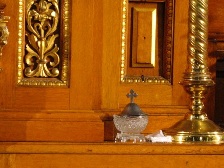
Anyway, if someone doesn’t know what we are talking about, there ought to be a small cup of water, normally with a cover, next to the door of the tabernacle. It is called an “ablution cup”.
Someone should do a study, with a graph of course, of the presence of and use of an ablution cup against the rigid imposition of Communion in the hand.
When one handles the Blessed Sacrament, and one is not the celebrant at Mass who will purify his fingers in the normal course of events, you use that small cup and small linen towel, to make sure that no particle of the Eucharist has remained on your fingers. The ablution cup could also be used for a Host which may need to be dissolved before putting the liquid down the sacrarium. Then there’s the not-so-legendary-maniple-pin-transfixed-enormous-chalice-invading-spider …
The Eucharist is not less the Eucharist in the Ordinary Form than it is in the Extraordinary. But, alas, I have seen some shockingly relaxed practices concerning handling the Eucharist in some places. We would do well to recover traditional discipline in this matter, a discipline which leads not to soul-crushing anxiety or scrupulosity, but to reverence and awe at what we are privileged to do.
Furthermore, I think Communion in the hand should be abolished. So there!
 From a priest:



 From a reader:
 From a reader:


 EAW on Continue the Rome shot posts? I dunno.: “Yes, please continue the Rome shot posts! They have become one of the things I always look forward to. TC…”




























