Some of the worst analysis from a TV broadcast and journalist that I have ever heard about the Church. HERE
Count the problems.
Remember… this is about the coverage.
Moderation queue is ON.
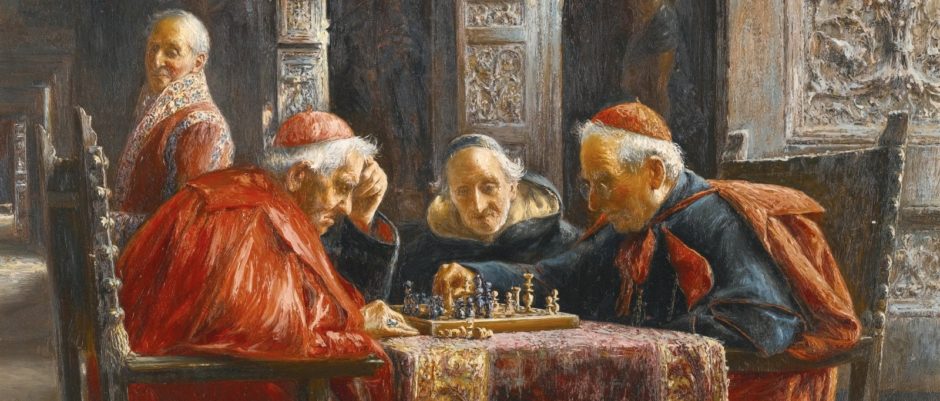
Some of the worst analysis from a TV broadcast and journalist that I have ever heard about the Church. HERE
Count the problems.
Remember… this is about the coverage.
Moderation queue is ON.
Based on my vacuuming up bits of information via conversations and emails.
Today the members of the Synod are going over the draft of the Final Report. God help us all.
I am not optimistic, given the breakdown of the orientations of the small groups I posted yesterday.
Pray. They vote tomorrow. The Kasperites must be soundly defeated. Defeated not by a little, but soundly.
South African Card. Napier Fox one of the drafting committee for the Final Report doubts that Communion for divorced and civilly remarried will be found clearly in the Final Report. If that is true, the Kasperites won’t be able to claim outright victory.
There is a video of a presser during which liberal Fishwrap journalist Robert Mickens (fired by The Tablet – HERE) by Card. Napier. Mickens took aim, through Napier, at Edward Pentin who wrote The Rigging of a Synod. Mickens clearly hates Pentin’s book. Napier slapped him down. Start at 42:15.

Also, read Pentin’s post at the National Catholic Register. HERE The Germans think “mercy” can be shown to civilly divorced and remarried Catholics and others in irregular situations in the “internal forum” (i.e., the Confessional). And watch Fr Carlos Errazuriz, professor of canon law at the University of Santa Croce, dissect the German position.
Also, to understand really well how the Kasperites’ minds work, there is Robert Stark in Catholic World Report. HERE
From a reader…
QUAERITUR:
In the Extraordinary Form of the Holy Mass (EF), are Deacons (either transitional or permanent) allowed to distribute Holy Communion? Or is this a faculty reserved to only the Priest and Bishop?
On the Correct Handling of Contradictions Among the People
Summorum Pontificum makes it clear that, in celebrating the Holy Mass according to the 1962 Missale Romanum, the rubrics of that Missal are to be observed. See also Universae Ecclesiae.
On the other hand, the celebration of the Extraordinary Form should not be seen as the proverbial fly frozen in amber.
We are not going back in time to recreate 1962. (That said, we are re-presenting AD 33!).
In 1962, deacons were considered extraordinary ministers of Holy Communion. In certain circumstances they were permitted to distribute Holy Communion.
In 2015, deacons are now considered by law to be ordinary ministers of Holy Communion.
The distribution of Communion to the faithful is something that is proper to their diaconal ordained state.
Therefore,…
Let a hundred deacons blossom!
Let them assist at regular celebrations of Solemn High Masses!
Let them assist in choro properly dressed in cassock, surplice, with biretta!
Let them place a stole upon their shoulder for the reception and distribution of Holy Communion!
While I was traveling a Friendly Roman Observer did some analysis of how the small groups or circuli minores are coming down… for the Kasperite (non) Proposal (boo!) or for the doctrine of the Church. I’ll share it here, somewhat edited.
The small group reports from this the third and final week are HERE.
There were 13 small groups in five languages.
Regarding the Kasperite Proposal (to allow civilly divorced and remarried Catholics to go to confession and Holy Communion without requiring of them sexual continence), the breakdown is more or less as follows:
So, the Kasper Proposal has not been completely defeated.
Today (Wednesday) and tomorrow the commission appointed by the Pope will draft a Final Report.
On Friday the draft will be discussed by the Synod Fathers, and amendments will be suggested.
On Saturday the revised draft will be voted on. (So, they say.)
That product, the Report, goes to the Pope. He can decide whether to make the Report public or not. The Pope will decide if he is going to issue a document about the questions, and if so what kind of document and with what authority.
… or like Pres. Obama.
GREETINGS BY METROPOLITAN HILARION OF VOLOKOLAMSK TO THE PARTICIPANTS OF THE FOURTEENTH ORDINARY GENERAL ASSEMBLY OF THE SYNOD OF BISHOPS OF THE CATHOLIC CHURCH ON THE “VOCATION AND MISSION OF THE FAMILY IN THE CHURCH AND IN THE CONTEMPORARY WORLD” (THE VATICAN. 20TH OCTOBER 2015)
Your Holiness!
Your Beatitudes, Eminences and Excellencies!
On behalf of His Holiness Patriarch Kirill of Moscow and All Rus I extend fraternal greetings to you on the occasion of the Fourteenth Ordinary General Assembly of the Synod of Bishops of the Catholic Church on the theme of the family.
In our restless and disturbing world the human person needs a firm and unshakeable foundation upon which he can rest and upon which he can build his life with confidence. At the same time, secular society, aimed primarily at the gratification of individual needs, is incapable of giving the human person clear moral direction. The crisis of traditional values which we see in the consumer society leads to a contradiction between various preferences, including those in the realm of family relationships. Thus, feminism views motherhood as an obstacle to a woman’s self-realization, while by contrast having a baby is more often proclaimed as a right to be attained by all means possible. More often the family is viewed as a union of persons irrespective of their gender, and the human person can ‘choose’ his or her gender according to personal taste.
On the other hand, new problems are arising which have a direct impact on traditional family foundations. Armed conflicts in the contemporary world have brought about a mass exodus from areas gripped by war to more prosperous countries. Emigration often leads to a disruption of family ties, creating at the same time a new social environment in which unions of an inter-ethnic and inter-religious nature arise.
These challenges and threats are common to all the Christian Churches which seek out answers to them, proceeding from the mission that Christ has placed upon them – to bring humanity to salvation. Unfortunately, in the Christian milieu too we often hear voices calling for the ‘modernization’ of our ecclesial consciousness, for the rejection of the supposedly obsolete doctrine of the family. However, we ought never to forget the words of St. Paul addressed to the Christians of Rome: ‘And be not conformed to this world: but be ye transformed by the renewing of your mind, that ye may prove what is that good, and acceptable, and perfect, will of God’ (Rom. 12: 2).
The Church is called to be a luminary and beacon in the darkness of this age, and Christians to be the ‘salt of the earth’ and ‘light to the world’. We all ought to recall the Saviour’s warning: ‘If the salt have lost his savour, wherewith shall it be salted? It is thenceforth good for nothing, but to be cast out, and to be trodden under foot of men’ (Matt. 5: 13-14). The salt which has lost its savour are those Protestant communities which call themselves Christian, but which preach moral ideals incompatible with Christianity. If in this type of community a rite of blessing of same-sex unions is introduced, or a lesbian so called ‘bishop’ calls for the replacement of crosses from the churches with the Muslim crescent, can we speak of this community as a ‘church’? We are witnessing the betrayal of Christianity by those who are prepared to accommodate themselves to a secular, godless and churchless world.
The authorities of some European countries and America, in spite of numerous protests, including those by Catholics, continue to advocate policies aimed at the destruction of the very concept of the family. They not only on the legislative level equate of the status of the same-sex unions to that of marriage but also criminally persecute those who out of their Christian convictions refuse to register such unions. Immediately after the departure of Pope Francis from the USA, President Barack Obama openly declared that gay rights are more important than religious freedom. This clearly testifies to the intention of the secular authorities to continue their assault on those healthy forces in society which defend traditional family values. Catholics here are found at the forefront of the struggle, and it is against the Catholic Church that a campaign of discrediting and lies is waged. Therefore courage in vindicating Christian beliefs and fidelity to Church tradition are particularly necessary in our times.
Today, when the world ever more resembles that foolish man ‘which built his house on the sand’ (Matt. 7: 26) it is the Church’s duty to remind the society of its firm foundation of the family as a union between a man and woman created with the purpose of giving birth to and bringing up children. Only this type of family, as ordained by the Lord when he created the world, can forestall or at least halt temporarily modern-day society’s further descent into the abyss of moral relativism.
The Orthodox Church, like the Catholic Church, has always in her teaching followed Holy Scripture and Sacred Tradition in asserting the principle of the sanctity of marriage founded on the Saviour’s own words (Matt. 19: 6; Mk. 10: 9). In our time this position should be ever more strengthened and unanimous. We should defend it jointly both within the framework of dialogue with the legislative and executive branches of power of various countries, as well as in the forums of international organizations such as the UN and the Council of Europe. We ought not to confine ourselves to well-intentioned appeals but should by all means possible ensure that the family is legally protected.
Solidarity among the Churches and all people of good will is essential for guarding the family from the challenges of the secular world and thereby protecting our future. I hope that one of the fruits of the Assembly of the Synod will be the further development of Orthodox-Catholic co-operation in this direction.
I wish you peace, God’s blessing and success in your labours.
From the OED Online’s Word of the Day:
Your word for today is: maril, n.
Your word for today is: maril, n.
maril, n.
[‘ An ornamental binding material with a variegated grain, made from scraps of coloured leather mixed in a resin, compressed, and dried.’]
Pronunciation: Brit. /ma?r?l/, U.S. /m??r?l/
Etymology: < -maril (in Silmaril, any of three mystic jewels featuring in works by J. R. R. Tolkien (1892–1973)): see quot. 19741, although Smith notes elsewhere in the same work that it subsequently occurred to him that the word could also be analysed as < mar- (in marbled adj.) + i- (in inlaid adj.) + l- (in leather n.).
Bookbinding.
An ornamental binding material with a variegated grain, made from scraps of coloured leather mixed in a resin, compressed, and dried.
1974 P. Smith New Direct. in Bookbinding x. 59 The first book on which experiments with early maril were tried was a copy of The Lord of the Rings… A name had to be found to describe this material… I remembered the name Silmaril in The Lord of the Rings and thought that the word had the right ‘ring’ to it, especially the ‘maril’ part which was short.
1974 P. Smith New Direct. in Bookbinding x. 59 Each volume reveals one or other facet of feathered, sectioned and maril onlays.
1978 Book Collector Summer 176 When I first visited the binder’s studio in 1969, he was experimenting with planing flat sections of maril to make decorative boards, but this has not been developed due to..the possibility of achieving the same effect by onlaying.
1989 New Bookbinder 9 26/1 One of the most remarkable innovations was the making of maril, which opened up for book-artists the whole range of fluid and broken surfaces.
I had always thought that, were I to have my own proper space with some elbow room, I’d like to take up bookbinding.
On that note, I urge everyone to get a Kindle! HERE
This afternoon I head to Rome.

I checked in and used some miles to upgrade.

The screen on this flight is a little different… hmmmm…

And there is a very odd fellow in the window seat.

Anyway, the day is underway.
More later.
(Honestly… what were the odds that I should turn on this particular movie, on the eve of my departure, right at that scene with the date?)
Meanwhile… back in Rome itself…. my friend the Great Roman Fabrizio sent photos as he entered S. Maria in Trivio to pray at the tomb of Saint Gaspar del Bufalo (+1837), “hammer of freemasons”.

I have been attached to him since my seminary days in Rome when I was assigned to help on Sundays at San Nicola in Carcere. Saint Gaspar started a confraternity there. There is a plaque and inscription about that in the apse, but it is now covered up by a painting.
Here is the saint.
As The Great Rome writes: “Napoleon’s police tried to tame him and Freemasons tried to kill him many times. He triumphed.
His answer to the French commissar asking him to sign his submission to emperor should be the motto of every pope and bishop requested to yield to the world: ‘non posso, non debbo, non voglio!’ That’s how a Roman priest says ‘No’ when he wants to be talkative.”
“I can’t. I musn’t. I don’t want to.”
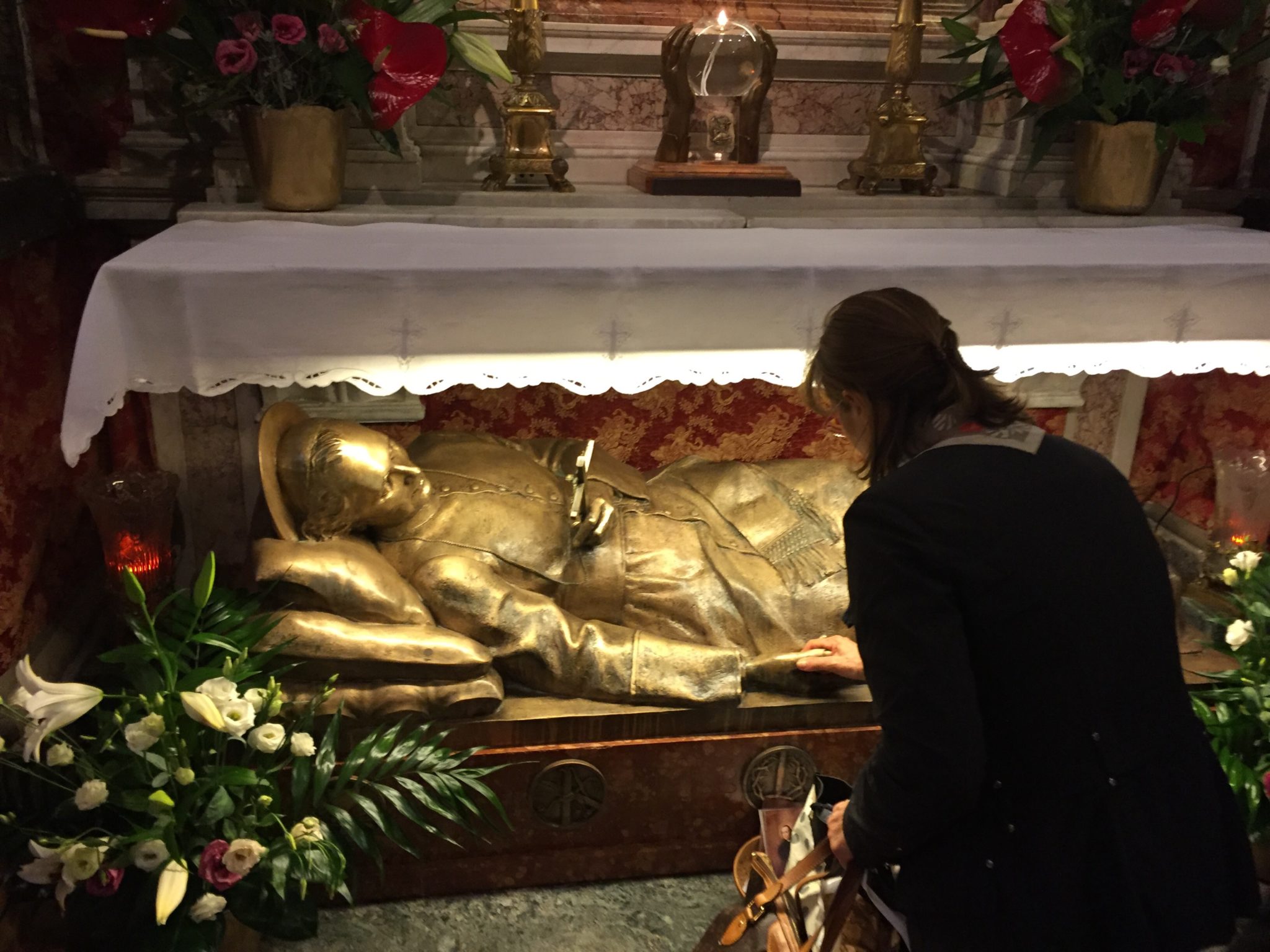
St. Gaspar, pray for us.
UPDATE:
This is more like it for these posts.

Flight delay ….

How I love rushing for a flight connection because of an unexplained delay. I really like that. These days I build a little extra time into my itinerary so I don’t have to rush. At least the gates are fairly close. there is a strong chance my bag will come with me to Rome.
Meanwhile, no drama in the boarding process so far. Hopefully we can make up time. Departing froma small airport helps a lot.

I liked the announcement. “No use of tobacco products and e-cigarettes is not a allowed.”
Where’s my snoose?!?

UPDATE:
We made up time and the taxi was short and the next gate was close.

Boarding soon. This is when I start to crave a cheeseburger.
UPDATE:
As I said above, I used miles to upgrade. It’s not a Delorean but it’s managable.


Once upon a time I flew business or first pretty often. It’s been a loooong time and I have lots of miles. Hopefully this will help my adjustment on arrival. Eastward travel is a greater challenge for me and my sojourn is short. I need to function when I hit the ground.
The music may make me slit my wrists.
Doors closed.
UPDATE:
I managed to write a column for the UKs best Catholic weekly, The Catholic Herald, eat something and then sleep for a few hours. Breakfast time has us about an hour out.
UPDATE:
Almost to my place.

Sam Gregg of Acton Institute has a great piece today at Crisis about the topic of “conscience”. My emphases.
An Archbishop and the Catholic Conscience
Conscience is one of those subjects about which numerous Catholics today are, alas, sadly misinformed. Despite great Catholic minds such as Thomas Aquinas, Thomas More, and John Henry Newman discoursing at length on the question, some Catholics speak of it in ways that have little in common with the Church’s understanding of conscience.
The latest Catholic to be embroiled in controversy about conscience is Archbishop Blase Cupich of Chicago. While recently discussing the question of whether those who have (1) not repented of sin and/or (2) not resolved to go and sin no more may receive communion, Archbishop Cupich stated: “If people come to a decision in good conscience then our job is to help them move forward and to respect that. The conscience is inviolable and we have to respect that when they make decisions, and I’ve always done that.” Referring specifically to people with same-sex attraction, he noted that “my role as a pastor is to help them to discern what the will of God is by looking at the objective moral teaching of the Church and yet, at the same time, helping them through a period of discernment to understand what God is calling them to at that point.”
This isn’t the first time that Archbishop Cupich has raised eyebrows. Many will recall what some regard as the effective equivalence he made between Planned Parenthood’s selling of body-parts and problems like homelessness and hunger.
Then there was his more recent speech to the Chicago Federation of Labor. Alongside a defense of religious liberty, most of the Archbishop’s address simply reiterated Catholic social teaching about unions. Perhaps it wasn’t the occasion to say such things, but absent from Archbishop Cupich’s remarks was any reference to the numerous caveats stated by popes—such as those detailed by Blessed Paul VI (who no-one would describe as a gung-ho anti-union capitalist) in his 1971 apostolic letter Octogesima Adveniens(no.14) and Saint John Paul II’s 1981 encyclical Laborem Exercens (no.20)—concerning the very real limits upon what unions may do. Unfortunately, modern America is awash with examples of what happens when unions (in collusion with business executives who go along to get along) ignore those limits, as broken cities such as Detroit know all too well.
Aspects of Archbishop Cupich’s comments about conscience, however, will remind some of arguments made by various theologians in the 1970s and ’80s as part of their effort to legitimize dissent from Catholic moral teaching. Certainly, Archbishop Cupich stressed the importance of priests conveying the Church’s objective moral teaching to people who consider themselves marginalized by that teaching (presumably because it does not and cannot affirm some of their free choices). [NB] But a significant omission in the archbishop’s statements concerned why conscience is inviolable. As Vatican II stated in Gaudium et Spes, conscience draws its inviolability from its “obedience” to the truth, or what the Council called the “law written by God” (GS 16).
So where is this truth and law to be found? On one level, we discover it in the natural law. Saint Paul famously stated (Rm 2: 14-16) that this is knowable by everyone who possesses reason, including those who don’t know the Word of God revealed in the Hebrew and Christian Scriptures. For people, however, who also believe in Christ and accept that the fullest account of Christ’s life and teaching is to be found in the witness of the Catholic Church, the very same truths about morality are also expressed, confirmed, and enriched by that same Church’s moral teaching.
These simple points lead to profound conclusions. One is that conscience doesn’t create its own truth. Nor is it above truth. The oft-used phrase “primacy of conscience” makes no sense in Catholicism unless we accept that conscience’s authority is derived from every person’s responsibility to know and live in the truth encapsulated in the divine and natural law. In Newman’s words, “Conscience has rights because it has duties.”
It follows that conscience cannot be construed as a mandate for us to depart from the truth whenever it clashes with our desires. Catholicism has never held that conscience is somehow superior to the divine and natural law. To claim, therefore, that our conscience somehow authorizes us to act in ways that we know contradict what Christ’s Church teaches to be the truth about good and evil is, at a minimum, illogical from the Catholic standpoint.
[…]
Please do read the rest over there.
Before I head to Rome (tomorrow, Wednesday – click the flag) I had to charge up with a different cuisine.
I was in my native place for a couple days. I had, among other important appointments, a meeting of my literary group (founded 19 years ago!). We read Francis Thompson. Interesting guy! Next time, probably some Browning.
Anyway, I had Chinese when I hit town.
Starting with soup dunplings. Now demoted to the 2nd best xiao long bao I’ve had.

Noodles with veg.

Pork in garlic sauce.

My dining companion had orange beef, which he was kind enough to let me sample.
Finally, the platitude cookie.

The next day, after my morning appointment, I dashed into downtown Minneapolis for ramen. Having had a couple visits to Tokyo now, I have sampled good ramen. This place in MSP has good ramen!
First, gyoza. Wonderfully crunchy and spicy! I don’t know what is in that sauce, but… wow.

Tonkotsu ramen.

So, now it is off to Rome and a whole different way to treat noodles.
Time to pack.
Go Cubs.
 I received a couple notes about where the word “reconciliation” comes from. Odd.
Anyway, rather than write it all out here is a page from a dictionary of Latin etymology, Ernout Meillet.
It derives from ancient words for “call”.
Look that voice (entry) for concilium to get to the roots beneath “reconcile”, etc.
Click for larger…

That page should take care of that question. Yes, I know it’s in French, but just about anyone can see what’s going on.
Since the voice sends you to calo, I’ll take you to calo.
Click for larger…


English etymological dictionaries will take you back to Sanskrit and Indo-European forms meaning, in some way, “call”. HERE and HERE
UPDATE:
I get it now. Chicago’s Archbishop Cupich (a member at the Synod this year) apparently opined that reconcile comes, somehow, from the Latin word cilia, which he said meant “eyelash”.
No.
First, cilia is plural of cilium, which means “eyelid”. And, no, “reconcile” isn’t from cilium. It has to do with being brought together by calling.
Anyway… on a hunch, with a raised eyebrow, I looked up concilium in St. Isidore of Seville’s Etymologies, VI, 16.11.
This is what I found.

LATIN HERE “Unde et concilium a communi intentione dictum, quasi comcilium. Nam cilia oculorum sunt.”
So… I will cut His Excellency a break (on this, at least), for it seems he is living in the past! Checking the insights of Isidore? Who died in AD 636? The last great scholar of late antiquity? Bridge figure to the Medieval period? I like it.
It’s still wrong, but it is fun!
BTW… do check the famous Internet Prayer, which I wrote many year ago now. Isidore is mentioned.


Coat of Arms by D Burkart
 Fr. John Zuhlsdorf on ROME 26/10-11 – Day 36: Ultimate: “I spoke with the sisters in Rome who do these corporals. I was told that they use a particular kind…”
 on ROME 26/10-11 – Day 36: Ultimate: “Fr. Z said: “I’m taking home a particular kind of soap that the Josephite Sisters who prepare starched corporal use…”
 on ROME 26/10-11 – Day 36: Ultimate: “Somebody pointed out that the brown thing has a hood pushed behind the head, so it might be a nun…”
 on ROME 26/10-11 – Day 36: Ultimate: “Fr Z i hope you dont object to my monologue here. If you do of course just don’t post it.…”
 on ROME 26/10-11 – Day 36: Ultimate: “Father Z, May the Father of Mercies extend His blessings as you travel back home. Peace and blessings for a…”
 on ROME 26/10-11 – Day 36: Ultimate: “Safe travels home Fr. Z. Maybe you will get ahold of the same driver you had on arrival on your…” on ROME 26/10-11 – Day 36: Ultimate: “There is a parallel illustration in the next section, which has the story of the Annunciation from the Gospel of…” on ROME 26/10-11 – Day 36: Ultimate: “Re: the bagpipe, there were and are lots of French bagpipes. This one has a place for the player to…”

A Daily Prayer for Priests








They find you a pro-life agent in your area who commits to giving a portion of the fee to a pro-life group!

PLEASE subscribe via PayPal if it is useful. Zelle and Wise are better, but PayPal is convenient.
A monthly subscription donation means I have steady income I can plan on. I put you my list of benefactors for whom I pray and for whom I often say Holy Mass.
In view of the rapidly changing challenges I now face, I would like to add more $10/month subscribers. Will you please help?
For a one time donation...



Help Monks in Wyoming (coffee – UPDATED LINK) and Norcia (beer) and the wonderful "Soap Sisters" of Summit, NJ!


Please follow me on Twitter!










Visits tracked by Statcounter
since Sat., 25 Nov. 2006:
